Will Google penalize my content if I write it with AI?
No. Google's own documentation focuses on value and quality, not on the tool. It depends on how you publish. What gets penalized is scaled content abuse: lots of low-value pages made mainly to manipulate rankings, with or without AI. The real risk with AI content is fabricated facts stated confidently. Run a verification pass so every number, quote, and named fact traces to a real source. Add first-hand specifics, and publish under your own name.
What Google's own docs actually say about AI writing
A financial advisor emailed me last month, halfway to panic. He'd drafted twelve blog posts with AI, loved them, then read a thread swearing Google was about to nuke every site that used AI to write.
He wanted to know if he should delete the whole batch before hitting publish. I told him what I'll tell you here: the fear is aimed at the wrong thing.
Google has never said AI writing gets you penalized, and its own public documentation points the other way. What actually gets punished is something you can avoid completely, and it's the same thing that has sunk lazy writing for as long as search has existed.
Let's start where the answer has to start: with what Google actually wrote, not what somebody's viral thread claims Google secretly thinks.
Google keeps published guidance about AI-generated content in Search. It's public, it's free, and almost nobody who's scared of this topic has read it.
Read it yourself: Google Search's guidance about AI-generated content and the Google Search spam policies, where "scaled content abuse" is actually defined. 10 minutes with those 2 pages will do more for your confidence than any thread.
The documentation treats appropriate use of AI as fine, not as an automatic violation. Whether a human typed every word, or you drafted it with AI and then edited it, is not the thing Google's systems are set up to grade. Google's stated concern is value and quality, not which tool produced the words.
It does draw a line, and it's worth reading closely.
Google: "using generative AI tools or other similar tools to generate many pages without adding value for users may violate Google's spam policy on scaled content abuse."
The trigger is "many pages without adding value," not "AI" by itself. AI is named as one way people commit the offense. It is not itself the offense.
Google's advice alongside that is almost boringly practical. It tells you to "focus on accuracy, quality, and relevance, especially when automatically generating the content."
That is the whole game. If your AI-assisted post is accurate, high quality, and relevant to what the reader wanted, you are doing exactly what Google's own words ask for.
What "scaled content abuse" actually means for you
The phrase everyone should be worried about is scaled content abuse, and it's important to understand it correctly, because the name sounds scarier than the reality for a solo creator.
Google's spam policy targets the practice of generating a large volume of pages primarily to manipulate search rankings, with little or no value added for the person reading them. The key words there are volume, primarily to manipulate rankings, and little or no value.
Picture the actual abuse case: someone points a script at a keyword list, spins out thousands of near-identical pages overnight, and publishes them with zero human review because the only goal is to blanket search results and catch traffic. That is the behavior the policy was built to stop.
Now picture what you're doing. You're writing one useful post about a question your clients actually ask. You drafted it with AI to move faster, then you read it, corrected it, added your own experience, and published it under your own name.
Here's the gap between those 2, laid out plainly.
| Dimension | The behaviour the policy targets | What you're actually doing |
|---|---|---|
| Volume | Thousands of near-identical pages, generated overnight | One post, on one question, published when it's ready |
| Review | No human reads a single page before it ships | You read every line and correct what's wrong |
| Intent | Blanket the search results and catch traffic | Answer a question a client actually asked you |
| Accountability | Nobody's name is on it and nobody stands behind it | Your name is on it and you'd defend it out loud |
You are not the target. You are not even in the same universe as the target. The policy is method-agnostic on purpose, and that cuts in your favour: it doesn't care that you used AI, only that you added real value.
This is why the answer to "will Google penalize my AI content" is no, not for being AI. The thing that gets penalized is publishing at volume with nobody accountable for whether each page is any good. You can use AI every single day and never come close to that line, as long as a human owns the result.
Thin content loses the same way, whoever wrote it
Here's the part that reframes the whole fear, and it's the thing I most want you to walk away with.
Thin, low-value content has struggled in Google for a very long time, well before anyone could ask a machine to write it. Google's own quality guidance describes the losing kind of page as one with "little to no effort, little to no originality, and little to no added value."
Notice that description says nothing about who or what wrote the page. A page written entirely by a human can fit it perfectly.
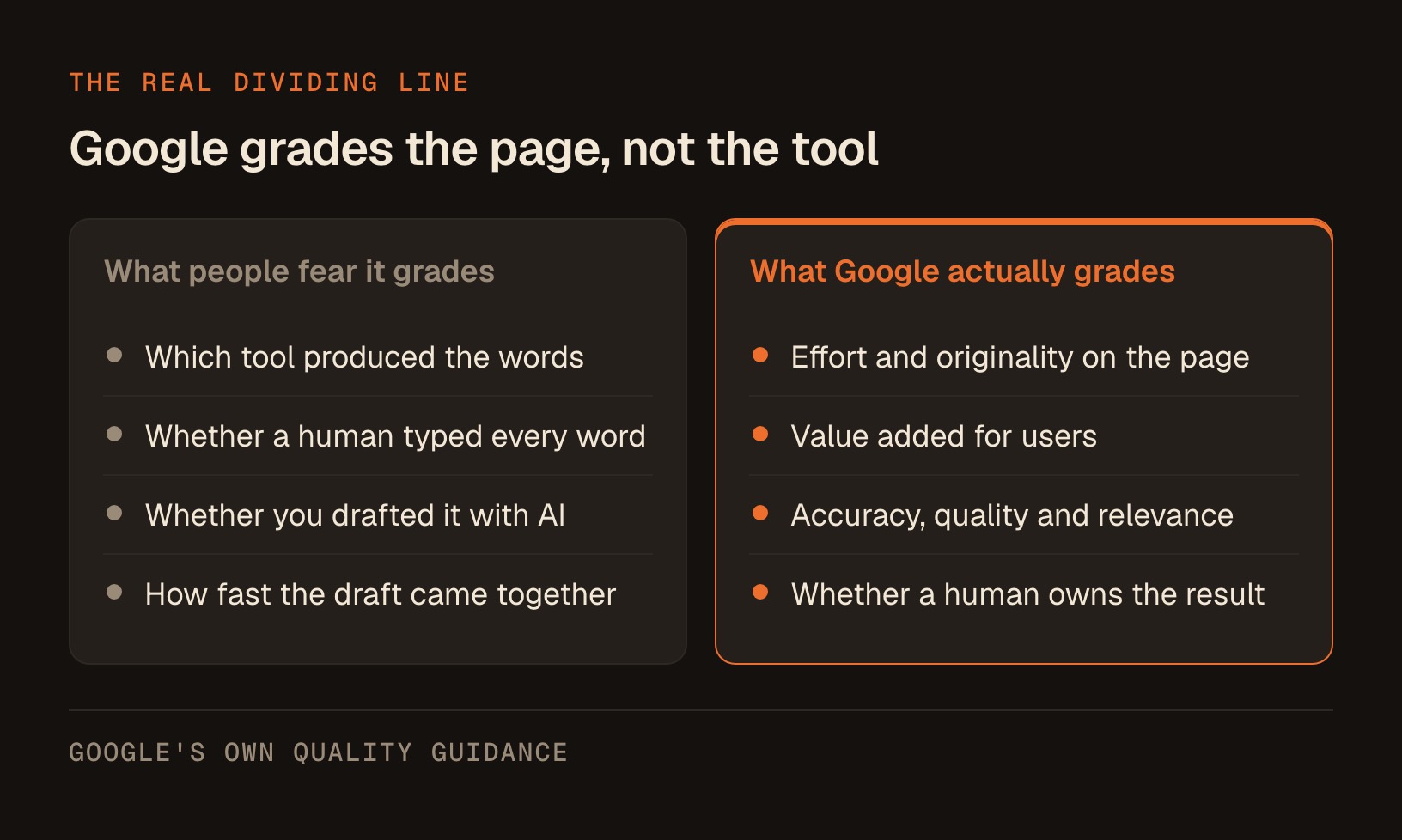
Google's quality guidance describes the losing page as one with "little to no effort, little to no originality, and little to no added value."
A human can write a worthless page, and AI can help you write a valuable one. Google is grading the page, not the tool that helped make it, so the only question worth asking is whether this page is actually good.
The 2 scary claims making the rounds that you can ignore
Because this is a fear query, it attracts fear-bait. 2 specific claims are circulating right now, and I want to name them so you can wave them off when a friend forwards you a screenshot.
The first is a claim of a huge, sudden traffic collapse hitting AI-content sites in early 2026, with dramatic percentage drops attached. I've seen the numbers passed around.
They don't trace to Google, they don't trace to any primary source I can verify, and a scary percentage with no verifiable origin is just a number someone typed to make you click.
I won't repeat an unverified statistic to you, because repeating it is how it becomes "common knowledge." If you ever see a traffic-apocalypse figure, ask one question: where did this number actually come from? Usually the trail ends at another blog quoting another blog.
The second is a claim about a supposed leaked internal Google ranking signal with an official-sounding codename that allegedly flags AI content. I'm not going to print the name, because printing it spreads it.
Here's the same thing in a table you can hand to the friend who sent you the screenshot.
| The claim | Where the trail actually ends | What Google's published docs say | What you should do |
|---|---|---|---|
| AI-content sites suffered a sudden traffic collapse in early 2026, with a dramatic percentage attached | Another blog quoting another blog. No primary source, nothing from Google | Nothing supporting it. The published guidance is about value and quality, not about AI drafting | Ignore the number. Ask anyone who repeats it for the primary source |
| A leaked internal ranking signal with an official-sounding codename flags AI content | An unverifiable screenshot. Impossible to confirm, and conveniently confirms the scariest story | The opposite. Appropriate AI use is treated as fine, and the spam line is drawn at scaled, low-value pages | Follow the documentation you can read yourself, not the leak |
When a mysterious leak and a company's plain public writing disagree, and the leak conveniently confirms the scariest version of events, be skeptical of the leak. Neither of these should change a single decision you make. Follow Google's own written guidance, which you can read yourself, over a screenshot that can't be sourced.
My own receipt: these pages are AI-assisted, and they rank
I'll put my own work on the table, because I think it's the most useful proof I can give you.
The article you're reading, and most of the guides in this /learn library, are AI-assisted and they rank in Google. I shipped an Apple-approved iPhone app in under 3 weeks without knowing how to code, and the same AI that built it drafts these articles.
Am I required to tell you that? No. Google doesn't require an AI disclosure for ranking, so nothing about your rankings hangs on this decision.
That makes disclosure a trust choice rather than a penalty-avoidance one, and I choose to be open about it for a simple reason: the people who read this are deciding whether to trust me, and I'd rather they hear how the sausage is made from me than wonder about it.
Being open about the tool also forces me to be rigorous about the facts, because I've told you exactly where to be skeptical.
What I do need to do, and what I actually do, is own every claim on the page.
Here's the story that made that real for me. When I built the system that produces these articles, one early batch came back looking beautiful and reading like authority. Then I checked it against reality. It had 35 fabricated facts in it.
A made-up price. Invented statistics. "Reporting" from studies that didn't exist. Every one of those would have sailed straight past a casual reader, because AI writes wrong facts with the exact same confidence it writes right ones.
That's the real risk with AI content, and notice it has nothing to do with Google's spam policy. It's a quality-and-truth risk.
So we fixed all 35 before anything published. We built verification into the process: every number, every quote, every named fact has to trace to a real source or it doesn't ship.
One early batch of these articles read like authority. It had 35 fabricated facts in it: a made-up price, invented statistics, "reporting" from studies that didn't exist.
It's fine to leave a number out if you can't stand behind it. Publishing one you made up is what does the damage, and that single rule is the difference between AI content that earns trust and AI content that torches it.
And here's why I'm telling you this in an article about Google penalties: the standard I just described is the standard Google describes. A human accountable for every page. Accuracy, quality, relevance. Value added by a person who actually knows the topic.
I didn't reverse-engineer that from a leak. I built it because it's how you make something worth reading, and it lines up exactly with what Google's own documentation asks for.
The line, drawn plainly
Here's the whole thing in one view, so a skimmer gets it too. Everything in the left column gets you in trouble whether a human or a machine wrote it. Everything on the right is safe, again regardless of tool.
| What actually gets penalized | What ranks fine |
|---|---|
| Little or no value added over what's already out there | Real experience, real specifics, a real point of view |
| Fabricated or unchecked facts stated confidently | Every claim traceable to a source you verified |
| Keyword-stuffed filler nobody would choose to read | Content a reader would happily finish |
| Copying and lightly spinning other pages | Original framing, your own examples, your own receipts |
Notice that the word "AI" appears nowhere in that table. The tool you used isn't on the list, because it was never the deciding factor. The problem is volume with nobody accountable for the result. The fix is a human who owns what ships.
A prompt that keeps you on the safe side
Since the real risk with AI content is unchecked facts, not the AI itself, the most valuable habit you can build is a verification pass before you publish.
Here's the exact prompt I'd hand the advisor who emailed me. Paste it into Claude (the desktop app) right after you've drafted a post, along with your draft.
You are my fact-checker and quality editor for a blog post I'm about to publish under my own name. Be skeptical and specific.

Here is my draft:
[paste your full draft]

Do three things:

1. FACT AUDIT. List every specific claim in the draft: every number, statistic, price, date, quote, study, or named source. For each one, tell me: can this be verified, and how confident are you it's accurate? Flag anything you may have generated without a real source. I would rather delete a fact than publish a fabricated one, so be ruthless. If you're not certain a number is real, say so plainly.

2. VALUE CHECK. Pretend you're the exact person who searched for this topic. Does this page actually answer their question better than a generic result would? Point to any section that is filler, padding, or something they could get anywhere. Tell me what real-world specifics or first-hand experience would make it more useful.

3. ACCOUNTABILITY PASS. If I publish this under my name, is there anything here I couldn't personally defend as true and mine? List those spots.

Do not rewrite the post. Just give me the audit so I can fix it myself.
That prompt turns AI from a thing you fear into a thing that protects you. You stay the human who's accountable, and you catch the fabrications before a reader (or your own credibility) ever does.
Run it every time and you're not just avoiding a Google problem you were never going to have. You're publishing better work than most of the people writing by hand.
A simple way to publish AI-assisted content with confidence
Let me make this a routine you can actually follow, no technical steps, nothing that touches anything scary.
Start with a question a real person actually asks you. Not a keyword you're chasing, an actual question a client or prospect has said out loud. That single habit keeps you on the value side of Google's line automatically, because you're writing to help someone specific instead of writing to fill a slot.
Draft it however you like, AI included. Speed is not a sin. Use AI to get from blank page to solid draft as fast as you want. The draft is raw material, not the finished product, and Google grades the finished product.
Then do the human pass, and treat it as the real work. Run the fact audit above. Add the things only you know: the client story, the number from your own business, the objection you actually hear, the opinion you'd defend at a dinner table.
Publish it under your name and stand behind it. Google is checking whether a person who knows the topic stands behind the page, and how fast you made it barely registers by comparison.
Here's the same routine as a checklist you can screenshot, with the reason each step keeps you on the safe side.
| Step | What you actually do | Why it keeps you on the safe side of Google's line |
|---|---|---|
| 1. Start from a real question | Write down a question a client or prospect asked you out loud this month | You're answering a person, which is the definition of "value added for users" |
| 2. Draft however you like | Use AI to get from blank page to a full draft in one sitting | Google grades the finished page, not the speed or the tool behind the draft |
| 3. Do the human pass | Run the fact audit, cut unverifiable claims, add your own stories and numbers | Accuracy, quality, and relevance are the 3 things the guidance names by name |
| 4. Publish under your name | Put your byline on it and be ready to defend every line | A named human who owns the page is the opposite of scaled content abuse |
What the human pass actually looks like, since "add your experience" is easy to nod at and hard to picture. A draft will hand you sentences like this:
Many clients worry about market volatility, so it's important to reassure them with a long-term perspective.
True, generic, and worth nothing. Here's the same idea after 2 minutes of your own knowledge going in:
The version of that worry I actually hear is "should I move to cash until the election is over?" I answer it with the same chart every time, and the conversation is usually over in 6 minutes.
Same point. One of them could have been written about anybody's practice, by anybody. The other one could only have come from you, and that is the entire value-add Google's guidance is asking for.
Quick caveat, because some of you write in regulated fields: I'm sharing how I approach content and what Google's public documentation says, not legal or compliance advice.
If you're a financial advisor or in another regulated space, run your published content past your own compliance process. That's true whether AI touched it or not.
What to do with the posts you've already drafted
Most people arrive at this question late. You're not staring at a blank page, you've got a folder of AI drafts, or posts already live, and now you're wondering whether they're a liability.
So here's what I told the advisor with the twelve posts: don't delete anything. Deleting is the panic move, and panic isn't a strategy. Triage instead.
Work through them one at a time, in this order:
- Run the fact audit on each post, exactly as written above.
- Cut every claim you can't source. Not soften it, cut it. A sentence without the number usually reads better anyway.
- Add one first-hand specific per post. One client question, one thing you've seen go wrong, one number from your own business.
- Put your name on it and publish. If you can't defend a post after those 3 steps, that's your answer, and it's a quality call, not a Google call.
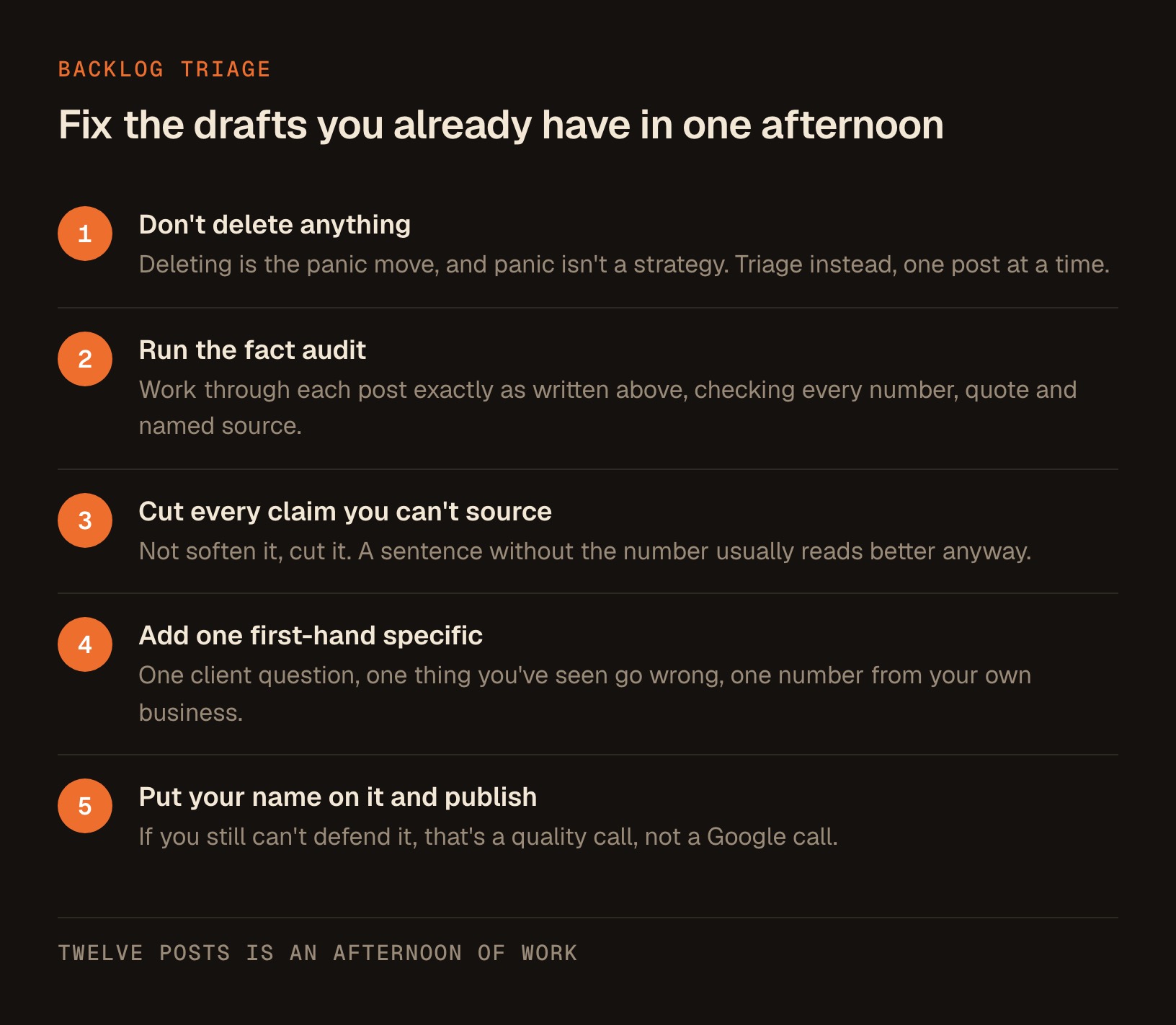
Twelve posts at maybe twenty minutes each is an afternoon of work. What comes out the other side is twelve posts he can stand behind, which is twelve more than most of his competitors have.
Here's a shorter prompt for the backlog. Use it on posts that are already drafted or already live, one at a time.
Here's a post I've already published, on the topic: [topic].

[paste the post]

Give me three things, briefly:

1. Any claim in here that can't be verified, ranked by how badly it would hurt me if it's wrong.
2. The single missing first-hand specific that would make this worth reading. Ask me for it if you need to.
3. A one-word verdict: keep, fix, or cut.
Run that on the whole folder in an afternoon, and the backlog stops being something you're anxious about.
The verification pass I run on every article
Every finished AI workflow I build lives inside The Solo Creators AI Studio, including the content system that produces these /learn articles with the verification pass baked in. It's the same setup that caught those 35 fabrications before they shipped.
You can see what's there, and reach me directly, at The Solo Creators AI Studio.
You don't need anything from me to act on this, though. Stop asking whether you're allowed to use AI, and start asking whether a real human stands behind every page. Get that right, and the scary headline you read was never about you.
Key takeaways
- Google does not penalize content for being written with AI. Its own documentation treats appropriate AI use as fine and focuses on value and quality, not the tool.
- The real offense is 'scaled content abuse': generating many pages, mainly to manipulate rankings, with little or no value added for readers. That's method-agnostic, so thin human-written content struggles the same way.
- Google's own guidance is to focus on accuracy, quality, and relevance, especially when generating content automatically.
- The genuine risk with AI content isn't Google, it's fabricated facts stated confidently. Build a verification pass so every claim traces to a real source.
- The scary claims going around (a sudden 2026 traffic collapse, a leaked anti-AI ranking signal) are unverified and contradict Google's published guidance. Don't let them drive your decisions.
- These /learn articles are AI-assisted and rank, because a human owns every claim and 35 fabrications in an early batch got caught and fixed before publishing.
- If you already have a folder of AI drafts, don't delete them. Triage each one: audit the facts, cut what you can't source, add one first-hand specific, publish under your name.
- Publish under your own name, add real experience and specifics, and stand behind the page. That's the standard Google's documentation asks for.
Get this skill, and every one I build.
30-day money-back guarantee. Cancel anytime.
Questions people ask
Will Google penalize my content just because I used AI to write it?
What is 'scaled content abuse'?
Do I have to disclose that I used AI?
Is it true that AI-content sites lost most of their traffic in early 2026?
What's the real risk of publishing AI-written content, then?
I've already published AI-drafted posts. Should I delete them?
How do I make sure my AI-assisted post is safe to publish?

Ronnie spent 18 years building a SaaS with a team of 20 that served over 650,000 customers, generated over $14M in sales, and sent over 550M emails. Now he's solo, solving real business bottlenecks and turning them into working AI skills, workflows, and automations. He teaches all of it, with direct access to him, inside the Solo Creators AI Studio Skool community. See what he's built →
 Michael HattawayFounder, Iron Strengthens Iron
Keep reading