How many small businesses actually use AI?
It depends on firm size and on who did the counting. The US Census Bureau found overall AI use among US firms ran between 17 and 20 percent from December 2025 to May 2026. For the smallest firms, under 20 employees, it stayed under 20 percent. Larger firms ran higher, about 37 percent at 250-plus employees. Much bigger numbers usually come from companies that sell AI. Before you repeat any stat, ask who profits, click through to the primary source, and confirm it says the same thing.
The number that tells you you're behind is usually selling you something
You've seen the headline a hundred times. Some survey says the majority of small businesses are already using AI, the wave has crested, and you're the last holdout still doing it by hand.
It's designed to make your stomach drop. It's designed to make you click.
I know that drop well. Last month I published a price on this very site that was flat-out wrong. I said a tool cost $849. It actually costs $249.99.
I published $849 for a tool that actually costs $249.99, and no human typed either number.
Nobody made it up on purpose, and that's exactly what makes the story worth telling, because the same kind of glitch that fooled me is hiding inside half the AI statistics you're being sold right now.
Here's what I want you to do the next time you feel that drop. Ask who paid for the number.
Almost every time I've traced one of these "most small businesses already use AI" stats back to its origin, the survey was run by a company that sells AI services to small businesses. It's not a conspiracy, just marketing doing its job. A company that sells umbrellas is going to tell you it's about to rain.
The stat that kicked off this article came from an AI vendor's own customer survey, and the shape of the claim was "a clear majority of small businesses already use AI." I'm leaving the exact percentage out on purpose, because a number that shaky doesn't need another citation from me. Tracing it took about 2 minutes.
So let's answer the real question a nervous solo creator is actually typing into Google: how many small businesses actually use AI? Not according to a company with something to sell, but according to the people whose entire job is counting American businesses.
What the US Census actually found about small-business AI use
The US Census Bureau runs something called the Business Trends and Outlook Survey. It's a rolling survey of hundreds of thousands of real US firms, and it asks them, among many other things, whether they use AI to produce their goods or services.
This is about as close to ground truth as you can get for this question, and it's free to read.
In the story the Census Bureau published in May 2026, covering the period from December 2025 to May 2026, overall AI use among US firms ran between 17 and 20 percent. Around one in 5, nowhere near a majority.
One limit to hold onto: these are US firms only. If you're in Canada, the UK, or Australia, no equivalent number exists for you unless your own national statistics agency asked the same question. Requoting 17 to 20 percent as a global figure is exactly the citation drift this article is about.
The Federal Reserve, looking at the same survey, put it at about 18 percent of firms as of the end of 2025. 2 respected government sources, same neighborhood.
Here's how to pull the number yourself, because "Business Trends and Outlook Survey" is an intimidating phrase until you've clicked it once.
Go to census.gov and search the site for "Business Trends and Outlook Survey." That section holds both the data tables and the Bureau's own plain-English write-ups of what the data shows.
The question you're looking for is the one asking whether the business used artificial intelligence in producing its goods or services. That's the adoption figure everyone quotes, usually without saying which question it came from.
2 things to notice once you're in there. The survey reports in short two-week reference periods rather than once a year, so the headline percentage moves a little with every release, and you can cut the results by firm size and by sector. That second filter is where the useful part lives.
Now here's the part that matters most for you, because you probably aren't a 500-person company. The smaller the firm, the lower the AI use.
Big firms with 250 or more employees came in around 37 percent. Firms with 100 to 249 employees, about 32 percent. But firms with fewer than 20 employees stayed under 20 percent, and firms with 4 or fewer employees also came in under 20 percent.
If you're a coach, a consultant, a financial advisor, or a course creator running a lean shop, you are squarely in the group where fewer than one in 5 is using AI in the business.
And here's the line that should quietly deflate the whole panic. That smallest-firm number didn't move.
The Census found AI use increased among firms with at least 20 employees, but among firms with fewer than 20 employees it "didn't change significantly" over those 6 months.
Census BTOS: 37% of firms with 250 or more employees use AI. Firms with 4 or fewer employees, under 20%, and it didn't move in 6 months.
| Who you are (US firm) | Share using AI, per Census BTOS (Dec 2025 to May 2026) |
|---|---|
| 250 or more employees | 37% |
| 100 to 249 employees | 32% |
| Fewer than 20 employees | under 20% |
| 4 or fewer employees | under 20% |
| Any US firm, overall | 17% to 20% |
There's a sector cut too, and it's worth a glance if you sell services. Find your own row.
Even in the most AI-heavy corners of the economy, the majority still isn't using it. The Census also asked firms what they expected over the following 6 months, and the answer nudged up to a range of 20 to 23 percent. Growing, yes. "Everyone but you," no.
So if you've been carrying around a low hum of guilt that you're the only person in your field not living inside a chatbot, put it down. You're early, and early is a good place to stand. The wave you're being told you missed hasn't actually reached your dock yet.
Check my work. An article about clicking through to primary sources owes you the trail, so here it is.
- Primary source: the US Census Bureau's Business Trends and Outlook Survey (BTOS). That page holds the data tables and the survey documentation.
- The specific write-up: the Census Bureau's May 2026 story, Large Firms With at Least 20 Employees Biggest AI Users, covering December 2025 to May 2026.
- The second source: the Federal Reserve's FEDS Note Monitoring AI Adoption in the US Economy (April 2026), which put AI use near 18 percent of firms at the end of 2025.
- Last checked: July 2026. BTOS reference periods roll forward continuously, so expect these percentages to shift a point or 2 by the time you look.
The $849 price that never existed
Let me tell you exactly how I learned to distrust a clean-looking number, because it happened on this website, with my name on it.
I was building out research for a page and I needed the price of a piece of software. The automated tools I use pulled the number off the vendor's own pricing page. They came back with $849.
It looked real. It sat there in a table looking like every other price I'd ever published. The real price was $249.99.
Here's the glitch, and it's beautiful in an infuriating way. That vendor's pricing page doesn't store its price as one tidy piece of text. It builds the price on screen out of separate little boxes, and the page carries more than one plan's numbers in its markup at once. Only the plan you selected is styled to be visible. The rest are still sitting there in the raw file.
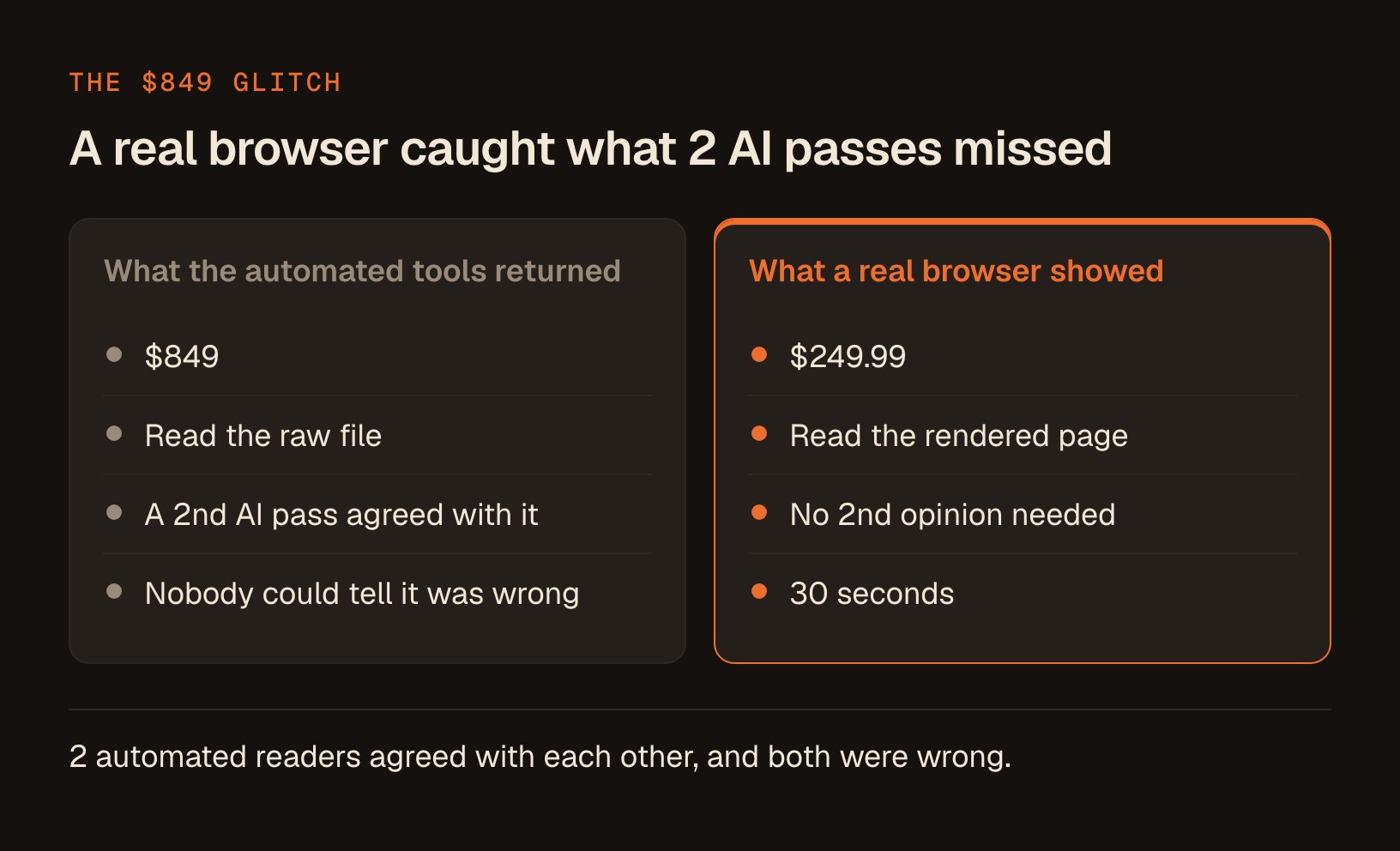
To your eye, standing in a browser, it reads $249.99 with no trouble. The browser applies the styling, hides the plans you didn't pick, and shows you one price.
A tool reading the raw file gets none of that. It sees every digit on the page with no way to tell which ones were meant to be on screen together, and it stitches a number out of fragments that never appear side by side for a human.
I can't tell you which fragments produced 849. I went back to reconstruct it for this article and couldn't. Once a number has been assembled out of pieces, the assembly leaves no trace, so there's nothing to audit after the fact. That is exactly why the fix below is to look at the rendered page rather than to interrogate the tool.
Now the part that should make every AI enthusiast sit up. I ran an adversarial review to catch mistakes exactly like this. A second AI pass, whose only job was to challenge the first one. And it "corroborated" the $849.
I ran a second AI pass whose only job was to challenge the first one. It corroborated the $849.
It confirmed the fake, because both passes were reading the page the same broken way.
The only thing that fixed it was opening the page in a real browser and looking with my own eyes. It wasn't a smarter model or a third AI. It was a human with a browser and thirty seconds. The price was right there, plain as day, $249.99, exactly where the tools had hallucinated $849.
That's the whole reason this article exists. If a careful process with a built-in skeptic can confidently publish a number that's off by more than triple, then the friendly stat in a blog post you're about to quote deserves the same suspicion.
A confident number can still be wrong, and 2 numbers agreeing proves nothing. Only the primary source is proof, and only when you actually look at it.
The two-minute source check, step by step
Here's the routine I run now on any statistic before it goes near something I publish or say to a client. It takes about 2 minutes, and it will save you from being the person who confidently repeats a fake number in a room full of people who know better.
| Step | What you actually do | The red flag that means stop |
|---|---|---|
| 1. Ask who profits | Look up who originally published the number and what they sell | The publisher's sales go up when you believe the stat |
| 2. Click to the primary | Follow the citations until you reach the study, dataset, or government page | The trail dead-ends in blogs quoting blogs |
| 3. Match the words | Find the exact sentence in the primary and compare it to the claim | The number isn't on that page, or a qualifier quietly vanished |
-
Ask who profits from this number. Look at where the stat is published and who funded the research behind it. Is it a government body, a university, a survey house with no dog in the fight? Or is it a company whose sales go up the more you believe the stat? A number that flatters the person selling it earns extra scrutiny, every time.
-
Click through to the actual source. Most scary stats are quotes of quotes of quotes. A newsletter cites a blog, the blog cites another blog, and somewhere at the bottom of that chain is either a real study or nothing at all. Keep clicking the citation until you either reach the primary source (the actual survey, the actual dataset, the government page) or you hit a dead end. If the trail runs out before you find a primary source, treat the number as fiction.
-
Check that the primary actually says what the blog says. This is the step almost nobody does, and it's where the $849 lives. Open the primary source and find the exact sentence. Does it really say what was claimed, or did somebody round it up, reword it, drop a qualifier, or attribute it to the wrong group? I've watched a summary confidently source a number to a page that doesn't contain that number anywhere. Confirm the words are actually on the page you're citing.
One extra habit that catches a whole category of errors: when the source is a live web page, look at it in a normal browser, not just through a tool that reads the underlying code.
Prices, especially, get split into pieces, toggled by region, or labeled monthly when they're really annual. What your eye sees on the rendered page is the truth the customer sees. That's the number that counts.
A prompt that does the boring part for you
You don't have to run all 3 steps by hand every time. You can hand the grunt work to Claude and keep the final judgment for yourself. Paste this into the Claude desktop app whenever you're about to lean on a statistic.
I'm about to cite this statistic in something I'm publishing:

"[PASTE THE STAT AND THE FULL SENTENCE AROUND IT]"

Act as a skeptical fact-checker. Do these three things and show your work for each:

1. WHO PROFITS. Tell me who originally published this number and what
   they sell. If the source is a company that makes money when I believe
   the stat, say so plainly and flag it as low-trust.

2. FIND THE PRIMARY. Trace the number to its original source: the actual
   study, survey, government dataset, or filing, not a blog quoting a blog.
   Give me the most direct link you can find to that primary source.

3. MATCH THE WORDS. Compare the primary source to the claim. Does the
   original say exactly what the claim says, or did something get rounded,
   reworded, stripped of a qualifier, or pinned on the wrong group? Quote
   the exact relevant line from the primary source.

If you cannot find a genuine primary source, say so directly and tell me
not to use the number. Do not guess, and do not fill the gap with a
plausible-sounding source. A clear "I couldn't verify this" is the answer
I want in that case.
Notice what this prompt does not do. It doesn't ask Claude to tell you whether the stat feels right. It forces a paper trail.
And it explicitly gives Claude permission to come back empty, which is the single most useful thing you can tell an AI, because the alternative is a confident invention.
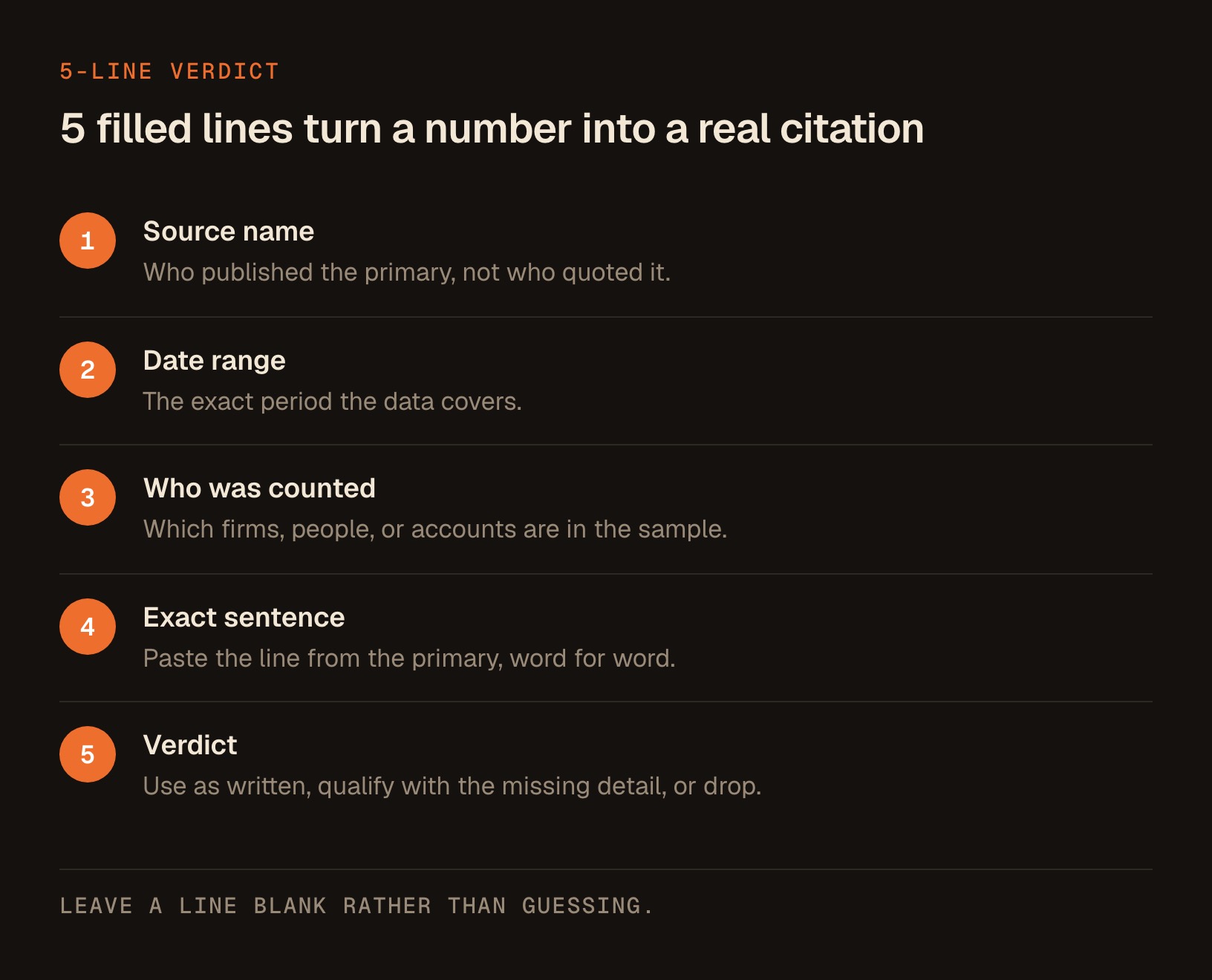
When it hands you a primary link, do step 3 yourself. Open the link, read the sentence, then fill in 5 lines. This is the part people skip, so make it mechanical.
Fill this in for the stat I'm about to cite, using only what you can see
in the primary source. Leave a line blank rather than guessing.

SOURCE NAME:      [who published the primary, not who quoted it]
DATE RANGE:       [the exact period the data covers]
WHO WAS COUNTED:  [which firms, people, or accounts are in the sample]
EXACT SENTENCE:   [paste the line from the primary, word for word]
VERDICT:          [USE as written / QUALIFY with the missing detail / DROP]
Save that block somewhere you can grab it. 5 filled lines is the difference between citing a number and repeating one. The prompt gets you to the door, and you still have to look inside.
When a statistic is actually safe to trust
None of this means every number is a lie. It means you should be able to tell the strong ones from the weak ones in about 2 minutes. Here's the quick contrast I keep in my head.
| Trust it more when | Trust it less when |
|---|---|
| A government body or university published it | A company that sells the thing published it |
| You can click straight to the raw data | Every link just points to another article |
| The primary source uses the same words as the claim | The number got rounder and scarier in the retelling |
| It names a clear time period and who was surveyed | It's a floating percentage with no date and no method |
| The rendered page shows the number to your own eyes | A tool read the code and you never looked yourself |
The Census AI numbers pass every test on the left. They come from a named government survey, they cover a stated period from December 2025 to May 2026, they tell you exactly which firms were counted, and you can read the study yourself.
That's what a trustworthy stat looks like. The vendor's "most small businesses already use AI" line fails on most of the right-hand column, and it fails fastest on the first row.
Get in the habit of running your eye down those 2 columns and you'll start spotting the weak numbers before you even finish reading the headline. It becomes automatic. It becomes the thing you do instead of feeling the stomach drop.
Why this beats the panic every single time
Here's the quiet advantage nobody selling you AI wants you to sit with. The field is wide open, and the person who calmly learns to build with AI while their peers are still frozen shows up next year looking like they were early, because they were.
One of the things I've built with AI is a Claude skill that now ships inside a WordPress plugin running on 250,000+ sites. I made it the same way I make everything: in a normal desktop app, by clicking and typing plain English. That's the whole toolkit.
A skill I built now ships inside a WordPress plugin running on 250,000+ sites. I made it by clicking and typing plain English.
What do you do when a stat fails the check and you still need a number for your newsletter or your client deck? You have 3 moves.
- Find a government or academic equivalent. Statistics agencies, central banks, and university research centres publish free data on most things a vendor is happy to survey for you.
- Cite your own first-party data. Your open rates, your client results, your booking numbers. Nobody else has them, and you can prove every one.
- Drop the number and make the argument without it. If the point only stands up with a percentage you can't verify, the percentage was doing the arguing, not you.
If you'd rather not assemble all of this yourself, the finished tools I build to do exactly this kind of checking, along with everything else in my workflow, live in one place. Every skill I ship ends up in the Solo Creators AI Studio, and you get a direct line to me inside it.
No terminal, no code, no pretending you're something you're not.
Check the number. Then decide how you feel. In that order, always.
Key takeaways
- The US Census Bureau's Business Trends and Outlook Survey found overall AI use among US firms ran between 17 and 20 percent from December 2025 to May 2026, and the Federal Reserve put it near 18 percent at year-end 2025.
- Every figure here covers US firms only. Outside the US, there's no equivalent number unless your own national statistics agency asked the same question.
- For the smallest firms (fewer than 20 employees, and 4 or fewer), AI use stayed under 20 percent and did not change significantly over those six months. Larger firms were higher: 37 percent at 250-plus employees, 32 percent at 100 to 249.
- Big, flattering AI-adoption numbers usually come from companies that sell AI, so the first question is always who profits from you believing the stat.
- The two-minute check is three steps: ask who profits, click through to the primary source, and confirm the primary actually says what the blog claims.
- I once published a fabricated $849 price for a $249.99 product because the vendor's page split the price into separate pieces and every automated read glued them together. An adversarial AI review even corroborated the fake.
- The only fix that worked was opening the page in a real browser and looking with my own eyes. A fact-check prompt does the grunt work, but you still fill in the five-line verdict checklist yourself.
Get this skill, and every one I build.
30-day money-back guarantee. Cancel anytime.
Questions people ask
How many small businesses actually use AI?
Why do vendor surveys show much higher AI adoption numbers?
Is the "everyone's using AI, you're behind" message true?
What's the fastest way to check whether a statistic is real?
How do I find the Census AI adoption number myself?
What do I do if a statistic fails the check but I still need a number?
Can I trust AI to fact-check a statistic for me?
Where do the trustworthy AI adoption numbers come from?

Ronnie spent 18 years building a SaaS with a team of 20 that served over 650,000 customers, generated over $14M in sales, and sent over 550M emails. Now he's solo, solving real business bottlenecks and turning them into working AI skills, workflows, and automations. He teaches all of it, with direct access to him, inside the Solo Creators AI Studio Skool community. See what he's built →
 Michael HattawayFounder, Iron Strengthens Iron
Keep reading