Can I copyright work I made with AI?
It depends on how much of it is yours. A work generated entirely by AI, with no human shaping its expression, can't be copyrighted by anyone. Thaler v. Perlmutter settled that. Your creative selection, arrangement, editing, and your own writing can be protected. Your copyright exists once you fix the work, and registration is a separate step that lets you enforce it in court. When you register, disclose the AI content and disclaim the machine's part. Keep a dated authorship log while you work.
The Law Finally Gave You a Straight Answer
Ask 10 people whether you can copyright something you made with AI and you'll get 10 answers, most of them guesses. As of 2026 there's a real one, backed by a federal appeals court and a Supreme Court that just declined to touch it.
For a couple of years, "can you copyright AI-generated content" was the kind of question that produced confident nonsense from every corner of the internet. That era is over, and there's a date on it.
One thing before we go further: I'm not a lawyer, and this isn't legal advice. It's a plain-English read of what the US Copyright Office and the courts have actually published, with links so you can check every line of it yourself. Copyright is decided case by case, and the rules differ outside the US. If real money or a real dispute is attached to the work, take it to an attorney who practises in this area.
In March 2025, the U.S. Court of Appeals for the D.C. Circuit decided a case called Thaler v. Perlmutter.
A computer scientist named Stephen Thaler had built a system he called the "Creativity Machine," let it produce a picture titled "A Recent Entrance to Paradise," and then tried to register the copyright with the machine listed as the sole author.
The court said no, and it said why in one clean sentence. Human authorship is the whole ballgame.
"The Creativity Machine cannot be the recognized author of a copyrighted work because the Copyright Act of 1976 requires all eligible work to be authored in the first instance by a human being." (U.S. Court of Appeals for the D.C. Circuit, Thaler v. Perlmutter)
Then it got locked in. Thaler asked the Supreme Court to hear the case, and on its order list dated March 2, 2026, the Court denied review. A denial means the Court declined to take it up, which leaves the D.C. Circuit's ruling standing as the law of the land. Settled, with a date you can cite.
So here is the plain headline for a working creator. A picture, a paragraph, or a track that a machine generated entirely on its own cannot be copyrighted by anyone. Not by the AI. Not by the company that built it. Not by you.
Before you over-read that, here's exactly how far the ruling reaches and where it stops:
| The question | What the 2026 answer is | Where it is decided |
|---|---|---|
| Fully machine-generated output, with no human shaping the expression | Not copyrightable by anyone, including the company that built the tool | Settled by Thaler v. Perlmutter, with Supreme Court review denied |
| A human-shaped work that contains AI-generated material | Your human contribution is protectable | Settled, and the Copyright Office already registers works like this |
| Your brand name or your logo used as a mark | Not decided here at all | Trademark law, a different filing and a different specialist |
| Whether the training data infringed somebody else's work | Not what this case decided | Separate cases, on their own timeline |
Which is exactly the door you want open.
You Can Own It When Your Fingerprints Are All Over It
Here's the part the thin blog posts skip. The U.S. Copyright Office has been clear that AI in the mix does not poison the whole work.
Its published guidance says a human may "select or arrange AI-generated material in a sufficiently creative way that 'the resulting work as a whole constitutes an original work of authorship.'"
In plain English, the creative choices you make (what to include, what to cut, how to order it, how to weave it together with your own words) can belong to you.
And this is not a theory sitting in a memo. People are doing this today, with the same tools you have open.
"The Office has registered hundreds of works that incorporate AI-generated material, with the registration covering the human author's contribution to the work." (U.S. Copyright Office, Part 2 report on copyrightability)
There's a price of admission, and it's honesty. The Office says applicants "have a duty to disclose the inclusion of AI-generated content" when they register, and any more-than-trivial AI-generated material "must be disclaimed in a registration application."
So the deal is simple: you tell them what the machine made, you claim what you made, and your copyright protects your slice. Disclose the AI, claim your work.
The Office even hands you the language. When you creatively arrange human and non-human content, it says to fill the "Author Created" field with a claim like "Selection, coordination, and arrangement of [your human-authored content] created by the author and [the AI content] generated by artificial intelligence."
If it helps to have a mental model, the Office gives you one. It compares AI to a tool in a long line of tools, noting that a visual artist who uses Adobe Photoshop to edit an image "remains the author of the modified image," and that what matters is "the extent to which the human had creative control over the work's expression."
A guitar pedal doesn't strip a musician of authorship. Used right, neither does a model. The test is whether a human made the creative decisions that shape the final expression, because selection, arrangement, editing, and judgment are exactly the contributions copyright was built to protect.
Here's a rough field guide to what you can and can't hang your hat on:
| What you actually did | Is your part protectable? |
|---|---|
| Typed one prompt, kept the raw output untouched | Weak. The machine formed the expression, so that output likely carries no copyright for anyone. |
| Generated many options, then selected and arranged them into a finished piece | Yes. Your creative selection and arrangement is human authorship. |
| Took AI text or images and meaningfully edited, rewrote, or reworked them | Yes, your modifications can qualify, if they're creative enough. |
| Wrote the words yourself and used AI only to brainstorm or polish mechanics | Yes. Your writing is yours. |
| Combined AI-generated pieces with your own writing, teaching, and structure | Yes, for the human-authored aspects and your arrangement. |
Log Your Authorship While You Work (Copy This Prompt)
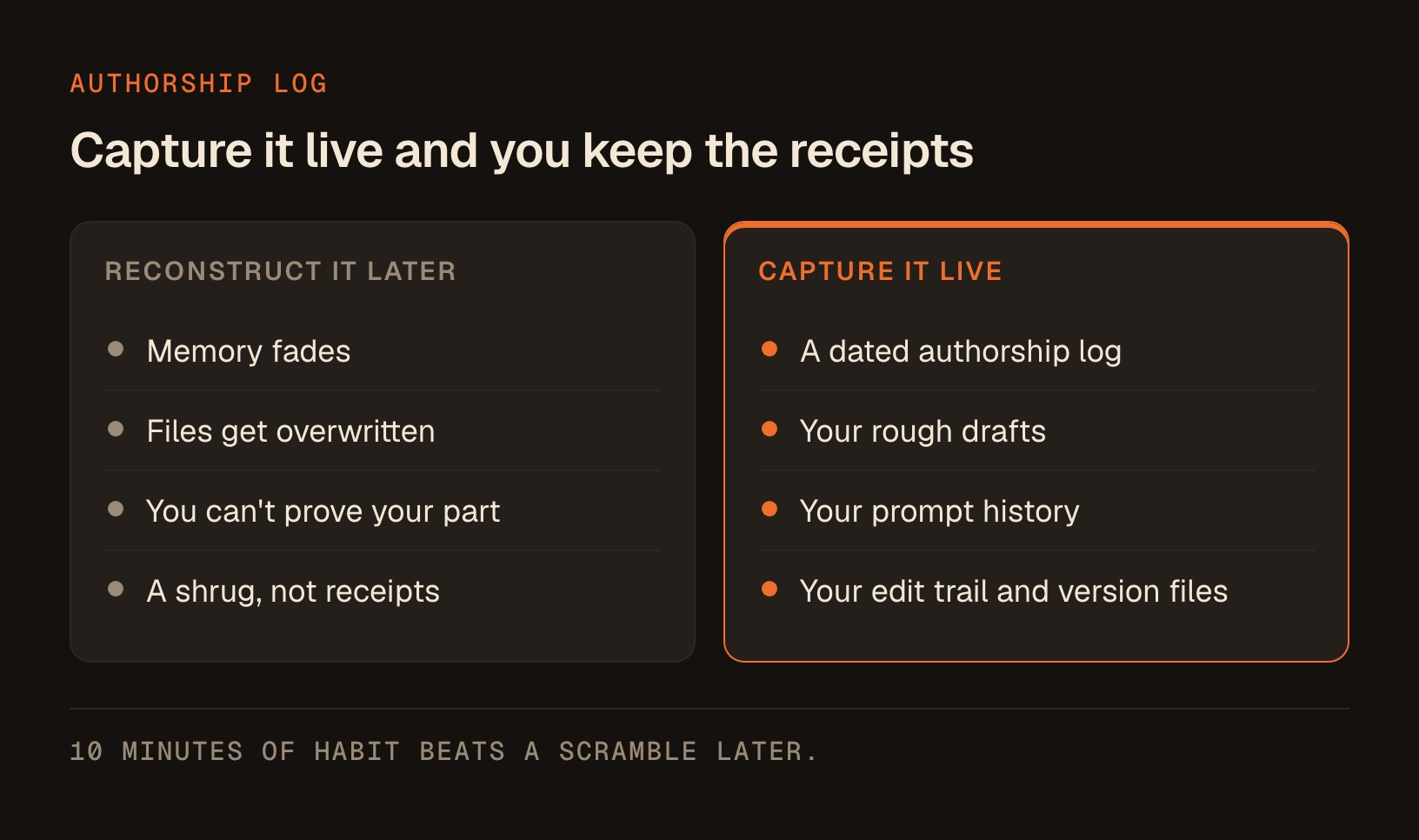
The single most common mistake is finishing a project and then trying to reconstruct, months later, what you personally contributed. Memory fades, files get overwritten, and suddenly you can't prove the thing that makes your work yours. So don't reconstruct it later. Capture it live.
Keep a running authorship log as you build. If you ever register the work, or ever have to defend it, you'll have receipts instead of a shrug. Paste this into Claude (the desktop app) and keep it open in a project while you work:
I'm creating [describe the work: e.g., a 12-chapter online course, a lead-magnet ebook, a set of 30 marketing images].

Act as my authorship log. After each work session, I'll paste in what I did, and you keep a running, dated record that clearly separates three things:
1) The creative decisions I made myself (what I selected, cut, reordered, rewrote, combined, or directed).
2) The raw material an AI tool generated before I shaped it.
3) The specific edits and arrangement choices I applied to that AI material.

Format each entry as: Date | My creative contribution | AI-generated raw material | How I selected, arranged, or modified it.

Keep it factual and specific enough that a copyright examiner could read it and see exactly what a human authored. When I paste a session, append a new entry and show me the running list. Start by asking me for today's entry.
Capture it live, not from memory. Alongside that log, hang onto the evidence itself:
- Your rough drafts
- Your prompt history
- Your edit trail
- Your version files
You're keeping a quiet paper trail that shows a human made the decisions, which is what protectability turns on.
Know Who Owns the Output Before You Sell It
Now the second question, the one almost nobody writes about. Set the Copyright Office aside for a second. The terms of service of the AI tool you used also have a say in the output. I'll work one tool all the way through as the example, then hand you a way to run the same read on yours.
Anthropic assigns the output to you. The consumer terms behind Claude give you "all of our right, title, and interest" in Outputs. Then read the hedge, 2 small words: "if any."
Anthropic's consumer terms hand you "all of our right, title, and interest" in Outputs, then add 2 words: "if any."
That "if any" is doing load-bearing work. A company can only hand you rights it actually holds, and after Thaler, purely machine-made output may carry no copyright to hand over in the first place.
So the clause tracks the law. Shape the work and there's real ownership to assign. Type one prompt and keep the raw output, and there may be nothing to own, which is why the wording promises whatever exists rather than something bigger. Generous and truthful at the same time.
The lesson generalizes past any one tool. Before you lean a paid product on an AI tool's output, read its current terms with 3 questions in hand:
| Question to ask the terms | Why it matters |
|---|---|
| Does the tool assign the output to me? | Anthropic's consumer terms assign you "all of our right, title, and interest" in Outputs, with the "if any" hedge. Confirm the same for whatever tool you use. |
| Which way does the indemnity run? | Terms differ on whether you cover the company or the company covers you. Read the current wording before you rely on it. |
| Will the company defend me if there's a claim? | Some tools promise to step in on copyright claims, and often only on higher tiers. Read your tool's current promise before you count on one. |
Reading a terms page cold is miserable, so make the machine do the reading and force it to show its work. Paste this in, along with the terms you're checking:
I'm about to sell a paid product I built with help from an AI tool, and I need to know exactly what that tool's terms say about the output.

Here are the terms: [paste the full text of the terms of service, or the URL of the tool's terms page].

Answer these three questions. For every answer, give me the exact sentence from the document, in quotation marks, that your answer rests on:
1) Does the company assign ownership of the output to me? Quote the clause, including any hedge words like "if any."
2) Which direction does the indemnity run? Do I cover them, do they cover me, or both?
3) Will the company defend me if someone brings a copyright claim about the output, and is that promise limited to certain plans or tiers?

Rules, and these matter more than the answers:
- Do not infer, summarize from memory, or fill gaps with general knowledge about this company.
- If the document doesn't answer a question, write "NOT FOUND IN THIS DOCUMENT" and tell me which section or page I should go look at instead.
- Never paraphrase a clause without also quoting it.

Finish with a one-paragraph plain-English summary, plus a short list of anything in here that looks risky for someone selling a paid product on top of this output.
None of this should scare you off using AI. It should just make you read one page before you build a paid product on top of it. Read the page before you sell the thing.
What Your Course Actually Owns, and How to Keep It
Let's bring this all the way down to the ground, because you're not registering a robot's oil painting. You're shipping a course, a book, a workbook, a set of client deliverables, a batch of marketing images. Here's what that body of work actually owns.
Your copyright covers your human contribution. The selection, the sequencing, the words you wrote, the edits you made, the way you taught it and structured it. For most of what solo creators sell, that human layer is the valuable part anyway. Nobody's buying your course for a stock paragraph. They're buying your judgment, your framework, your voice.
Raw, untouched AI output sitting inside your product is the soft spot. If a competitor lifts a paragraph that a machine wrote word for word and you never shaped, your claim on that exact paragraph is thin, because it may not be anyone's to own.
The fix is boring and effective: put your fingerprints on anything you care about owning. Edit it, arrange it, rewrite it, make a decision about it.
Run your own product line through this in about a minute:
| What you're selling | The part that is clearly yours | The soft spot | The 5-minute fix |
|---|---|---|---|
| Course lesson video and script | Your teaching, your sequence, your delivery on camera, the script you rewrote | A lesson you generated whole and read out verbatim | Rewrite the script in your own words and note what you changed in your log |
| Workbook or PDF | Your exercises, your framework, the order you put them in | Filler pages of generated prose you never touched | Cut or rewrite the filler, and keep the exercises you designed |
| Marketing images | Your selection from many options, your edits, your layout and typography | A single generated image used raw as a paid asset | Generate a batch, choose deliberately, edit it, and save the versions |
| Client deliverables | Your analysis, your recommendations, your judgment on their situation | Boilerplate sections pasted in unchanged across clients | Tailor every section to that client and say so in your process notes |
| Sales page copy | Your offer, your proof, your structure and voice | Generated headlines and body copy shipped as-is | Rewrite the lines that matter and keep the drafts that show you did |
Do You Even Need to Register?
This is the question nobody answers for you, so here it is straight. Copyright exists the moment you fix the work in a tangible form. You don't file anything to have it. Registration is the separate step that, in the United States, lets you enforce that claim in court.
Registration is voluntary, and it adds things you don't get automatically. It puts your claim on the public record, and registering early matters for the strongest remedies, so check the current rules at the US Copyright Office rather than trusting a summary, including mine.
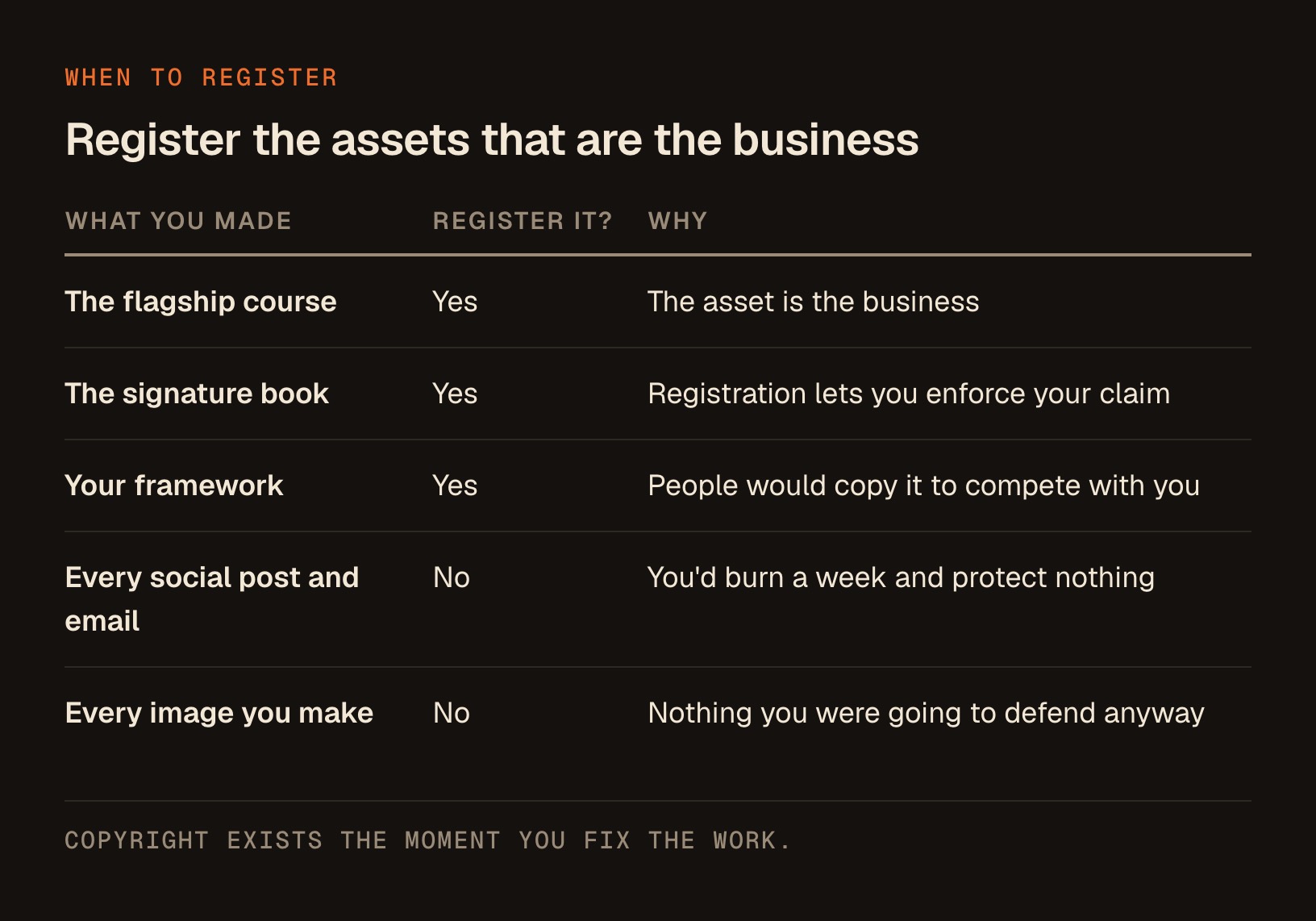
So when should a solo creator bother? When the asset is the business. Register the flagship course, the signature book, the framework people would copy to compete with you. Don't try to register every social post, every email, every image. You'll burn a week and protect nothing you were going to defend anyway.
How to Register Without Guessing
The mechanics trip people up more than the law does. 4 steps, in order:
- Start on the Copyright Office's own site. Registration runs through the electronic system you reach from US Copyright Office. You don't need a third-party "filing service" to type a form you can type yourself.
- Pick the application type that matches the work. A written course or ebook goes in as a literary work, images go in under visual arts. If your product mixes both, register the pieces separately rather than forcing one application to cover everything.
- Fill the Author Created field with your human contribution. This is where the Office's own wording goes: "Selection, coordination, and arrangement of [your human-authored content] created by the author and [the AI content] generated by artificial intelligence."
- Exclude the AI material in the limitation of claim section. That's the part of the application where you tell the Office what you are not claiming, which is how the required disclaimer actually gets made.
Disclose and disclaim if you register. It's required, and it's also protective, because a clean, accurate application is a stronger application. Sloppiness here is the thing that gets registrations questioned later.
For anything you sell, keep your drafts and versions, your prompt history, your dated authorship log, and a clear note of what you personally selected, arranged, and edited. 10 minutes of habit now beats a scramble later.
Your Brand Name Is a Separate Fight
One more boundary so you don't over-read any of this. Copyright is one body of law, and it's the only one Thaler settled.
Your brand name, your logo as a designed mark, and your trademarks live under different rules entirely. Whether AI helped you make the logo doesn't change which law governs the mark.
If protecting a name or a mark matters to you, treat it as its own project with its own specialist. Nothing above tells you whether your name is available, registrable, or already somebody else's.
I'm not a lawyer. I used to run my company with a team of 20-plus, engineers and marketers and support, and now I'm solo by choice, happier and shipping faster, building everything I sell with AI. So I care about this exact question as much as you do.
Nothing here is legal advice, and your situation may have wrinkles mine doesn't, so for anything real, check with your own attorney. What I can tell you is that the workflow above (shape the work, log the work, read the terms, disclose honestly) is the one I actually use.
Every finished AI skill I build, including the ones that help you package and document the work you create, lives in The Solo Creators AI Studio, and you can reach me directly in there if you want to talk through your own setup.
No pressure. The sources above are free to read, and now you know which ones matter.
Key takeaways
- A work generated entirely by AI, with no human shaping its expression, can't be copyrighted by anyone. Thaler v. Perlmutter settled it, and the Supreme Court denied review on March 2, 2026.
- You can still copyright the human part: your creative selection, arrangement, and edits. The Copyright Office has already registered hundreds of works that include AI-generated material.
- Your copyright exists the moment you fix the work. Registration is a separate, voluntary step that puts your claim on the public record and is what lets you enforce it in court, so save it for the assets that are the business.
- When you register, you have a duty to disclose the AI-generated content and to disclaim the parts the machine authored. Your copyright then covers your contribution.
- Keep a dated authorship log while you work so you can show exactly what a human created, instead of reconstructing it from memory later.
- The AI tool's terms of service matter too. Anthropic's consumer terms assign you output rights, if any, so read the current terms of whatever tool you use before you sell on top of it.
- Your brand name and logo are trademark questions, not copyright ones, and none of this decides them.
- Put your fingerprints on anything you want to own, and treat this as a workflow rather than legal advice.
Get this skill, and every one I build.
30-day money-back guarantee. Cancel anytime.
Questions people ask
Can you copyright AI-generated content?
Do I actually have to register my course to be protected?
Where do I actually register, and what do I type?
What did Thaler v. Perlmutter actually decide?
Do I have to tell the Copyright Office I used AI?
If I heavily edit AI output, does it become mine?
Who owns the output, me or the AI company?
Does this mean my brand name and logo are protected too?

Ronnie spent 18 years building a SaaS with a team of 20 that served over 650,000 customers, generated over $14M in sales, and sent over 550M emails. Now he's solo, solving real business bottlenecks and turning them into working AI skills, workflows, and automations. He teaches all of it, with direct access to him, inside the Solo Creators AI Studio Skool community. See what he's built →
 Michael HattawayFounder, Iron Strengthens Iron
Keep reading