What can I legally say about AI in my marketing?
It depends on whether your product actually uses AI. If it only helped you build the thing, the FTC says that isn't the same as a product having AI in it, so say "built with AI" instead of "AI-powered." There's no general FTC duty to label copy as AI-written. Disclosure matters when words are attributed to a person, or a face or voice is synthetic. Never invent testimonials, and only claim AI beats a human professional with proof. This isn't legal advice.
Last month a friend asked me to glance at her new sales page. Right at the top, in big confident letters: "AI-powered coaching that reads your mind."
She'd built the whole funnel herself with AI and she was proud of it, as she should be. Then she asked the question that made me put my coffee down: "Wait, am I actually allowed to say this?"
I've sent over 550 million marketing emails across my career, so I've watched up close what an overpromised subject line does to a list, and it isn't pretty. These days I build everything I sell with AI, so I went and read what the FTC actually says, word for word, instead of trusting the twenty stale blog posts that come up first.
First, the disclaimer that matters: I'm not a lawyer, and nothing here is legal advice. Run anything real past your own attorney.
What I can do is show you the primary sources in plain English, and link every one of them so you can check my work. The rules kept moving through 2024 and 2025, so dates matter more than usual here.
The 4 questions the FTC says it asks
Back in February 2023, an FTC staff attorney named Michael Atleson published a short business-guidance post with a blunt title, "Keep your AI claims in check." It's still the clearest thing the agency has ever written for people like us, and it lays out 4 questions the FTC asks when it looks at an AI claim.
- "Are you exaggerating what your AI product can do?"
- "Are you promising that your AI product does something better than a non-AI product?"
- "Are you aware of the risks?"
- "Does the product actually use AI at all?"
Here's what each one means when you're a coach, a consultant, or an advisor selling to real people:
- Question 1 is about the gap between your headline and your demo. If a prospect watched the product work, would the headline still feel true?
- Question 2 has a catch buried in it. Comparing your AI to a human or a non-AI option is allowed, but you need adequate proof in hand before you say it, not after someone asks.
- Question 3 is the one everybody skips, and it's simple: you're on the hook for what your output does to a client. If your AI hands a client a bad number, a bad plan, or a bad piece of advice, "the AI wrote it" is not a defense. You sold it, so you own it.
- Question 4 is the one that catches the most solo creators, and it gets its own section below.
That's it. No jargon, no thousand-page code. The test is basically "are you telling the truth", applied to a technology that makes it very easy to sound more magical than you are.
"Merely using an AI tool in the development process is not the same as a product having AI in it." (FTC staff guidance, "Keep your AI claims in check")
"AI-powered" has one bare-minimum test to pass
Here's the line that tripped up my friend, and it's the one I'd tattoo on the inside of every creator's eyelids. Straight from that same FTC post: "merely using an AI tool in the development process is not the same as a product having AI in it."
Read that twice. My friend used AI to build her coaching funnel. That does not make her coaching "AI-powered." Using AI to make something is not the same as the something running on AI.
If a customer reads "AI-powered coaching" and reasonably expects a live model analyzing their answers, but what they actually get is you, a human, coaching them with materials you happened to draft with Claude, then the words are doing work the product doesn't do.
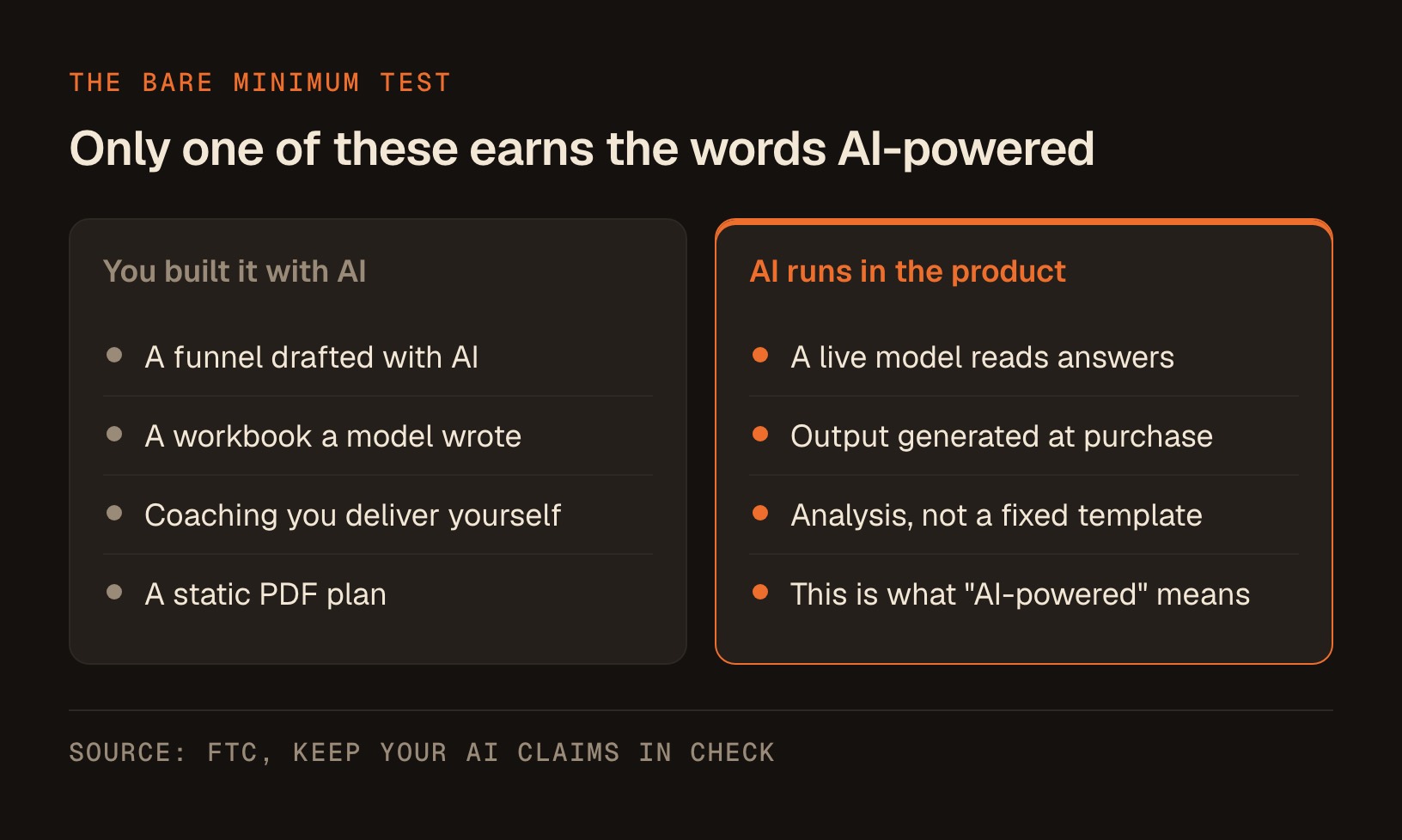
This is the single most common mistake I see solo creators make right now, and it's an easy fix. If AI genuinely runs inside the thing the customer uses, say so. If AI just helped you build it, say that instead.
Here are the swaps I'd make on most sales pages I read. Every rewrite keeps the energy, because accurate copy is allowed to sell hard.
| What you wanted to say | Why it overclaims | What to say instead (still sells) |
|---|---|---|
| "AI-powered coaching" for a program you personally deliver | The customer expects a model in the loop and gets a human | "Coaching built on a system I made myself with AI, so you get agency-depth materials at a solo price" |
| "AI that reads your mind" | It promises a capability no product on earth has | "Answer a few questions and you'll get a plan that reads like I've been watching your business for a year" |
| "Our AI analyzes your business" when it's a fixed template | No analysis happens; every buyer gets the same output | "The same framework I run on every business I look at, so nothing gets missed" |
| "AI-generated custom plan" when it's a static PDF | Nothing is generated and nothing is custom at the moment of purchase | "A step-by-step plan I built with AI, plus a worksheet that fits it to your numbers" |
| "Powered by advanced AI" when a model drafted the workbook | The product isn't powered by anything; the workbook was written with help | "I built this myself, with AI, which is why it costs a fraction of an agency" |
That last one is my favorite because it's true, it's differentiating, and no regulator on earth has a problem with it.
The robot lawyer case that fits solo operators
If you want to know what happens when a solo-ish operator overclaims AI in a professional service, there is one case that fits us better than any other, and it's DoNotPay. The company marketed itself as "the world's first robot lawyer."
What it actually sold was substitution. The pitch was that the service could stand in for the expertise of a human lawyer, generating legal documents and giving law-related advice, for a subscription fee.
The problem, per the FTC, was that DoNotPay never tested the service against an actual human lawyer and hired no attorneys to check the quality and accuracy of its law-related features. The claim was the product's whole identity, and there was nothing behind it.
The result was a settlement with a final order in January 2025.
The FTC's announcement of the finalized order sets out what it required: monetary relief, notices to past subscribers, and a prohibition on advertising that the service performs like a real lawyer without evidence to back it up.
I checked the case page while writing this, and that order still stands.
Notice the shape of that remedy. The company didn't just have to stop saying the thing, it had to go back and tell the people it already sold to.
Now, you and I are not marketing robot lawyers. But swap the words:
- "AI that does your taxes as well as a CPA."
- "An AI that reads contracts like a lawyer."
- "AI coaching that outperforms therapy."
Those are all the DoNotPay claim wearing a different hat. The trap is comparing your AI to a trained human and having no proof you could hand a skeptic. Making the comparison is legal. Making it without evidence is the risk.
Former FTC Chair Lina Khan put the whole principle in one sentence.
"There is no AI exemption from the laws on the books." (Lina Khan, former FTC Chair)
What the Rytr reversal changed, and what it didn't
This is where a lot of what you'll read online is now out of date.
On December 22, 2025, the FTC reopened and set aside its earlier order against Rytr, an AI writing tool.
The vote was 2-0. The Commission said the original complaint "failed to satisfy the legal requirements of the FTC Act" and that it "unduly burdens artificial intelligence (AI) innovation."
Christopher Mufarrige, Director of the FTC's Bureau of Consumer Protection, added a line people are quoting everywhere.
"Condemning a technology or service simply because it potentially could be used in a problematic manner is inconsistent with the law and ordered liberty." (Christopher Mufarrige, Director of the FTC's Bureau of Consumer Protection)
Cue a hundred hot takes announcing that fake AI reviews are legal now. They are not. What got set aside was liability for the tool vendor whose product could theoretically be misused by someone else.
Rytr made a writing tool. The FTC decided you can't punish the toolmaker just because a customer might use the tool to write something dishonest. That's a real and meaningful narrowing, and it's good news for anyone building AI tools.
But here's the part the hot takes skip. It does not legalize publishing a fake testimonial. If you are the one who invents a glowing review from a client who doesn't exist, the tool question never even comes up. You're the person making the misrepresentation.
Here's the split at a glance, so you can't get it backwards:
| What the December 2025 Rytr order narrowed | What it left completely untouched |
|---|---|
| A tool vendor is not liable merely because a customer could misuse the tool | The Rule on Consumer Reviews and Testimonials, 16 CFR Part 465, effective October 21, 2024 |
| "Could potentially be used in a problematic manner" is not enough, on its own, to condemn a technology | Misrepresenting that a reviewer exists, that they used the product, or the nature of their experience |
| The 2024 Rytr order itself, reopened and set aside on a 2-0 vote | You, as the publisher of the review, when you're the one making the claim |
The testimonial rule that actually has teeth
There are 2 different things people lump together, and separating them is where you get safe.
The first is the FTC's Endorsement Guides, 16 CFR Part 255. They're interpretive guidance: they tell you how the Commission reads the law, and they were written well before generative AI was a marketing concern. So when a blog cites the Endorsement Guides to scare you about AI reviews, it's leaning on the wrong document.
The one with teeth is the Rule. In full, it's the Rule on the Use of Consumer Reviews and Testimonials, 16 CFR Part 465, and it took effect on October 21, 2024. It's a legislative rule with civil penalty authority behind it. And the FTC's September 2024 crackdown sweep, Operation AI Comply, went straight at AI-enabled fake reviews, with Rytr among the named targets.
3 documents, 3 very different weights:
| Document | What it is | Date | Does it bind you |
|---|---|---|---|
| "Keep your AI claims in check" | FTC staff business guidance | February 2023 | No penalty attaches, but it tells you exactly what the agency looks for |
| Endorsement Guides (16 CFR Part 255) | Interpretive guidance on how the FTC reads the law | Written before generative AI was a marketing concern | Not a standalone regulation you get fined under |
| Rule on Consumer Reviews and Testimonials (16 CFR Part 465) | A legislative rule with civil penalty authority | Effective October 21, 2024 | Yes. This is the one with teeth |
What the Rule prohibits is misrepresenting, among other things, that a reviewer "exists," that they "used or otherwise had experience with" the product, or the nature of their "experience."
Notice what those words turn on. The rule is about misrepresentation, not the tool. It never says "written by AI." It says the reviewer has to exist, has to have actually used the thing, and their experience has to be real.
So let's get precise:
| Situation | Is it a problem? | Why |
|---|---|---|
| You invent a testimonial from a client who doesn't exist | Yes, squarely prohibited | The reviewer doesn't "exist" |
| You attribute a review to a real person who never used your program | Yes | They never "used or otherwise had experience with" it |
| You use AI to fix the grammar and tighten a real client's real, approved words | Not what the rule describes | Reviewer exists, used the product, experience is accurate |
| AI "polishes" a real review into specifics the client never actually said | The danger zone | "Polish" has drifted into inventing experience |
That last row is exactly what sank Rytr's original complaint in the first place: the FTC described output with "specific, often material details that had no relation to the user's input." The risk lives in the middle, where cleaning up a review quietly becomes writing a new one.
If your AI added a number, a result, or a feeling the client never expressed, stop. If it just fixed their typos and their real quote survived intact, you're doing what any good editor has always done.
Do you have to disclose that AI wrote it?
This is the question most people actually arrive with, so let's take it head on. Nothing I read in the FTC's own materials creates a general duty to stamp "written by AI" on your marketing copy.
Look at what the sources actually govern. The 4 questions ask what your product does for the customer. The Rule asks whether a reviewer exists, used the product, and described a real experience. Neither one turns on which keyboard, human or model, produced the sentences.
Where authorship does start to matter:
- When the words are attributed to a person. A testimonial, an endorsement, a quoted expert. Now the question is no longer "was AI involved," it's "did this person really say and experience this."
- When you show a face or a voice. A synthetic person presented as a real customer misrepresents that the reviewer exists, which is exactly what the Rule is built to catch.
- When a material relationship is hidden. That's the Endorsement Guides territory, and it applies whether AI was in the room or not.
- When a platform's own terms require it. Plenty of ad networks, app stores, marketplaces, and publishing platforms have AI-disclosure rules of their own. Those are contract terms you agreed to, not FTC rules, and they'll get your account pulled long before a regulator calls.
- When a client asks you directly. Not a legal point. A trust one. "Yes, I use AI, here's exactly where" is a better answer than a dodge.
To be clear about what I'm not saying: I'm reading US federal materials, I'm not a lawyer, state law and industry regulators can add their own requirements, and if you're in a licensed field like financial advice you have a whole other rulebook. Ask yours.
A copy-paste claim audit you can run right now
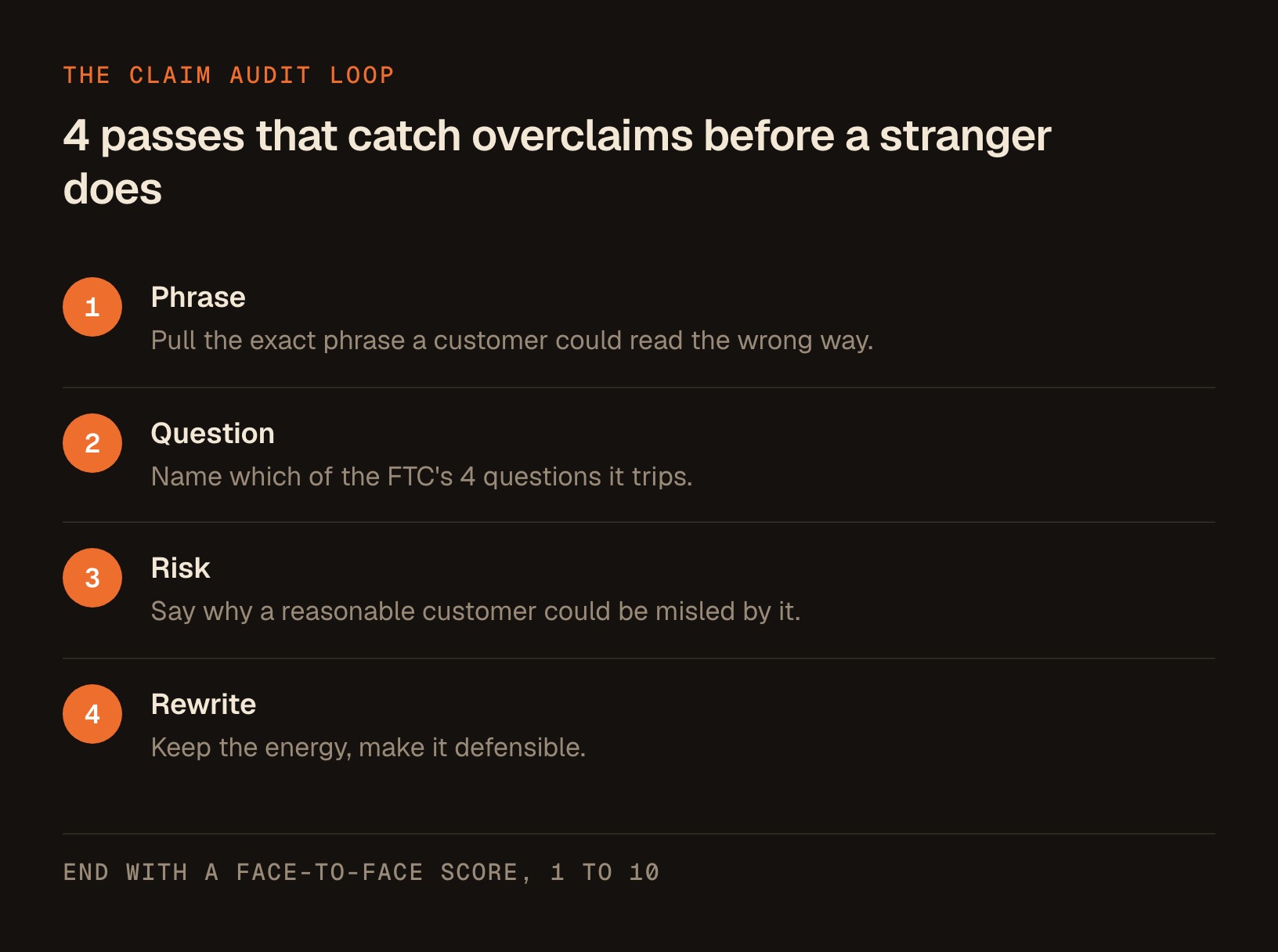
Here's the practical part. Before anything with an AI claim goes live, I run it through this. Paste it into the Claude desktop app, drop your copy at the bottom, and let it play skeptic. It's built around the FTC's own 4 questions.
You are an FTC-savvy marketing reviewer. I'm a solo coach/consultant/
creator and I am NOT asking for legal advice, just a claims check on
my marketing.

Audit the copy below against the four questions the FTC says it asks
about AI claims:

1. Am I exaggerating what my AI actually does?
2. Am I claiming it works better than a non-AI or human option without
   proof I could show a skeptic?
3. Am I taking responsibility for the output, or leaning on "the AI did
   it" as an excuse?
4. Does my product actually use AI in the way a customer would assume
   from these exact words? (Using AI to BUILD it doesn't count.)

For every line that could be a problem, give me: the exact phrase, which
question it trips, why a reasonable customer could be misled, and a
rewrite that keeps the energy but is defensible.

Then, if my copy quotes any testimonial or review, flag anything that
sounds like a specific result or detail, and ask me to confirm the real
client actually said it.

End with a "would I say this to the customer's face, with proof on the
table" score from 1 to 10.

Here's my copy:
[PASTE YOUR COPY]
Here's what one finding looks like, run on my friend's headline from the top of this article:
- Exact phrase: "AI-powered coaching that reads your mind"
- Question it trips: #4, and #1 for good measure
- Why a customer could be misled: They'd expect a model reading their answers in real time. What they get is a human coach working from materials that were drafted with AI.
- Defensible rewrite: "Coaching built on a system I made myself with AI, so you get agency-depth materials at a solo price."
- Face-to-face score: 3 out of 10 before the rewrite, 9 after.
That's the whole loop. Phrase, question, risk, rewrite. If your output doesn't look like that, feed the prompt again and tell it to be specific.
It won't make you bulletproof, and it isn't a lawyer. What it does is catch the obvious overclaims before a stranger does, which is most of them. Run it on every page with the letters "AI" on it.
The stakes, in one figure worth memorizing
People always want to know the stakes, so here it is, and I pulled the live figure rather than trusting a blog. Under 16 CFR 1.98(d), penalty exposure runs up to $53,088 per violation.
That figure comes from the Federal Register at 90 FR 5581, dated January 17, 2025.
Hold onto that structure, because it's the scary part. The exposure is per violation, which is what makes fake reviews at scale a real problem rather than a theoretical one.
Penalty exposure runs up to $53,088 per violation. A hundred invented testimonials is a hundred violations.
The positioning that actually converts
Here's what I keep coming back to after reading all of this. Honesty is the higher-converting play anyway. The claims that get you in trouble are almost always the lazy, inflated ones, and those are the same claims a sharp prospect discounts on sight.
"AI that reads your mind" makes people roll their eyes. "I built this system myself, with AI, which is why it costs a fraction of an agency and I can turn it around this week" makes people lean in, and it happens to be completely true.
Here's the whole playbook in 4 lines:
- Say what your product really does.
- Compare it to a human only if you can prove it.
- Take responsibility for the output instead of hiding behind "the algorithm."
- Never, ever put words in a client's mouth they didn't say.
Do that and you don't need to memorize regulations, because you're already on the right side of all of them.
Every finished AI skill I build for my own business, the ones that write copy, audit sites, and yes, pressure-test marketing claims like this, lives inside the Solo Creators AI Studio, and I'm a real person you can reach if you want to talk it through. You can see what's in there at the Solo Creators AI Studio. No pressure, and definitely no robot lawyers.
Key takeaways
- The FTC's own four questions live in a February 2023 staff post, "Keep your AI claims in check." It's free, it's short, and it's still the clearest thing the agency has written for solo operators.
- In the FTC's own words, merely using an AI tool in the development process is not the same as a product having AI in it. That single line is what disqualifies most "AI-powered" headlines.
- There's no general FTC duty to label marketing copy as AI-written. Authorship starts to matter when the words are attributed to a person, when a face or voice is synthetic, or when a platform's own terms require disclosure.
- On December 22, 2025, the FTC reopened and set aside the Rytr order on a 2-0 vote, saying the complaint failed the FTC Act's legal requirements and unduly burdened AI innovation. That narrowed liability for tool vendors, nothing more.
- The Rule on Consumer Reviews and Testimonials (16 CFR Part 465) took effect October 21, 2024 and is a legislative rule with civil penalty authority. The Endorsement Guides (16 CFR Part 255) are interpretive guidance, not a rule you get fined under.
- Penalty exposure runs up to $53,088 per violation under 16 CFR 1.98(d), per 90 FR 5581 dated January 17, 2025. Because it's per violation, faked reviews at scale multiply the exposure.
- DoNotPay's "world's first robot lawyer" claim was never tested against an actual lawyer. The January 2025 final order required monetary relief, notices to past subscribers, and proof before repeating the claim.
Get this skill, and every one I build.
30-day money-back guarantee. Cancel anytime.
Questions people ask
Can I say my service is "AI-powered"?
Do I have to disclose that AI wrote my emails or blog posts?
Is it illegal to use AI to write my testimonials?
Did the Rytr decision make AI marketing claims legal now?
What's the penalty if I get an AI claim wrong?
Do the FTC's Endorsement Guides apply to AI?
Can I claim my AI works better than a human professional?

Ronnie spent 18 years building a SaaS with a team of 20 that served over 650,000 customers, generated over $14M in sales, and sent over 550M emails. Now he's solo, solving real business bottlenecks and turning them into working AI skills, workflows, and automations. He teaches all of it, with direct access to him, inside the Solo Creators AI Studio Skool community. See what he's built →
 Michael HattawayFounder, Iron Strengthens Iron
Keep reading