Do I legally have to tell clients I use AI?
For most US solo coaches and consultants, no, but it depends on your state and your license. The big AI laws regulate companies that build AI systems, not small businesses that use them. Utah is the real exception. Any business must disclose if a client asks, and licensed professionals like financial advisors must disclose up front. Everyone owns every claim their AI makes, and your NDAs may limit pasting client material. Disclosing still wins on trust. This isn't legal advice, so confirm with your attorney.
The Short Answer, So You Can Stop Bracing
A coaching client emailed me last spring and asked, point blank, "Are you using AI to write these?" I'd been dreading the question for months, convinced there was some law I was quietly breaking. So I went looking for the rule that was going to bite me.
I couldn't find it. Not because I searched badly, but because for a US solo coach or consultant, that general rule mostly doesn't exist. The scary headlines are real laws. They just aren't aimed at you.
Let me give you the finish line first, because I know that low hum of compliance dread and I'd rather kill it than milk it.
For a typical US solo coach or consultant, there is essentially no general legal duty to tell your clients you use AI. No federal statute makes you announce that ChatGPT or Claude helped draft your emails, outline your course, or clean up your proposal. The famous state laws people wave around regulate a different animal entirely.
I want to be careful here, so one caveat up front: I'm not a lawyer, and this isn't legal advice. I'm a solo operator who reads the actual bills instead of the blog posts about the bills, and who checks with his own attorney before doing anything that matters. You should check with yours.
What I can do is show you what the primary sources say, and link every one of them, so your conversation with that attorney starts from facts instead of from a panic headline.
The reason the panic is misplaced comes down to one structural fact worth sitting with for a second.
Why These Laws Skip Right Over You
Almost every AI law that made the news is written to regulate the companies that build AI systems, not the small businesses that use them.
Think about who actually has the power to put a watermark in an AI image, label a synthetic voice, or publish a "we trained this model" disclosure. It falls on the lab that trained the model. The coach typing a prompt is nowhere in that definition. You, the person who opened an app and typed a request, are a customer of that system, and the duties land upstream of you.
Hold that lens up to each of the 4 laws everyone panics about and they fall over one by one. Let me walk them.
The 4 Laws Everyone Panics About, Handled
Here's the map before the detail, so a skimmer gets the whole thing in one look:
| The law everyone cites | Who it actually regulates | Does it make a solo coach disclose? |
|---|---|---|
| California SB 942 (AI Transparency Act) | "Covered providers" who produce a large gen-AI system | No. You use one, you don't produce one. |
| Colorado's AI Act (SB 24-205) | Deployers in named high-risk domains | No, and the original act never even took effect. |
| California SB 1001 (the "bot" law) | Anyone using a bot to mislead about identity to drive a sale | Only if you run a deceptive bot. Say it's a bot and you're clear. |
| EU AI Act, Article 50 | Providers and some deployers of certain AI content | Human-reviewed content is carved out. |
Now the specifics, because the specifics are where the fear lives.
California SB 942: a law for the model makers
SB 942 is California's AI Transparency Act, and it's the one I see cited most. The duty falls on a "covered provider," which the law defines as someone who "creates, codes, or otherwise produces a generative artificial intelligence system that has over 1,000,000 monthly visitors or users."
Read that twice. A coach who uses ChatGPT does not create, code, or produce a generative AI system. And a coach's practice does not have a million monthly users of a system they built, because they didn't build one. You miss the definition twice over.
SB 942 only reaches someone who "creates, codes, or otherwise produces" a generative AI system with over 1,000,000 monthly visitors or users.
This law is aimed squarely at the OpenAIs and Anthropics of the world, the outfits that ship the models to millions. It is not aimed at their customers.
One more detail so nobody catches you flat-footed: this law becomes operative on August 2, 2026, after a delay. A lot of older articles say January 1, 2026, which is now wrong.
There is amending legislation in the works, so if you're reading this much later, the "covered provider" definition is the one thing worth having your attorney re-check against the current text. A bill still in process is not a rule you have to follow today.
Colorado: the act that got repealed before it lived
This is the cleanest example of stale advice on the whole internet. You'll find dozens of pages warning about "Colorado's AI Act, effective June 30, 2026."
That version never took effect. Colorado passed a replacement, SB 26-189, signed in May 2026, before the original (SB 24-205) was ever due to switch on. The law those articles describe was repealed and rewritten before it applied to a single business.
Separate the 2 dates people keep blurring together. The replacement is already on the books, signed in May 2026. Its main business-facing obligations, things like developer documentation and the Attorney General's rules, don't begin until January 1, 2027.
And even then it only reaches specific high-risk domains: education, employment, housing, lending, insurance, health care, and essential government services. General coaching and consulting were never in scope in the first place, so for most solo operators the Colorado story is noise either way.
California SB 1001: the "bot" law, and a correction
SB 1001 is the "B.O.T." law, and I have to correct something you'll read everywhere. Countless summaries claim it only applies to sites with "10 million or more visitors." That figure is not in the operative section.
The number sits in a definition the operative rule never uses. The actual duty, Business and Professions Code 17941, reaches "any person."
The "10 million or more visitors" cutoff everyone cites isn't in the operative section. Business and Professions Code 17941 reaches "any person."
So why aren't you sweating it? Because the law turns on intent to deceive. It's unlawful to use a bot to mislead someone about the bot's artificial identity in order to incentivize a sale or influence a vote. 2 things follow, and both are good news:
- If your AI drafts an email and then you send it as yourself, there's no bot in the interaction at all. You're out.
- If you run a website chatbot that doesn't pretend to be a human, you're fine. The fix is almost insultingly simple: let the bot say it's a bot. "Hi, I'm an automated assistant" and you've satisfied the whole concern.
EU AI Act, Article 50: the human-review carve-out
If you ever serve a client in the EU, Article 50 of the AI Act is the transparency piece, and it applies from August 2, 2026. You may have seen news that the EU's "Digital Omnibus" delayed parts of the AI Act.
It didn't delay the part that matters here for most of us. The core transparency duties around AI-generated content still stand.
Here's the part that lets most of us relax. Article 50's obligations for AI-generated content include a carve-out for content that has been through human review or editorial control, where a person takes editorial responsibility for it.
A coach who writes a newsletter with AI help and then reads it, edits it, and hits send has exercised exactly that editorial control. You're the human in the loop, and the law recognizes it. Editing your own work is the whole exemption.
The One Place You Actually Have to Speak Up: Utah
Now the exception, and I'm putting it in lights because this site is read by financial advisors, and if that's you, this paragraph is the one to print.
Utah has a real, active AI disclosure law, and it has 2 gears. The first gear is reactive and applies broadly: under Utah Code 13-75-103(1), a business using generative AI has to disclose that fact "if the individual asks or otherwise prompts."
That's it. No duty to volunteer. If a customer asks whether they're talking to AI, you tell them the truth. If they never ask, the general rule doesn't force you to bring it up.
The second gear is proactive, and it targets regulated occupations. When AI use rises to a "high-risk artificial intelligence interaction" inside a "regulated occupation," Utah 13-75-103(2) and (3) require you to disclose up front: "verbally at the start of a verbal interaction" and "in writing before the start of a written interaction."
And the statute's list of high-risk interactions expressly includes "the provision of financial advice or services."
Utah's high-risk list expressly includes "the provision of financial advice or services," and covered advisors have to disclose "verbally at the start of a verbal interaction" and "in writing before the start of a written interaction."
So does this catch you? It depends on one word: licensed.
- A licensed financial advisor is covered. Utah's occupational-licensing structure runs through the Department of Commerce, and Utah Code 13-1-2 lists the Division of Securities as a division of that department. Investment adviser representatives are licensed there. If that's your world, and you use AI in a client interaction, Utah wants you to say so at the start, out loud and in writing.
- An unlicensed coach is not a regulated occupation under that section. The proactive duty doesn't reach a life coach or a general business consultant the way it reaches a securities-licensed advisor.
Find your own row here instead of parsing 3 paragraphs:
| Your situation | Client asks directly | Client never asks | Statute cited here |
|---|---|---|---|
| Unlicensed coach or general consultant | Confirm that you use generative AI | No duty to volunteer it | Utah 13-75-103(1) |
| Licensed financial advisor (securities-licensed) | Confirm that you use generative AI | Still disclose up front: verbally at the start of a call, in writing before a written interaction | Utah 13-75-103(2) and (3) |
| Any other business using gen AI | Confirm that you use generative AI | No duty to volunteer it | Utah 13-75-103(1) |
The question nobody answers: does this reach me if I'm not in Utah? It sits in Utah's consumer protection code, and consumer protection statutes generally reach businesses dealing with that state's consumers, so "my office isn't in Utah" doesn't automatically end the analysis. I'm not going to pretend the text settles it cleanly, and notice that the blog posts citing this law don't answer it either.
The practical move is boring and cheap. If any client of yours is a Utah resident, hand this section to your compliance person and let them make the call. Then disclose anyway, because the disclosure costs you a sentence and the ambiguity costs you sleep.
Since I promised you that sentence, here are both of mine. Adapt the wording, keep the structure:
Spoken, at the top of a client call: "Quick note before we start. I use AI tools to help prepare and draft parts of this work. I review everything personally, and every recommendation you get from me is mine."
Written, one line in your engagement letter: "We use generative AI tools to assist with drafting, research, and analysis. All AI-assisted work is reviewed by [your name], who takes full responsibility for every deliverable and recommendation."
If you're a licensed advisor, that's genuinely the whole lift. One sentence at the top of a client call. One line in your engagement letter. Done.
(Same caveat, louder for this section: confirm your exact licensing status and obligations with your compliance person or attorney. Rules for regulated professionals are the ones you never freelance.)
The Rule That Actually Governs All of Us: Don't Deceive People
Here's the shift that made this whole topic click for me. I was so busy hunting for an "AI disclosure law" that I almost missed the law that's actually in charge of my behavior.
It isn't about AI at all. It's ordinary deception law, and it's been on the books for decades.
3 statutes, one idea. Look at what each one actually forbids, and at the answer in the last column:
| Statute | What it actually forbids | Does "an AI wrote it" help you? |
|---|---|---|
| FTC Act Section 5 | Unfair or deceptive acts or practices in commerce | No. The claim is judged by whether it misleads a consumer, not by who typed it. |
| Utah 13-75-102 | Deception by a business using generative AI | No. The statute says in as many words that it's not a defense. |
| California 17941 | Using a bot to mislead about its artificial identity to drive a sale or a vote | No. Hiding the machine is the violation, so pointing at the machine can't excuse it. |
Notice the common thread. The thing all 3 forbid is deceiving the human on the other end. Whether a robot or a person produced the words is almost beside the point. If the claim is false or misleading, you're exposed.
This reframes everything productively. If your AI drafts a testimonial that never happened, that's a deception problem, and no disclosure label saves it. If your AI promises a result you can't deliver, same thing.
The AI question is a distraction from the real duty, which you already knew: tell the truth. You don't need to memorize 4 AI statutes. You need to make sure that whatever goes out under your name is true.
You Own Every Word Your AI Writes
Utah's law says the quiet part out loud, and every solo operator using AI should tape this to the wall.
Under Utah 13-75-102, "it is not a defense" to a deception claim that the generative AI "made the violative statement."
You cannot blame the model. I actually find this clarifying rather than scary, because it matches how a good operator already thinks. You're the editor, the signature, and the liability, always.
The AI is a very fast junior drafter who has never once read your compliance file. You read everything before it leaves the building. Do that, and the "who wrote it" question loses most of its teeth.
Why Telling Them Wins Anyway
So if there's usually no duty to volunteer it, why did I answer my client honestly? Because the legal question and the trust question are 2 different games, and the trust game is the one that pays my mortgage.
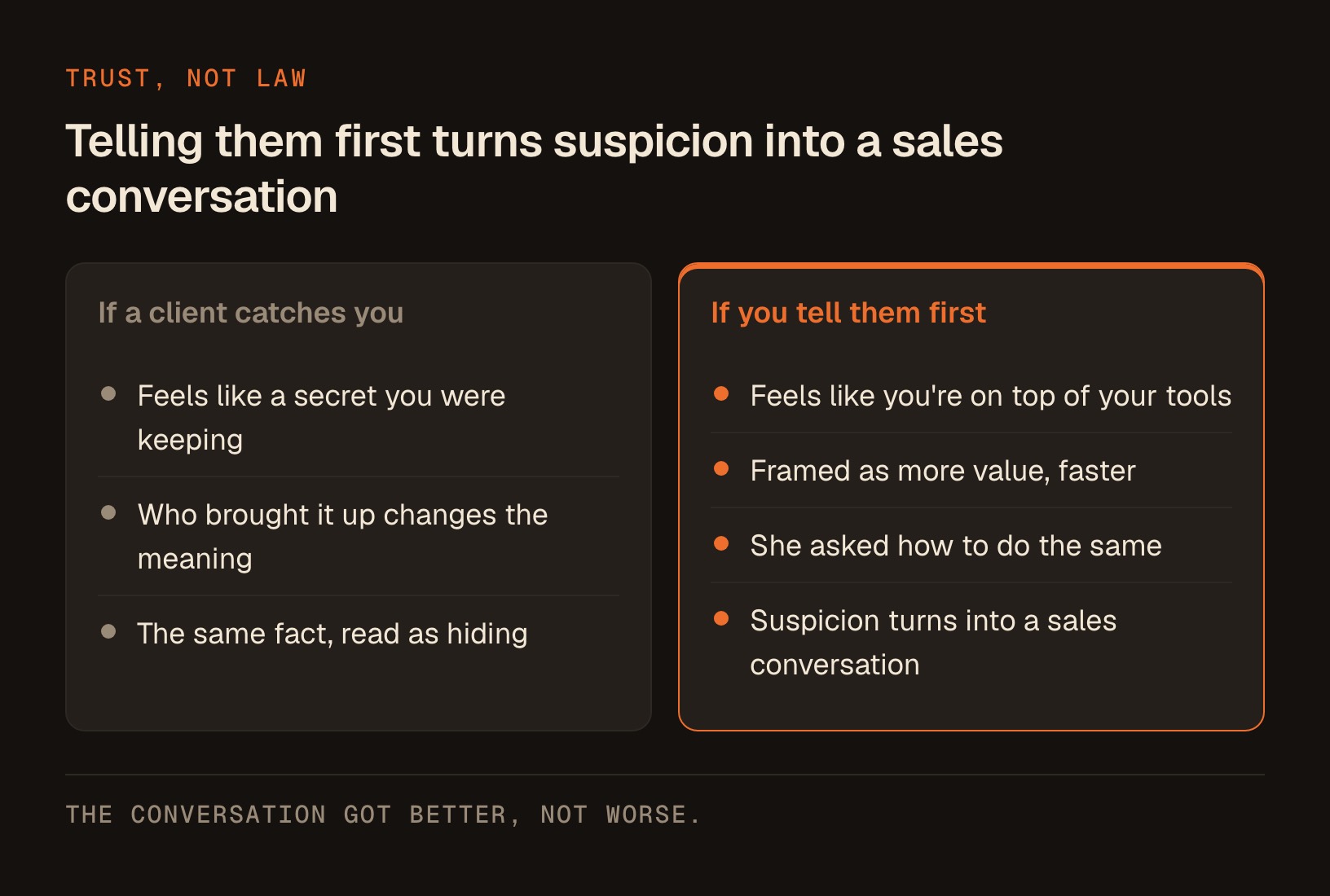
Think about the 2 ways a client learns you use AI. If a client catches you, it feels like a secret you were keeping. If you tell them first, calmly, framed as how you deliver more value faster, it feels like you're on top of your tools. The client learns the exact same fact either way, and what changes the meaning is who brought it up.
So I bring it up. My position, and it's the one on this very site, is that I tell people plainly: this work is AI-assisted, and a human owns every claim. I'm open about using AI, and I still own the result.
Clients don't hire me because I typed every character by hand. They hire me for judgment, taste, and the fact that my name is on the outcome. AI doesn't threaten any of that. It just means I can give them more of it.
When I told that client "yes, I use AI to draft, and I edit and own everything that reaches you," the conversation didn't get worse. It got better. She asked how she could do the same in her business. Disclosure turned a suspicion into a sales conversation.
What to Actually Put in Writing
First, the risk that actually bites consultants, and it isn't disclosure law. For most of us the real exposure is the confidentiality language in the contracts we already signed, years before any of us had heard of a prompt.
If you've pasted a client's strategy doc, customer list, or draft financials into a tool, the governing question is contractual. Does the NDA you signed permit sharing that material with a third-party service at all? Plenty of standard NDAs don't, and none of them care that the third party is a chatbot.
So do this before you write a single word of disclosure: open your existing client agreements and NDAs, find the confidentiality section, and read what it says about third parties, subcontractors, and approved service providers. It takes fifteen minutes and it's the highest-value thing in this article.
Then, if you want to disclose the grown-up way, don't post a vague "we use AI" banner. Put a real clause in your engagement agreement. A good AI-use clause covers 4 things:
- Scope: where AI is used, and where it isn't.
- Data handling: what client information does or doesn't get entered into AI tools.
- A named human reviewer: the specific person who takes responsibility for the output.
- Billing treatment: what your fee is actually buying.
Here's a plain-English clause you can adapt. Read it, make it yours, and run it past your attorney before it goes in a contract:
Each of those 4 elements is answering a question the client is too polite to ask out loud. Here's the mapping, so you can see which sentence is doing which job:
| Clause element | The client question it answers | The line in the sample clause that covers it |
|---|---|---|
| Scope | "Where does AI touch my work, and where does it stop?" | "We use generative AI tools to assist with tasks such as drafting, research, and summarizing." |
| Data handling | "Is my confidential information sitting in some tool?" | "We do not enter your confidential information into third-party AI tools without your consent." |
| Named human reviewer | "Is an actual person checking this before I see it?" | "A human on our team reviews all AI-assisted work, and we take full responsibility for every deliverable and recommendation." |
| Billing treatment | "Am I paying my old rate for something that took a machine four seconds?" | "our fees reflect the outcomes and expertise we provide." |
And because you shouldn't have to draft this from scratch, here's a prompt I use to tailor a disclosure to a specific practice. Paste it into Claude and answer the 2 blanks:
You are helping a solo professional write a clear, plain-English AI-use disclosure for their clients. This is not legal advice and will be reviewed by their attorney.

My profession: [e.g., business coach / marketing consultant / bookkeeper]
Am I licensed in a regulated field (e.g., securities, law, accounting)? [yes/no, and which]

Write me three things:
1. A one-sentence verbal disclosure I can say at the start of a client call.
2. A two-to-four sentence written clause for my engagement agreement that covers: where I use AI and where I don't, how I protect client data, that a named human (me) reviews and owns every deliverable, and that my fees reflect judgment and outcomes rather than effort.
3. A short, warm way to answer if a client directly asks "are you using AI?"

Keep it confident and non-defensive. No jargon. No apologizing for using good tools. Do not use em-dashes.
That prompt gets a licensed advisor a compliant-sounding starting draft and an unlicensed coach a trust-building one, and it takes about thirty seconds.
Where This Leaves You
Put the whole thing back together. For most US solo coaches and consultants, no general law forces you to announce AI use. The big 4 statutes regulate model builders, high-risk domains, deceptive bots, and un-reviewed content, and a solo operator editing their own work sits outside all 4.
Utah adds a real proactive duty, but only for licensed professionals like financial advisors, and it's satisfied by a sentence. The rule that actually governs everyone is the oldest one there is: don't deceive people, and own what goes out under your name.
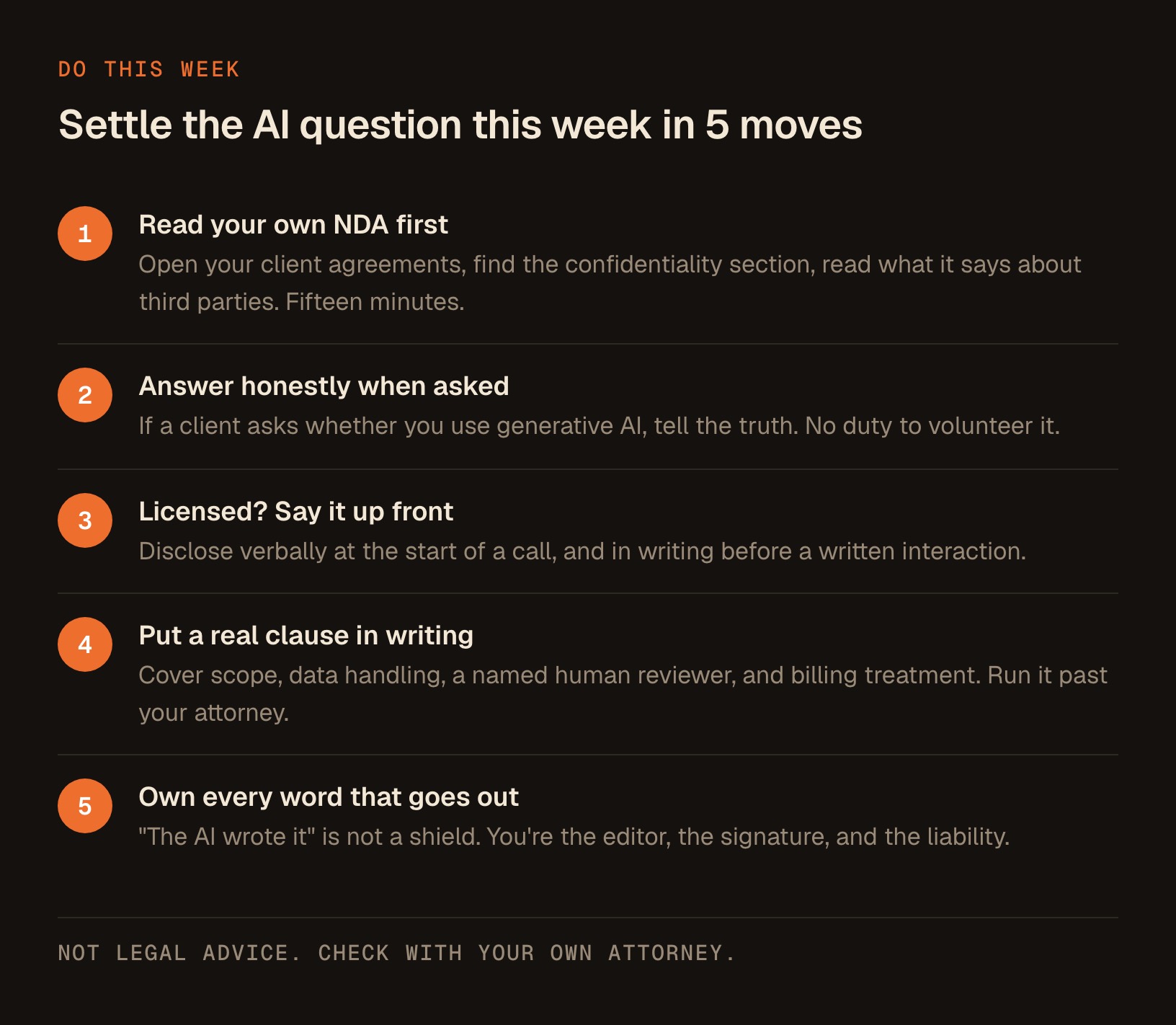
The nearest real risk for most consultants is duller than any statute: the confidentiality clause already sitting in your own client agreements. Go read it this week.
Then, having established you mostly don't have to, disclose anyway, because getting there first is worth more than the silence protects.
The primary sources, so you can forward this to compliance:
- California SB 942, AI Transparency Act
- Colorado SB 24-205, the original AI Act and Colorado SB 26-189, the replacement
- California Business and Professions Code 17941, the "bot" duty
- EU AI Act, Regulation (EU) 2024/1689, Article 50
- Utah Code 13-75-102 and 13-75-103, plus Utah Code 13-1-2
- FTC Act Section 5
I'm still not a lawyer, and these laws are moving, so use this to have a smarter conversation with your own attorney rather than to skip it.
Every finished AI skill I build, the ones that draft, edit, and keep a human firmly in the loop, lives in The Solo Creators AI Studio, and I'm a direct email away if you want help wiring AI into your own practice.
I built this whole approach out in the open, AI-assisted and human-owned, because that's the version I'd want a professional I hired to use.
Key takeaways
- For most US solo coaches and consultants, no general law requires disclosing AI use to clients. The big AI statutes regulate the companies that build AI systems, not the small businesses that use them.
- California SB 942 (operative Aug 2, 2026) binds a 'covered provider' who produces a large gen-AI system, not a coach who uses ChatGPT. Colorado's original AI Act was repealed and rewritten (SB 26-189, signed May 2026) before it ever applied, and its replacement's main business-facing obligations don't begin until January 1, 2027.
- California's 'bot' law only bites if you deceive someone about a bot's identity to drive a sale, so letting a chatbot say it's a bot clears it. The EU AI Act's Article 50 carves out content that has been through human review or editorial control.
- Utah is the real exception: any business must disclose AI if a client asks, and licensed professionals like financial advisors must disclose proactively, verbally and in writing, at the start of an interaction. An unlicensed coach is not covered by that proactive duty.
- The law that actually governs everyone is ordinary deception law (FTC Act Section 5 and its state cousins). Utah is explicit that 'the AI wrote it' is not a defense, so you own every claim your AI makes.
- The risk that actually bites consultants is usually confidentiality, not disclosure. Reread the confidentiality section of the NDAs and client agreements you already signed before pasting client material into any AI tool.
- Disclosing wins on trust even when it isn't required: if a client catches you it reads as a secret, but if you say it first it reads as competence. A good AI-use clause covers scope, data handling, a named human reviewer, and billing.
- This is not legal advice. Confirm your own licensing status and obligations with your attorney or compliance person before relying on any of it.
Get this skill, and every one I build.
30-day money-back guarantee. Cancel anytime.
Questions people ask
Do I legally have to tell my clients I use AI?
Doesn't California's AI law require disclosure?
What about Colorado's AI Act that was supposed to start in June 2026?
I'm a financial advisor. Are the rules different for me?
Does Utah's law apply to me if I'm not based in Utah?
If my AI writes something false, can I blame the AI?
Is pasting client information into an AI tool a legal problem?
If I don't have to disclose, why should I?
What should an AI-use clause in my contract actually say?

Ronnie spent 18 years building a SaaS with a team of 20 that served over 650,000 customers, generated over $14M in sales, and sent over 550M emails. Now he's solo, solving real business bottlenecks and turning them into working AI skills, workflows, and automations. He teaches all of it, with direct access to him, inside the Solo Creators AI Studio Skool community. See what he's built →
 Michael HattawayFounder, Iron Strengthens Iron
Keep reading