Can an AI detector prove my writing was made with AI?
Not reliably, so it depends on the proof you keep. The FTC found one popular detector did "no better than a coin toss," with 53 percent accuracy on general writing against the 98 percent it advertised. A detector score is weak evidence either way. Your version history is strong evidence. Draft in Google Docs or Word, keep the brief in the same doc, and save the AI chat thread. If a client's contract requires human-written work, follow it. Otherwise, own and edit every sentence you ship.
The regulator's verdict: a detector that did no better than a coin toss
For a while I had a specific nightmare. I paste my draft into one of those detector tools, it says "87% AI," and suddenly I'm defending my whole business over a number a website invented.
I shipped an iPhone app that Apple approved in under 3 weeks, and I did it without knowing how to code. AI builds everything I put out now. So this one was personal. I went and read what a US regulator actually found when it put one of these detectors under oath, and the short version is that you can relax.
In April 2025, the Federal Trade Commission (the US consumer-protection regulator) took action against a company called Workado, LLC over the way it marketed its AI Content Detector. Workado had advertised that detector as "98 percent" accurate. That's the number that makes you nervous, because 98 percent sounds like a lie detector you can't argue with.
Then it got tested. According to the FTC's administrative complaint, independent testing showed the real accuracy on general-purpose content was just 53 percent. Fifty-three out of a hundred. You could flip a quarter and land within a few points of that.
I read the FTC's own press releases to get the wording right, because when something is this useful you want the exact quote, not a paraphrase floating around on someone's blog. Here is how the FTC's own consumer-protection chief described what Workado was selling.
"Consumers trusted Workado's AI Content Detector to help them decipher whether AI was behind a piece of writing, but the product did no better than a coin toss." Chris Mufarrige, Director of the FTC's Bureau of Consumer Protection
The vote was unanimous, 3-0. Every commissioner agreed to issue the complaint, and the Commission gave the order final approval in August 2025. When a government body that spends its days chasing scams and false advertising unanimously calls your accuracy claim a coin toss, that tells you how much weight these tools deserve.
Why the 98 percent number fell apart
The most useful detail in the whole case, and the one almost nobody quotes, explains exactly why these tools fail in real life.
The AI model powering the detector "was only trained or fine-tuned to effectively classify academic content." FTC administrative complaint against Workado, LLC
The tool was taught on academic writing: research papers, the stiff formal prose of journals and dissertations. But Workado marketed it to everyone, and claimed the detector was built using a wide range of material including blog posts and Wikipedia entries to make it more accurate for the average user.
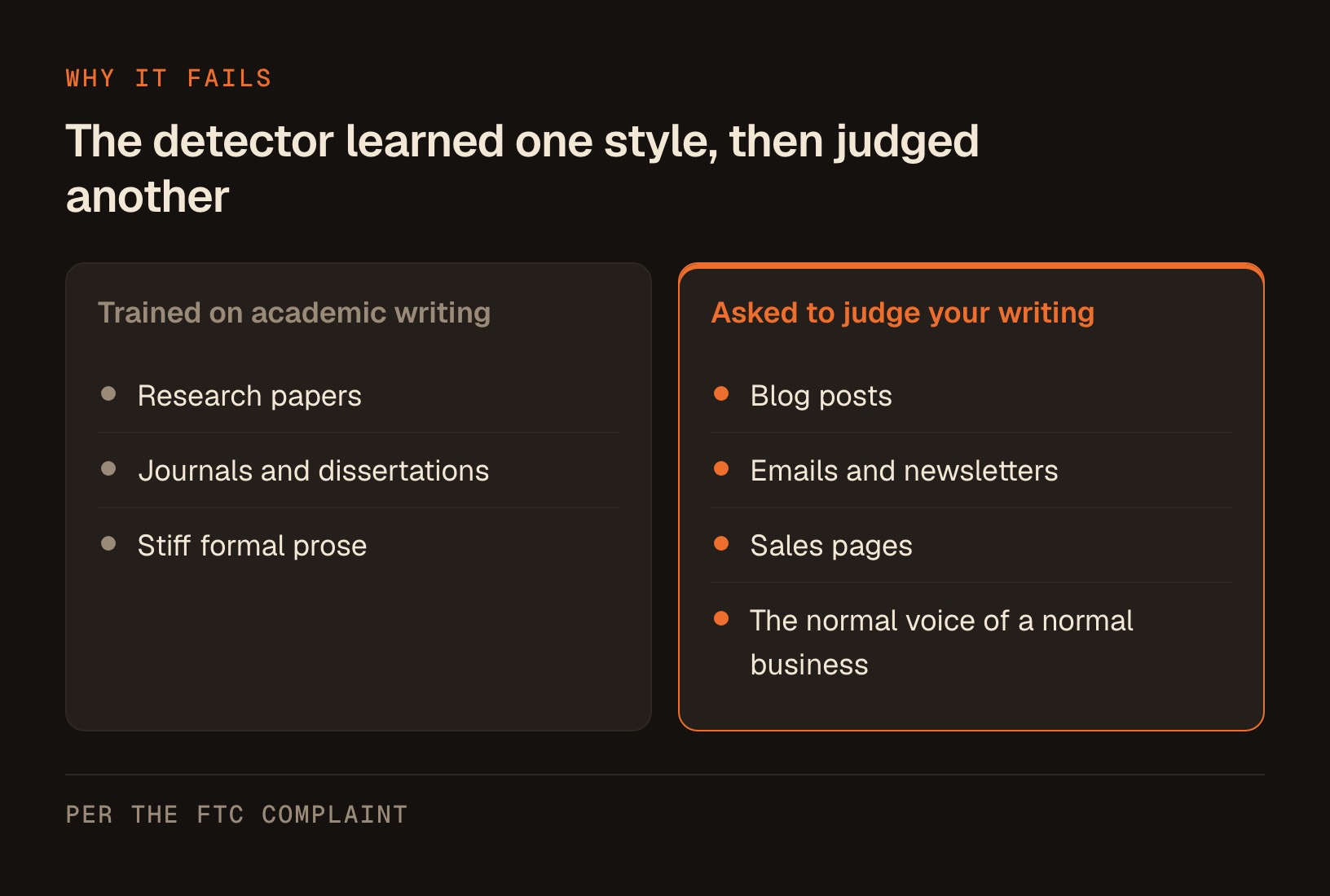
Then outside testers fed it the kind of writing you and I actually produce: blog posts, emails, sales pages, newsletters, the normal voice of a normal business. The measured accuracy collapsed.
A detector trained on one narrow style cannot judge the rest of the world's writing. That is the fundamental shape of the problem, and it shows up in every tool built this way.
These tools learn what "AI-ish" looks like from one pile of text, then get pointed at your completely different pile of text and asked to render a verdict with total confidence. The confidence is the marketing. The verdict is closer to a guess.
And here's the part that should genuinely relax you: the errors run in both directions. A tool that's wrong roughly half the time doesn't just miss AI writing. It also flags human writing as AI. If a machine can't reliably tell that a human wrote something a human wrote, its opinion about your work is worth exactly what you paid to hear it.
Plenty of people who never touched a chatbot have watched a detector accuse their own words.
What the FTC order actually forces the company to do
I want to be precise here, because the details matter and because I am not a lawyer (this isn't legal advice, and if you have a real legal question, check with your own attorney). Here's what the order shuts down, and what it deliberately leaves alone.
| What the FTC order shuts down | What is still allowed |
|---|---|
| Effectiveness claims about its detection products when the claim is misleading or has no "competent and reliable evidence" behind it at the moment it's made | Selling and running an AI detection product at all |
| Asserting an accuracy number and then discarding the proof, since it has to retain the evidence supporting any efficacy claim | Advertising accuracy that's documented and held on file |
| Going quiet with the people affected, since it has to email eligible consumers about the settlement | Ordinary marketing that doesn't overstate what the tool does |
| Self-policing on the honour system, since it has to file compliance reports for 4 years: one year after the order, then every year for the following 3 | Continuing to operate the business while it reports in |
Workado has to keep the evidence behind every accuracy claim it makes and file compliance reports for 4 years.
Notice what survived. The regulator left AI detection itself alone, so the tools can still exist and still be sold. What it stopped was promising an accuracy number nobody can prove.
Read the marketing on any detector you're tempted to pay for and ask the one question the FTC essentially asked: where is the competent and reliable evidence for that accuracy percentage? If it's a big number on a landing page with nothing behind it, you already know how much to trust it.
Write the cleanest version and let it stand
Here's the quiet cost of AI detectors that nobody puts a price tag on, and it's the one that actually hurt me before I understood any of this. Forget the subscription fee for a second. The real damage is what the fear does to your writing.
When you're scared of a detector, you start writing for the machine instead of the human. You avoid clean, confident sentences because they feel "too AI." You sprinkle in weird typos on purpose. You bloat your paragraphs with filler because someone told you short punchy prose gets flagged.
There's an entire cottage industry of "humanizer" tools that exist to rough up your writing until a different broken tool approves of it. You end up paying 2 machines to argue about your voice while your actual reader gets a worse piece of writing.
I did a version of this. I'd write something clear, then second-guess it, then muddy it up. And the whole time, the tool I was afraid of was, per a federal regulator, about as reliable as a coin. I was degrading real work to satisfy a fake authority.
Here's the swap, line by line.
| What fear makes you do | What the reader actually wants | Why it matters |
|---|---|---|
| Sprinkle in deliberate typos | Copy that's clean enough to trust with money | Typos read as careless, not human, and carelessness is the one thing a paying client notices |
| Bloat paragraphs with filler | The answer in the fewest words that still land | Filler is the fastest way to lose a busy reader who's skimming on a phone |
| Avoid clean, confident sentences | A clear position they can act on today | Hedged writing makes you sound unsure of your own advice, which is the opposite of expertise |
| Run the draft through a "humanizer" | Your actual voice, quirks included | You're degrading finished work to satisfy a tool a regulator already called unreliable |
Write for the human on the other end. Your reader is a person who wants their problem solved, their question answered, their time respected. That's the only judge whose opinion pays your bills.
Detectors versus what actually proves your work is yours
If a client or an editor ever needs assurance that you stand behind your work, a detector score is the weakest possible evidence you could offer. Here's how the options actually stack up.
| What you could rely on | How trustworthy is it | What it actually proves |
|---|---|---|
| An AI detector score | A US regulator called one "no better than a coin toss" at 53% on general content | Almost nothing about who wrote a specific piece |
| A "humanizer" tool | A second unproven tool built to fool the first unproven tool | Nothing, and it usually makes the writing worse |
| Your draft history and version timeline | High. It's a real record with timestamps | That the work was built over time, by you |
| Your process and your voice | High. You can explain choices no tool can | That you understand and stand behind the work |
| Named sources and real receipts | High. Anyone can check them | That the facts are true, which is what usually matters |
The bottom 3 rows are things you already own or can produce in minutes. The top 2 are things you pay for that prove nothing, which is the entire argument for keeping your money.
Build the receipt before you need it
Everyone says "keep your draft history" and almost nobody says how. Here's the whole thing, and it takes about 5 minutes to set up once.
1. Draft in Google Docs or Word so the timeline builds itself. Both save a timestamped version history automatically, for free, with nothing to turn on. In Google Docs it's File, then Version history, then See version history. In Word it's File, then Info, then Version History (for files stored in OneDrive or SharePoint). Paste your first rough pass in there and keep editing in the same document instead of starting fresh files.
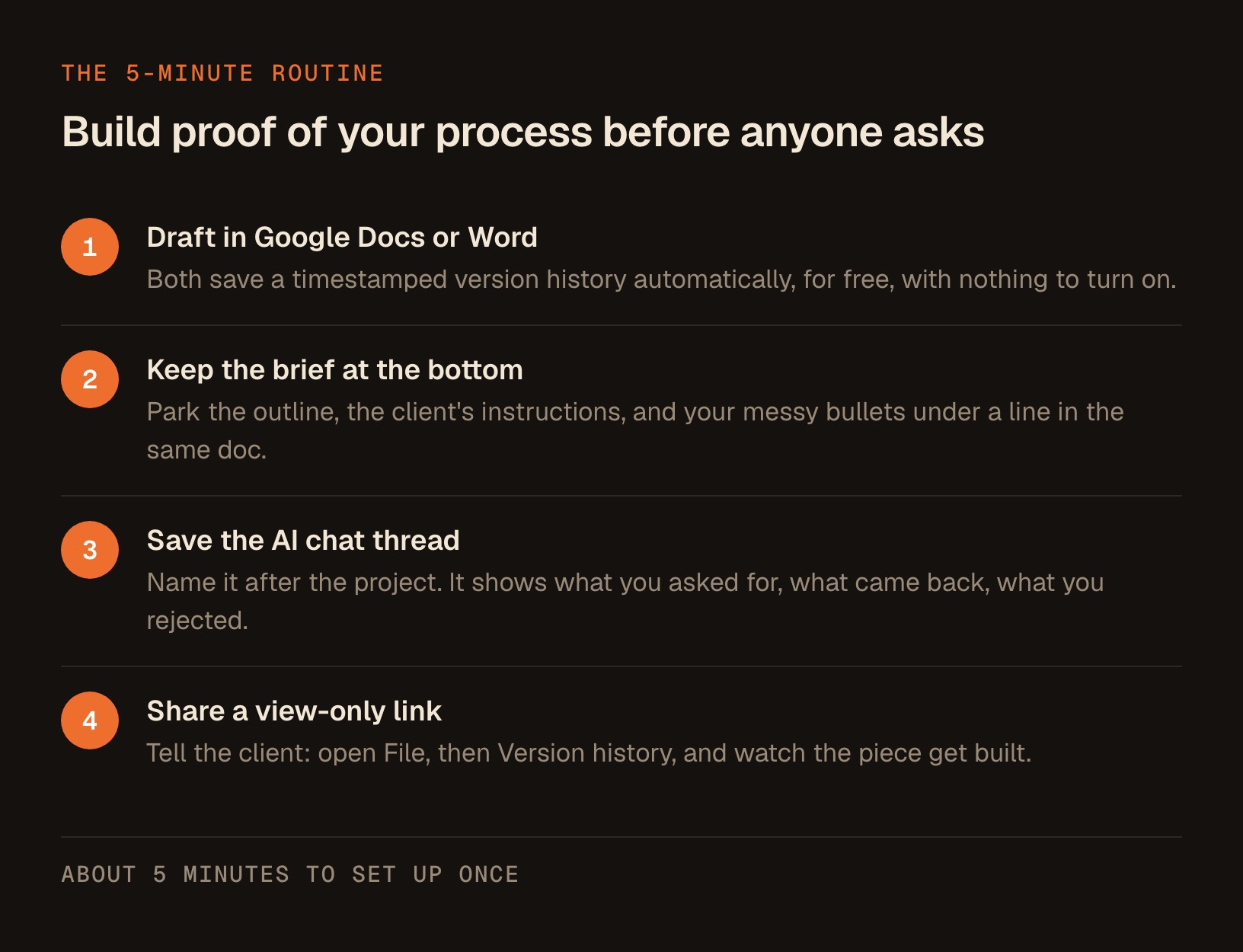
2. Keep the brief at the bottom of the same doc. Don't delete the outline, the client's original instructions, or the messy bullet list you started from. Drop a horizontal line at the end of the document and park all of it underneath. It costs you nothing and it turns the doc into a record of where the piece came from.
3. Save the AI chat thread. Name the conversation after the project so you can find it later, and export or copy the thread into the same doc if you want everything in one place. That thread is the prompt-and-edit trail: it shows what you asked for, what came back, and what you rejected.
How to share it if you ever need to. Send the client a view-only link to the document and tell them plainly: open File, then Version history, and watch the piece get built. You're not asking them to take your word for anything, which is exactly why it works.
If your process lives in a messy chat thread and you don't want to hand that over raw, this prompt turns it into something presentable.
You're turning my messy AI chat thread and my final draft into a clean, one-page "process summary" I can attach to a client reply.

Here is the chat thread where I worked on this piece:
[paste the full thread, or the key parts of it]

Here is the final draft that shipped:
[paste the final piece]

Produce a one-page summary with these sections:
1. Starting point: the brief, outline, or question I began with, in 2-3 lines
2. How the draft evolved: 4-6 bullets covering the biggest changes from first pass to final, in plain language
3. What I changed and why: the specific places where I overrode the AI, rewrote a section, cut something, or corrected a fact, with a one-line reason for each
4. Sources and facts checked: every claim in the final piece that rests on an outside source, and what that source is
5. What is mine: a short, factual paragraph on the judgment calls, examples, and opinions in this piece that came from me

Rules: plain language a non-technical client can read in two minutes. No marketing tone, no defensiveness, no apologising. If something isn't in the material I gave you, leave it out rather than guessing.
Build this once on your next project and the scary email stops being scary, because the answer is already sitting in a folder.
The exact playbook when a client accuses you
This is the scenario that keeps solo creators up at night, so let me give you a calm, specific script. A client emails: "I ran your article through a detector and it says this is 90% AI. What's going on?" Here's how I'd handle it, in order.
First, stay warm and ask one question. Don't get defensive, and don't confess to anything. Just ask which detector they used. The moment you know the tool's name, you know how much its verdict is worth.
Second, show your work. This is why you keep drafts. Send the view-only link, point them at Version history, and walk them through the outline you started from and the revisions that followed. Here's where this started, here's how it changed, here's the note where I reworked the middle section. Real process beats a fake score every time.
Third, cite the FTC, gently. You don't need to lecture anyone. You can simply say that a US federal regulator, the Federal Trade Commission, found a popular AI detector performed no better than a coin toss, and that detectors are known to flag human writing as AI. Most clients have never heard this, and it reframes the whole thing.
Here's the same 3 steps in a form you can screenshot and keep.
| Step | What you say | What it does to the conversation |
|---|---|---|
| 1. Ask which detector | "Happy to walk you through it. Which detector flagged it, out of curiosity?" | Shifts it from "prove you're innocent" to "let's look at the evidence together" |
| 2. Show your work | "Here's a view-only link to the working doc. Open File, then Version history, and you can watch it get built." | Replaces a bare score with a timestamped record only you can produce |
| 3. Cite the FTC, gently | "For what it's worth, the FTC found a popular detector performed no better than a coin toss, and these tools flag human writing as AI too." | Makes you the most informed person in the thread, with no lecture attached |
A detector produces a number with no story behind it. You can produce the whole story. Here's a prompt you can paste into Claude (the desktop app) to get a ready-to-send reply tailored to your exact situation. Fill in the 2 brackets and let it draft in your voice.
You're helping me write a calm, warm, confident reply to a client who accused my work of being AI-generated because an online "AI detector" tool flagged it.

Context:
- What I actually did: [describe how you wrote it, e.g. "I used AI to help draft and then heavily edited in my own voice" or "I wrote this entirely myself"]
- My relationship with the client: [e.g. "long-term, friendly" or "brand new, first project"]

Write a short reply (under 150 words) that:
1. Stays warm and non-defensive, never apologizes for using good tools
2. Asks which detector they used
3. Offers to share my draft history and version timeline as proof of process
4. Mentions, briefly and factually, that the US Federal Trade Commission found a popular AI detector performed "no better than a coin toss," with real-world accuracy around 53% on general writing, and that these tools are known to flag human writing as AI too
5. Redirects to what actually matters: whether the work is accurate, useful, and does the job

Use contractions. No em-dashes. Sound like a confident professional, not a nervous freelancer. Give me two versions: one for a warm relationship and one for a brand-new client.
That prompt does the emotional labor for you. The goal is to sound like the informed professional you are.
One caveat on institutions. If the accuser is a university academic integrity board, a school, or a platform enforcing an automated policy, this is a different conversation, because there's often no warm negotiation available and the process runs on its own rails. Your draft history is still the single strongest thing you can put in front of them, so produce it early and completely rather than arguing about the tool. And if a contract, a course policy, or a platform rule requires human-only work, that's a rule to follow, not a detector to argue with.
What honesty actually looks like
I want to be careful not to swing too far. "Detectors are unreliable" is not a license to lie about your work. If a client's contract says human-written only, then you follow the contract. Being able to prove your process cuts both ways: it protects you when the work really is yours, and it should keep you honest when you're tempted not to be.
For most of us, the physical question of who typed each word barely matters. The real question is whether the work is true, useful, and yours. Did you check the facts? Do you understand every claim well enough to defend it? Does it actually solve the reader's problem?
Those are the standards that matter, and no detector measures a single one of them. I use AI to draft, and then I own every sentence that ships. That ownership is the thing I can defend in any room.
Some of this fear is really impostor syndrome wearing a lab coat. You worry the detector will "expose" you, as if using a powerful tool well is cheating. A detector can't detect judgment, which is exactly why it can't detect the thing that makes your work worth paying for.
The stance that ends the worry for good
So here's where I've landed, and where I'd suggest you land too:
- Cancel the detector subscription if you have one, because you're paying for a coin toss with a confident user interface.
- Delete the humanizer tools, because they degrade your writing to fool a tool that's already broken.
- Set up the version history today, using the five-minute routine above, because that's the only evidence that actually holds up.
- Write like a human writing for humans, because that's the audience that pays.
The fear was really about not having a clear answer ready. Now you have one, and it's backed by a unanimous 3-0 decision from a federal regulator. When someone waves a number at you, you know what the number is worth, you know how to show your real work, and you know how to say all of it without breaking a sweat.
Every finished AI workflow I build for my own business, including the writing and client-reply systems I lean on daily, lives inside The Solo Creators AI Studio, and I'm reachable there directly if you get stuck on a situation like this. That's the soft pitch and the whole pitch. Mostly I just want you to stop being afraid of a coin.
Key takeaways
- A US federal regulator, the FTC, found a popular AI detector (Workado's) performed "no better than a coin toss," with real-world accuracy of just 53 percent on general writing versus the 98 percent it advertised.
- The core failure: the detector was trained only on academic writing, so it can't reliably judge the blog posts, emails, and sales pages you actually write. Its errors run both ways, flagging human writing as AI too.
- The FTC order was unanimous (3-0) and forces the company to hold evidence for its accuracy claims and report compliance for four years. The lesson: confident accuracy numbers with nothing behind them are the problem.
- Build the receipt before you need it. Draft in Google Docs or Word so version history saves itself, keep the original brief at the bottom of the same doc, and save the AI chat thread as your prompt-and-edit trail.
- If a client accuses you: stay warm, ask which detector they used, send a view-only link and point them at Version history, and cite the FTC's coin-toss finding. Institutional cases run on their own rails, so lead with the evidence there.
- Detector unreliability isn't a license to lie. Follow your contracts, check your facts, and own every sentence you ship. That ownership is what you can actually defend.
Get this skill, and every one I build.
30-day money-back guarantee. Cancel anytime.
Questions people ask
Can AI detectors really tell if my writing was made with AI?
Why do AI detectors flag writing that a human actually wrote?
How do I actually keep a draft history I can show a client?
What should I do if a client says my work was flagged as AI?
Should I use a "humanizer" tool to avoid getting flagged?
Is it dishonest to use AI to write my content?
Did the FTC ban AI detectors?

Ronnie spent 18 years building a SaaS with a team of 20 that served over 650,000 customers, generated over $14M in sales, and sent over 550M emails. Now he's solo, solving real business bottlenecks and turning them into working AI skills, workflows, and automations. He teaches all of it, with direct access to him, inside the Solo Creators AI Studio Skool community. See what he's built →
 Michael HattawayFounder, Iron Strengthens Iron
Keep reading