How should I price my work when AI makes me faster?
It depends on whether the result is knowable up front. If it is, quote a fixed price for the outcome before you start, so the speed gain stays with you. Billing by the hour while AI makes you 4x faster is roughly a 75 percent pay cut. Value sets your ceiling, and your old invoice for the same job sets your floor. Name the scope and the revision rounds in every quote. Keep hourly or a retainer only for truly open-ended work.
Do This Arithmetic Once and You'll Never Bill Hourly Again
Last month I watched a friend who does financial plans finish a deliverable in about an hour that used to eat most of her week. She was thrilled for one afternoon, then went quiet.
She bills by the hour. She had just figured out that getting good at AI, on her current pricing, means billing her clients less and less for work that keeps getting better.
That's the trap almost nobody warns you about, and it's pure arithmetic. So let's do the arithmetic, then fix the pricing.
Let's start with the simplest possible example and no fancy numbers. Say you charge 150 dollars an hour. A client project takes you 8 hours, so you invoice 1,200 dollars. Fair work, fair pay, everybody's happy.
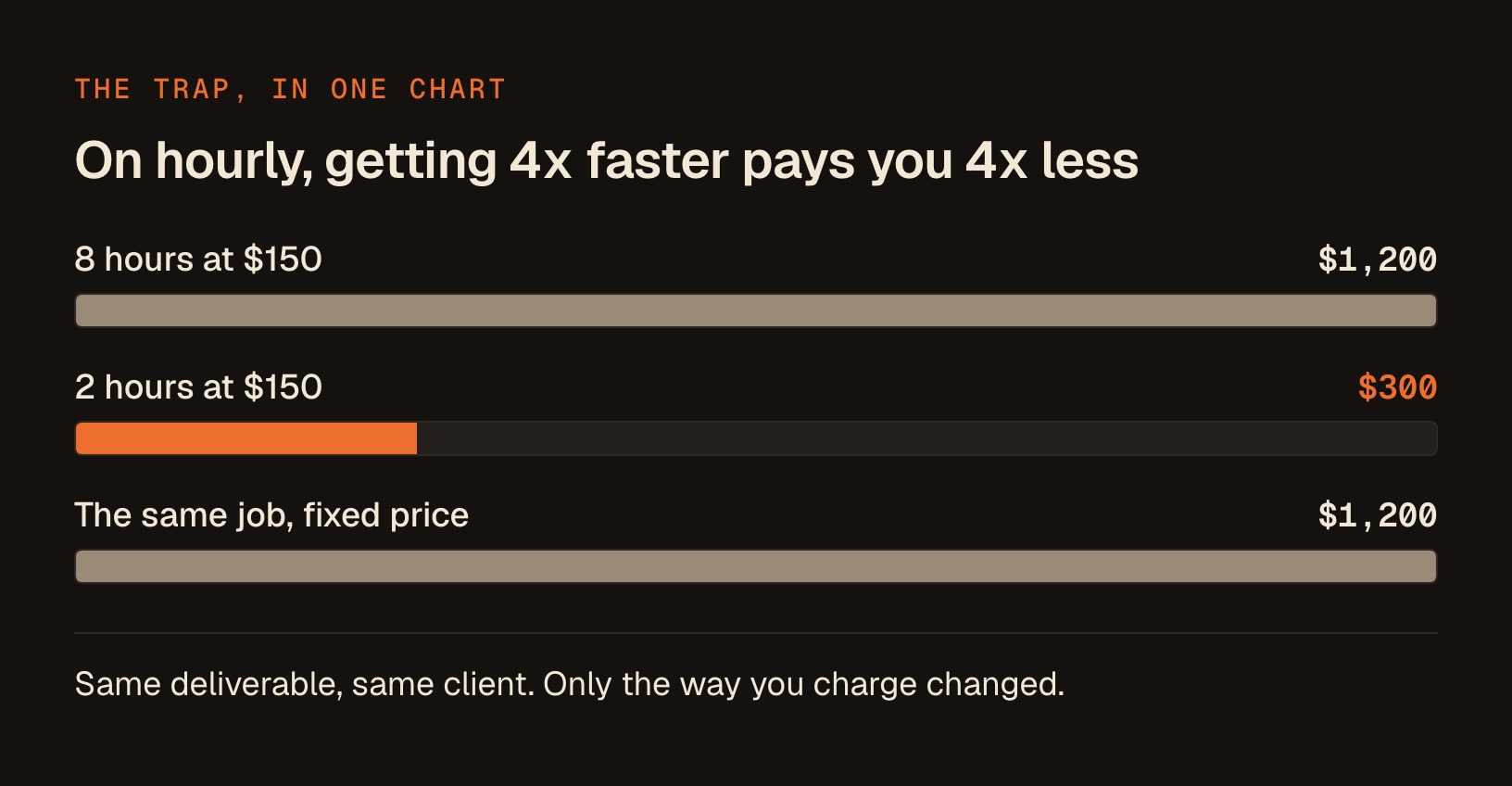
Now you get good with AI. The research, the first draft, the formatting, the tedious rework: the parts that used to eat most of that day now take a fraction of the time. The same project takes you 2 hours. At 150 an hour, you invoice 300 dollars.
8 hours at 150 dollars invoiced 1,200. The same project in 2 hours invoices 300. That's a 75 percent pay cut for doing better work faster.
The client got the same result, or a better one, sooner. And your reward for building a valuable skill was to earn a quarter of what you used to.
This is what hourly billing does the moment your speed changes. The hour is the unit you sell, so when you need fewer hours to hit the same outcome, you've quietly agreed to sell less. The better you get, the less you make, and no hourly consultant designed that on purpose.
The instinct is to hide the efficiency. Pad the timesheet, stretch the 2 hours back into 8, pretend nothing changed.
I understand the temptation, and I'd tell you to stay far away from it. It's dishonest, it's stressful to maintain, and it caps you at the exact ceiling AI was supposed to lift. There's a cleaner way out, and it starts with changing what you sell.
Why Billing More Per Hour Quietly Fails
The first fix people reach for is obvious: if I'm 4 times faster, I'll just charge 4 times more per hour. 2 hours at 600 dollars an hour, back to 1,200, problem solved.
It works on a spreadsheet. It falls apart in a sales conversation. Your rate is a number your client has already anchored to. They know what 150 an hour feels like.
When you say 600, you're triggering a negotiation rather than describing your new speed, because the client has no idea what a "fair" hourly rate for an AI-assisted consultant even is. Nobody does yet. You're asking them to accept a 4x rate hike on faith.
There's a deeper issue. The hourly frame trains your client to watch the clock instead of the result. Every hour you bill is an hour they're mentally auditing.
When the work takes 2 hours, a sharp client thinks, "Wait, that was fast, why am I paying so much?" The hourly frame keeps them fixated on your speed instead of your value.
And speed is the one thing you can no longer charge a premium for, because the tool is doing it and the tool is getting cheaper.
You can push your rate up somewhat, and you probably should. But rate alone leaves you defending a number your client can't benchmark, on a unit that's actively shrinking. The stronger move is to stop selling the unit that's shrinking.
Price the Outcome Your Client Actually Buys
Here's the reframe. Your client was never buying your hours. They were buying a result: a financial plan they can act on, a website that brings in leads, a course that's finally finished, a marketing campaign that lands. The hours were just how you happened to measure the invoice.
Charge for the outcome, and the clock stops mattering. If a complete financial plan is worth 1,500 dollars to your client, it's worth 1,500 whether it took you a week by hand or ninety minutes with AI doing the heavy lifting.
The value lives in the result, in your judgment about what goes in it, in the years of experience that let you know it's right. None of that got cheaper when you got faster. Only the typing did.
I built and sold a SaaS business that generated over $14 million in revenue, and not one dollar of that was billed by the hour.
I've lived this personally. I built and sold a SaaS business that generated over $14 million in revenue, and not one dollar of that was billed by the hour. Everything I ship now, I build with AI.
If I charged for the hours the tool saves me, I'd be broke and confused. I charge for the thing at the end that works, because that's the only thing anyone was ever paying for.
The practical shift is smaller than it sounds. You quote a project price before you start, based on what the finished result is worth to that specific client. The price is locked before you begin the work, so how fast you deliver becomes your business, not theirs.
Deliver it in 2 hours instead of 8, and the extra 6 hours are yours to spend on the next client, or your kids, or a nap. That's the raise AI was supposed to give you, and outcome pricing is how you actually collect it.
So how do you find out what the result is worth? You ask. This is the conversation hourly billing let you skip, and it's the single highest-return skill in this whole shift. Book twenty minutes before you quote anything, and put these 4 questions on the table:
- What does solving this actually make you? Revenue, clients, funded retirements, hours back.
- What does it save you? Money, headcount, tools you'd otherwise pay for.
- What is it costing you right now while it stays broken?
- What happens if it's still broken 6 months from now?
Let them answer in their own numbers. You're not negotiating yet, you're finding out how big the problem is, and their answers become the paragraph you say out loud when you name your price.
Then set a floor so you don't talk yourself down. The fixed price should never land below what that job used to invoice at your old rate and your old duration. In the running example, 8 hours at 150 means the floor is 1,200 dollars, full stop, no matter how fast AI makes you.
Value sets the ceiling. Your old invoice sets the floor. Underpricing is the most common way people ruin their first outcome-priced quote, and this one rule prevents it.
Productize the Thing You Keep Repeating
Once you're pricing outcomes, you'll notice something. A lot of your work is the same shape over and over. The intake, the analysis, the structure of the deliverable, the way you present it. The client is different, the specifics are different, but the machine you run to get there barely changes.
That repeatable machine is a product waiting to happen. When AI does the middle of the process, the parts that stay the same become something you can package, name, price, and sell as a fixed thing.
Instead of "I consult, hourly," you offer "The 90-Day Advisor Plan, one price, delivered in a week." Same expertise, wrapped in a package the client can understand and say yes to without a negotiation about your rate.
Productizing does 3 things at once:
- It kills the rate conversation, because a named package has a price the way a product on a shelf has a price.
- It lets you improve the machine over time, so every client makes the next one faster and better.
- It lets you sell the same thing more than once without reinventing it, which is the only way a solo operator ever escapes the trap of earning strictly by the hour.
The repeat is the asset, and AI is what makes the repeat cheap to run. The first time you build the process, it's work. The tenth time, the AI carries most of it and you supply the judgment and the polish.
Your margin climbs on every delivery while your quality holds or improves. That's the compounding hourly billing could never give you, because an hour is an hour is an hour, forever.
You don't need to productize everything. Keep bespoke work for the strange, high-value problems where your brain is the whole point. Run your actual service list down this table and the answer usually falls out in a minute:
| Signal | Keep it bespoke | Package it |
|---|---|---|
| How many times you've run it | Once or twice, still figuring it out | 3 or 4 times in roughly the same shape |
| How predictable the deliverable is | You don't know what it looks like until you're in it | You could describe the finished thing before you start |
| Whether your brain is the whole point | The thinking IS the deliverable | Your brain sets the direction, the process does the rest |
| Whether AI can carry the middle | Every step needs your hands on it | Research, drafting, and formatting can be handed off |
| What the client is actually buying | Access to you on a hard problem | A specific result, on a date, at a price |
Fix the Price by Fixing the Scope
Here's the fear that keeps good consultants on hourly, and it's a fair one: if the price is fixed and the client keeps asking for more, you eat the difference. That's not an argument against fixed pricing. It's an argument for writing 3 guardrails into every quote you send.
Guardrail one: spell out what's included, and what isn't. List the deliverables by name, in plain language, with the format and the length. Then add a short "not included" line for the obvious neighbours: extra deliverables, new stakeholders, a rebuild after the client changes direction. The "not included" line does more work than the included one, because it's the thing you'll point at later.
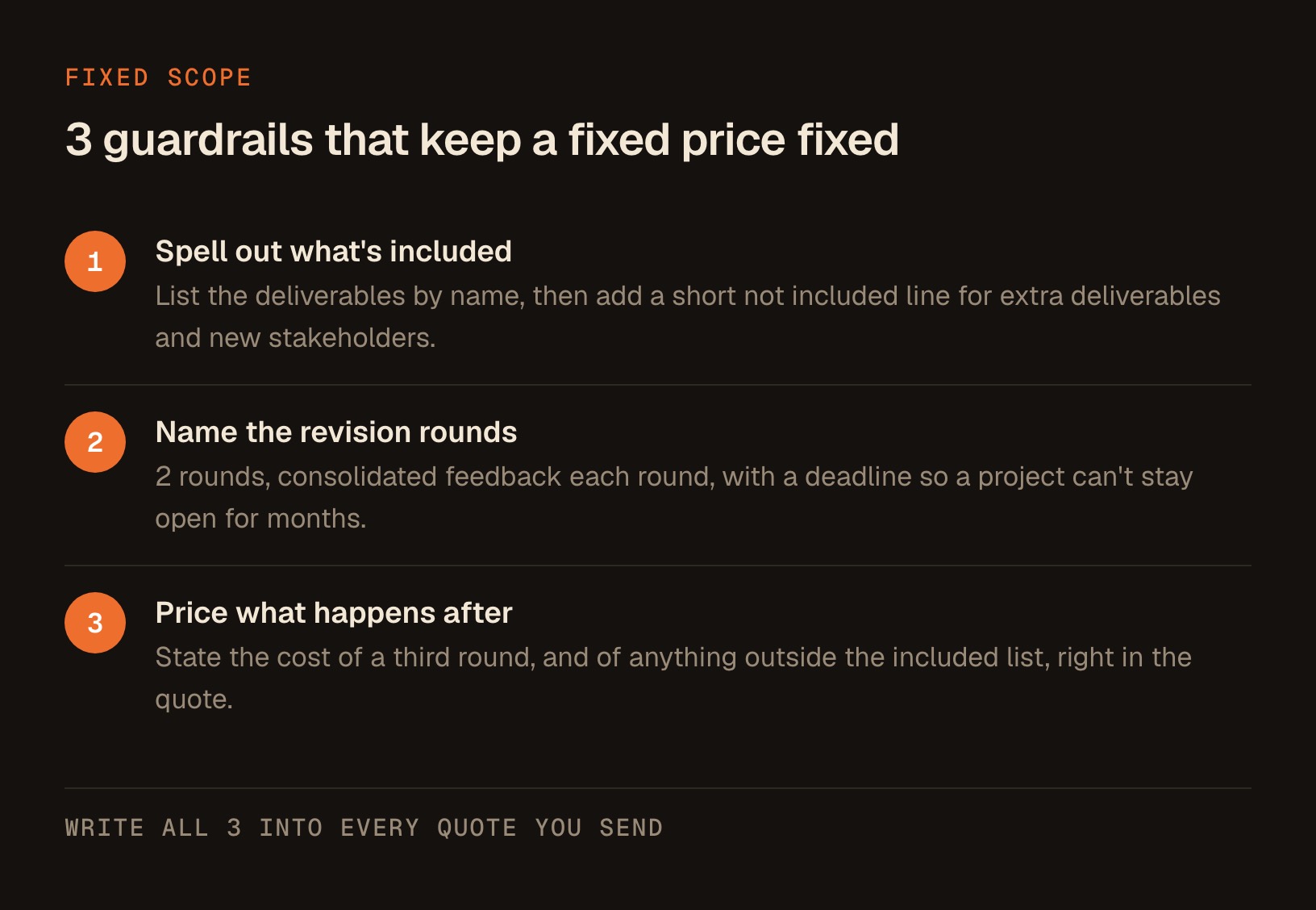
Guardrail 2: name the number of revision rounds. 2 is the normal answer, and 2 is enough for good work. Write it as "two rounds of revisions, consolidated feedback each round," because 10 separate emails from 4 people is a fourth round wearing a disguise. Give the rounds a deadline too, so a project can't stay open for months.
Write it as "two rounds of revisions, consolidated feedback each round," because 10 separate emails from 4 people is a fourth round wearing a disguise.
Guardrail 3: price what happens after that. State the cost of a third round, and the cost of anything outside the included list, right in the quote. A number written in advance turns an awkward conversation into an easy one, because you're reading from a document instead of improvising. Most clients never use it. The ones who do are happy to pay, because you told them the price before they asked.
What Nobody Says: Your Clients Are Getting Faster Too
Now the uncomfortable truth, the one most pricing advice conveniently leaves out. The same tools making you 4 times faster are landing on your client's desk too.
They can feel the ground moving. Some of them will start to wonder whether they need you at all, or at least whether they need you as much.
Pretending your client hasn't noticed is the fastest way to lose them. They've seen the demos. They've watched a chatbot draft something in seconds that used to take a specialist.
If you act like AI doesn't exist and quietly bill them the old way, you look like the last person in the room who hasn't figured it out. That's a bad look for someone selling expertise.
The move is to get ahead of it, out loud. Tell your client you use AI, that it's why you're faster and sharper, and that what they're paying you for is the part the tool can't do: knowing what good looks like, catching the thing that's wrong, taking responsibility for the result, applying years of scars to their specific situation.
There's a real division of labor here, and it's worth writing down because you'll want to say it to a client one day:
| What the tool does | What you do (and get paid for) |
|---|---|
| Produces the first draft | Decides what belongs in it |
| Works in seconds | Knows when the fast answer is the wrong one |
| Always sounds confident | Is right on purpose |
| Has no memory of this client | Applies years of scars to this situation |
| Cannot be held responsible | Signs off and carries the result |
Your job shifts toward judgment, editing, and accountability, and away from raw production. You're the one who signs off, and the signature is the value.
Price that, and most clients will pay it gladly, because the alternative is trusting a machine with no one standing behind it.
The clients you'll lose are the ones who only ever wanted the cheap, fast, commodity version. Let them go to the chatbot. The ones who want a result they can stake their business or their retirement on will pay more, not less, for a human they trust holding the tool. Your whole pricing job is to make sure you're clearly the second thing.
3 Ways to Charge, Side by Side
Here's how the 3 models stack up once AI is in the picture. Read down the "who captures the speed" row, because that's the column that decides your income.
| Hourly | Higher hourly rate | Outcome / productized | |
|---|---|---|---|
| What you sell | Your time | Your time, repriced | The finished result |
| Who captures the speed gain | The client | Split, awkwardly | You |
| The sales conversation | Clock-watching | Defending a big rate | What the result is worth |
| Effect of getting faster | You earn less | You earn the same | You earn more per hour of your life |
| Ceiling | Hours in a day | Hours in a day | How many results you can ship |
| Client's mental frame | Auditing your time | Suspicious of your rate | Buying a solution |
The pattern is hard to miss. Only outcome and productized pricing let you keep the gains AI hands you.
Everything on the left leaks your improvement straight back to the client or traps you in a rate fight. The question was never which model is nicer, it's which column pays you for getting better instead of punishing you for it.
The Copy-Paste Prompt to Reprice One Offer
Enough theory. Let's turn one of your current hourly services into an outcome-priced package right now. Open the Claude desktop app, paste this in, and fill in the brackets with your real situation. It's built to make you do the one thing hourly billing let you dodge: naming what the result is actually worth.
You are a pricing strategist helping a solo consultant move from hourly billing to outcome-based pricing.

Here is my situation:
- What I do: [describe your service in one plain sentence]
- One specific deliverable I sell: [e.g. a full financial plan, a 5-page website, a launch email sequence]
- What I currently charge: [your hourly rate] per hour, and this deliverable usually takes me about [X] hours
- How AI has changed my speed: [e.g. it now takes me about 2 hours instead of 8]
- Who my client is: [their role, their business, what's at stake for them]

Do four things for me:
1. Estimate what this finished result is actually WORTH to that client (the money it makes them, saves them, or the risk it removes). Show your reasoning.
2. Propose a single fixed project price for the deliverable, based on that value, and explain the number in one paragraph I could say out loud to a client.
3. Turn the deliverable into a named, packaged product: a name, a one-line promise, exactly what's included, and the turnaround time.
4. Give me three sentences I can use to tell the client I use AI, without making my expertise sound cheaper.

Ask me up to three clarifying questions first if you need them. Don't invent facts about my business.
Run it once, answer the clarifying questions honestly, and you'll walk out with a real package and a price you can defend. Run it again for your next service. You walk out with a price tied to the result instead of a number pulled from the air. That shift alone is worth more than any rate table I could hand you.
How to Talk About It Without Apologizing
One last thing, because the pricing only works if you can say it with a straight face. When you move a client from hourly to a package, some of them will ask why. Don't get defensive, and please don't apologize for being efficient.
Delivering faster is worth more to a busy client. You're getting them a better result sooner, with your name on it, and that deserves confident pricing.
Say it plainly: "I've moved to fixed project pricing so you know the cost up front and I'm rewarded for delivering quickly instead of dragging it out." Most people exhale with relief when they hear that, because the hourly model made them nervous too.
Sequencing matters as much as the script. New clients get the fixed price from day one, starting with your next proposal. Existing clients move at the next natural boundary: a renewal, a new project, a new fiscal or calendar year. And never re-price work that's already underway, because changing the terms mid-job is the one version of this that damages trust.
Here's the rest of what they'll ask, and what to say back:
| What the client says | What you say back |
|---|---|
| "Why the change from hourly?" | "Fixed project pricing means you know the cost up front, and I'm rewarded for delivering quickly instead of dragging it out." |
| "That only took you two hours." | "The price is for the finished result and my judgment about what goes in it. Getting it to you sooner is the part you benefit from most." |
| "Are you using AI on my work?" | "Yes, and it's why I'm faster and sharper. What you're paying me for is knowing what good looks like, catching what's wrong, and standing behind the result." |
| "Can you just bill hourly like before?" | "I've moved everything to fixed pricing so there are no surprise invoices. Here's exactly what's included, and what a change beyond that costs." |
Want the announcement written for you? Paste this into the Claude desktop app and fill in the brackets:
Draft a short, warm email telling an existing client I'm moving from hourly billing to fixed project pricing.

- My name and what I do for them: [your name, your service]
- Package name and what's included: [package name, deliverables, turnaround]
- What I used to charge: [old hourly rate], typically [X] hours per project
- How long we've worked together: [e.g. three years]
- When the change takes effect: [next renewal / next project / January]

Rules: no apologizing, no jargon, under 200 words, plain language, one clear next step. Frame the change as certainty for them, not a raise for me. Ask me a clarifying question if anything is missing.
If a legal or compliance wrinkle comes up around how you present AI-assisted work in a regulated field, get a straight answer from someone qualified. I'm not a lawyer, this isn't legal advice, and the rules differ by profession and region. Check with your own advisor before you put anything in a client contract.
Where This Goes Next
The bigger win is building the repeatable machines behind those packages, the actual AI skills that let you deliver a productized service in an afternoon instead of a week. That's the part that turns a new price into a new business.
Every finished skill I build for exactly that, the ones that take a repeatable piece of consulting work and let AI run the middle of it, lives in The Solo Creators AI Studio. If you want to see how a specific service of yours could become a package, that's also where you can reach me directly and ask.
Start by repricing one offer with the prompt above, and go from there.
Key takeaways
- If you bill by the hour and AI makes you 4x faster, you've handed yourself roughly a 75 percent pay cut for doing better work.
- Simply raising your hourly rate fails, because it starts a negotiation over a number your client can't benchmark and keeps them watching the clock.
- Clients never bought your hours, they bought a result. Price the outcome and quote it before you start, so the speed gain stays with you.
- Value sets the ceiling on your price, and your old invoice sets the floor. Never quote below what the job used to bill at your old rate and old duration.
- A fixed price only works with fixed scope. Every quote names what's included, how many revision rounds you get, and what anything beyond that costs.
- Package the work you repeat. Once a service has run a few times in the same shape, name it, fix the price, and sell it again without rebuilding it.
- Your clients are getting faster too, so say out loud that you use AI. What they pay for is your judgment and your accountability, the part the tool can't be responsible for.
- Move new clients to fixed pricing immediately and existing ones at the next renewal or project. Never re-price work already underway.
Get this skill, and every one I build.
30-day money-back guarantee. Cancel anytime.
Questions people ask
If AI makes me faster, shouldn't I just charge less and win more clients?
Won't clients feel cheated paying a project price when the work only took me two hours?
How do I figure out what my outcome is actually worth?
What stops the client from asking for endless revisions once the price is fixed?
Should I tell clients I use AI, or keep it quiet?
How do I move a long-term hourly client onto fixed pricing without losing them?
What if I'm in a regulated field like financial advice?
Is hourly billing ever still the right call?

Ronnie spent 18 years building a SaaS with a team of 20 that served over 650,000 customers, generated over $14M in sales, and sent over 550M emails. Now he's solo, solving real business bottlenecks and turning them into working AI skills, workflows, and automations. He teaches all of it, with direct access to him, inside the Solo Creators AI Studio Skool community. See what he's built →
 Michael HattawayFounder, Iron Strengthens Iron
Keep reading