What should I automate with AI, and what should I keep doing myself?
It depends on one question: if a client learned a machine did this part, would they feel served or cheated? Formatting, transcribing, repurposing, and admin earn a shrug, so automate them fully. The specific advice they hired you for stays human. Most of your week sits in the middle lane, where AI drafts and you decide. Keep a qualified human on anything with legal, financial, or medical stakes. Klarna and Duolingo both learned this the hard way in public.
Most advice about AI automation is a hype-man yelling "automate everything" or a skeptic yelling "automate nothing." Both are useless to a solo creator who has actual clients and an actual reputation.
The real question is which half of your business is safe to automate and which half is the thing people are paying you for. The amount you automate matters far less than getting that split right.
Get that line wrong in either direction and you either burn out doing robot work by hand, or you quietly delete the exact thing that made you worth hiring.
I ran a SaaS business for 18 years and served over 650,000 customers, so I've watched at scale which half of the work people actually care about. I'm solo now, I automate almost everything I do, and the line I'm about to draw is one I hold on purpose, not by accident.
2 companies just showed the cost of drawing it wrong. One quietly rebuilt the human help desk it had bragged about tearing down. The other watched its beloved social account take a hit the week it announced it was going "AI-first." Let me show you both, then hand you the table I use to get it right.
2 Companies Already Ran This Experiment in Public
Start with Klarna, the "buy now, pay later" giant. The company put out its own marketing claiming its AI assistant was doing the work of roughly 700 customer service agents. That figure came from Klarna itself, so treat it as a company talking up its own product, not an independent audit. It was the poster child for "AI replaced our support team."
Then the story turned. By 2025, according to a Forbes column by Gene Marks, Klarna was walking it back. CEO Sebastian Siemiatkowski admitted the aggressive cost-cutting had come at a price, conceding the company had leaned so hard on savings that service quality suffered.
Klarna started bringing human agents back into the loop, framed carefully as a blended "dual-track" approach rather than a full retreat. Read past the corporate language and the lesson is plain. They automated the part customers actually valued, felt the drop, and re-hired the humans to fix it.
Now Duolingo. In April 2025, CEO Luis von Ahn sent a memo declaring the company "AI-first." He wrote that one of their best recent decisions was replacing a slow, manual content process with an AI-powered one, and that the company would rather move fast and take, in his words, "occasional small hits on quality" than move slowly and miss the moment.
Internally, reasonable. Externally, it landed like a brick.
The backlash hit the one channel that made Duolingo famous. Duolingo's whole brand personality lived on social media, that unhinged green owl millions of people genuinely loved. When "AI-first" went public, the audience read it as "we're replacing the humans who made this fun," and the company pulled back its edgy social posts to cool the sentiment.
According to Customer Experience Dive, user growth slowed to 40% year over year, down from 60%, concentrated among younger US and Canadian users. Von Ahn later admitted the framing was the problem, saying he'd "said some stuff about AI" without giving enough context.
Luis von Ahn said Duolingo would rather move fast and take "occasional small hits on quality." Then user growth slowed to 40% year over year, down from 60%.
Put the 2 side by side and it's one story told twice.
| Company | What they automated (or signalled) | What it cost them | How they walked it back | The lesson for you |
|---|---|---|---|---|
| Klarna | Customer support, marketed as roughly 700 agents' worth of work (Klarna's own figure) | The CEO conceded service quality suffered under the cost-cutting | Brought human agents back in a blended, dual-track model | Don't automate the relationship |
| Duolingo | Signalled "AI-first" in an April 2025 internal memo that went public | Growth slowed to 40% year over year from 60%, plus backlash on its flagship social channel | Pulled back its edgy social posts; the CEO admitted the framing lacked context | Don't announce automation in a way that makes humans sound disposable |
Klarna automated the relationship (support) and had to undo it. Duolingo signaled it would automate the personality (its voice) and got mauled for it. In both cases the thing they treated as overhead was the thing customers were actually attached to.
That's the trap, and it's the one every solo creator walks into, because you're even closer to your customers than they are. The parts of your business that feel like overhead to you are often the exact parts your customers are paying for.
The One Question That Sorts Every Task You Do
Here's the question I ask about any task before I let AI near it:
"If a client found out a machine did this part, would they feel served or would they feel cheated?"
That single question does almost all the sorting. Nobody feels cheated that a machine formatted your invoice, resized your images, or drafted a first-pass outline.
People feel deeply cheated when the judgment they hired you for, the read on their specific situation, the "here's what I'd actually do if I were you," turns out to be a generic model output with their name pasted on top.
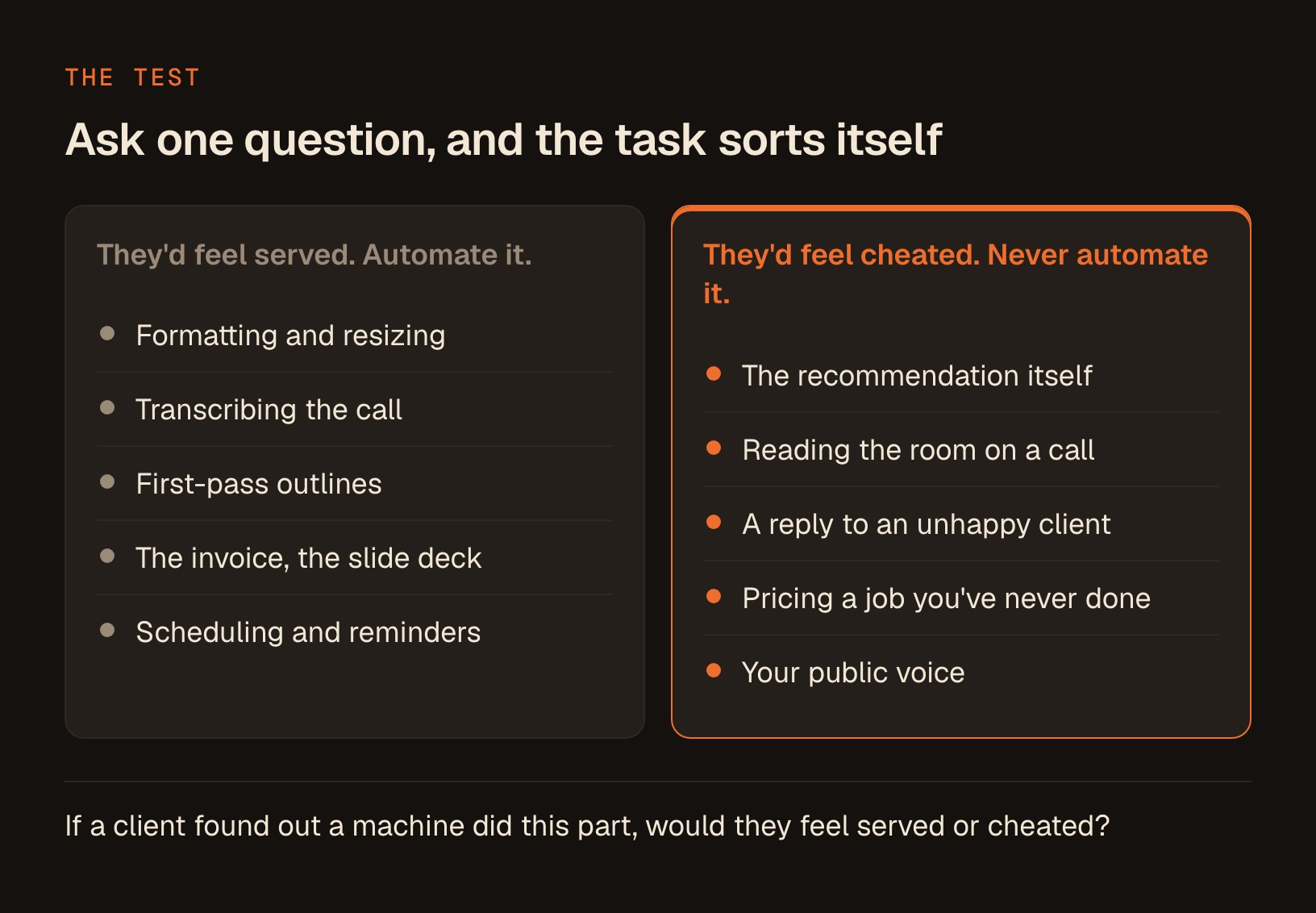
The PDF, the email, the slide deck, the session notes, those are packaging. Automate the packaging as hard as you want. Never automate the judgment, because the judgment is what they're buying, and the moment it's obviously automated, it's worth nothing.
This is why "the relationship is the product" isn't a soft slogan. For a solo creator it's a literal description of the asset on your balance sheet. You don't have a factory or a patent.
You have trust, and trust is manufactured one specific human moment at a time. For a coach, a consultant, an advisor, a course creator, the product isn't the deliverable, it's your judgment applied to their specific situation.
A Decision Table You Can Actually Use
Talk is cheap, so here's the table. I sort every recurring task into one of 3 lanes: hand it fully to AI, let AI draft it but you sign off, or keep your hands on it entirely. The columns are what matter.
| The task | Lane | Why it lands here |
|---|---|---|
| Formatting, resizing, transcribing, file cleanup | Automate fully | Zero judgment. Nobody bought your formatting. |
| First-draft outlines, summaries, repurposing one asset into many | Automate fully | Raw material you'll shape. The value is in your edit, not the draft. |
| Research and "find me everything on X" | Automate fully, then verify | Great at gathering, unreliable on facts. You confirm before it ships. |
| Scheduling, reminders, follow-up nudges | Automate fully | Logistics. Being on time is table stakes, not your edge. |
| A proposal or plan for a specific client | Draft, then you decide | AI structures it. The actual recommendation is yours. |
| Marketing copy in your voice | Draft, then you decide | Speed up the blank page. You own the final word and the taste. |
| The recommendation itself: what should this person do | Never hand off | This is the product. Full stop. |
| Reading the room on a call, a hard conversation, a judgment call | Never hand off | The relationship is the asset. |
| Anything with legal, financial, or medical stakes | Never hand off | High cost of being wrong. A human owns the call. |
| Your public voice and brand personality | Never hand off wholesale | Ask Duolingo. Automate the production, keep the soul. |
| The gray zone | Where the served-or-cheated test earns its keep | |
| A discovery-call follow-up | Draft, then you decide | AI can lay out what you heard. Whether you're the right fit for them is your call, and they can tell. |
| A testimonial request | Draft, then you decide | The ask can be templated. The specific thing you're thanking them for cannot. |
| A reply to an unhappy client | Never hand off | The apology is the product. If it reads generated, you've made the problem worse. |
| A LinkedIn comment on a peer's post | Draft, then you decide | Fine to have a starting point. Ship nothing you wouldn't have said out loud. |
| Pricing a job you've never done before | Never hand off | The number encodes your risk, your capacity, and your read on the client. |
Notice the middle lane does the heavy lifting. That lane is where solo creators win, because you get the speed of automation with your judgment stamped on the output. Most of your day is a draft a machine can start and only you can finish.
A quick honesty note. I'm not a lawyer and I won't pretend to be. For anything with legal, tax, medical, or compliance stakes, "never hand off" means a qualified human owns the decision, and if it's outside your expertise, that human is a licensed professional, not you and not your AI. This isn't legal advice. Check with your own advisor.
Find Your Own Product in 10 Minutes
You can't apply the table until you know which of your tasks are the product and which are packaging, and most people are fuzzy on that.
The 10 minutes is the listing. Write out everything you did for a client last week, in whatever order it comes to you, then let the prompt below do the sorting. Open the Claude desktop app, paste this in, and answer it.
I'm a solo [coach / consultant / advisor / course creator]. I want to figure out which parts of my work I can safely automate with AI and which parts ARE my product and must stay human.

Here is a list of everything I do in a typical week for a client:
[paste 10 to 20 tasks: calls, emails, proposals, content, admin, research, deliverables, follow-ups]

For each task, do three things:
1. Label it PACKAGING (the wrapper around the value) or JUDGMENT (the value itself, the specific read only I can give this person).
2. For anything you label JUDGMENT, explain in one sentence why a client would feel cheated if they learned a machine did it.
3. Sort every task into one of three lanes: "automate fully," "AI drafts, I decide," or "keep fully human."

Be blunt. If I'm treating my actual product as overhead, call it out. Then give me the single task I should automate FIRST for the biggest time win with zero risk to the relationship.
I've watched people discover that most of their week is packaging they've been doing by hand out of habit, and the actual product, the reason clients stay, is a small slice they could protect and even expand if they stopped hand-formatting PDFs. Read the JUDGMENT rows twice. Those rows are your business, and everything else is a candidate for automation this week.
Automate the Packaging Without Apology
Once you know what's packaging, go hard. This is where being solo becomes a superpower instead of a bottleneck, and it's most of what I do all day.
Turn one thing into 10. One recorded talk becomes a transcript, a set of emails, a carousel, and a batch of social posts. The ideas are yours. The machine just changes the container, and nobody feels cheated by that.
Kill the admin drag. Scheduling, reminders, follow-up sequences, file naming, resizing, first-pass research. None of it is why anyone hired you, and every minute you spend on it is a minute stolen from the judgment work that actually is your product.
One Client Call, End to End
Here's what that looks like on a single deliverable, so it stops being theory.
The call ends. The recording goes into a transcription tool and comes back as clean text a few minutes later, speaker-labelled, no typing on my part.
That transcript goes into Claude with a recap prompt. Out comes a structured summary, a list of what we agreed on, and 3 follow-up emails: one to the client, one to the person they want me to loop in, one scheduling the next session.
Then I do the part that's actually mine. I add the one insight I had at minute forty that never made it out of my mouth on the call. I rewrite the opening line so it sounds like a person who was in the room. I delete the recommendation the draft invented and replace it with the one I actually believe.
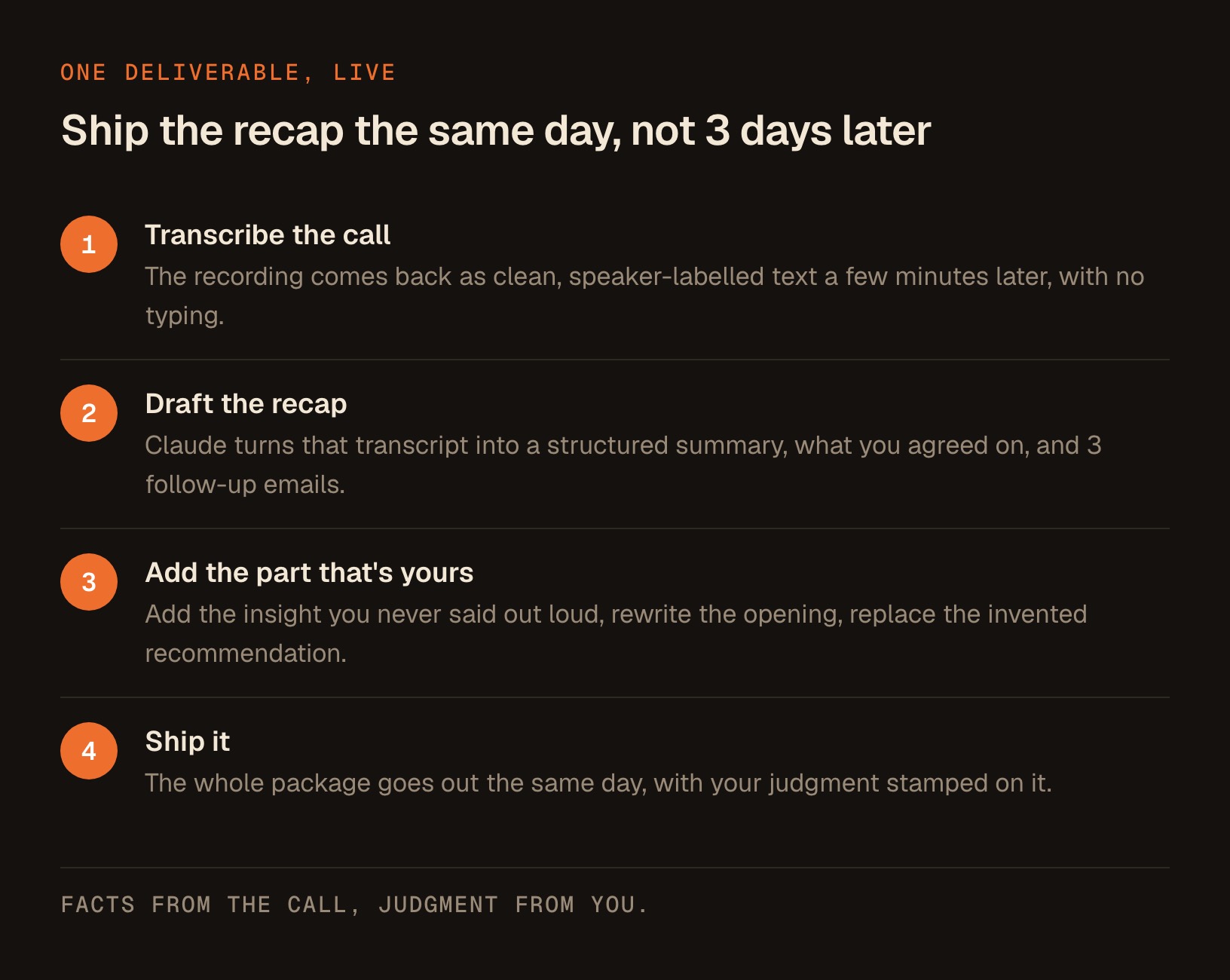
The whole package ships the same day instead of 3 days later. Every fact in it came from the call, and the judgment in it came from me. That's the split, running live.
Here's the prompt I use for the repurposing half. Paste your transcript in and it does the container-changing.
Below is the transcript of a talk I gave. I want to turn this one recording into a week of content, without changing what I actually said.

TRANSCRIPT:
[paste the full transcript]

Produce all of the following, in this order:

1. A cleaned-up version of the transcript: fillers and false starts removed, my phrasing kept.
2. Three emails to my list, each one built on a DIFFERENT idea from the talk. Short paragraphs, one clear takeaway each, one call to action at the end.
3. A 10-slide carousel outline: one line per slide, slide 1 is the hook, slide 10 is the call to action.
4. Five standalone social posts, each one a single point I made, written so it stands on its own without the talk.

Hard rules:
- Do not invent any fact, number, example, or story that isn't in the transcript.
- Where I made a claim without evidence, flag it in brackets instead of smoothing it over.
- Keep my words where my words were good. Don't upgrade my vocabulary.
- No em-dashes. Use contractions.

At the end, list every place you had to guess at my meaning so I can fix it.
Automating the packaging moves your hours to where the standards actually matter, and it keeps those standards fully intact.
"I used AI to turn our call into a clean summary" earns a nod. "I used AI to decide what you should do with your retirement account" earns a refund.
Keep the Human Where the Money Actually Is
Klarna's fix is the model to copy, and it's worth stealing directly. They didn't swing back to "humans do everything." They built a blend: let AI handle the volume, keep humans on the moments that carry the relationship.
Klarna marketed its AI assistant as doing the work of roughly 700 customer service agents, then brought humans back after CEO Sebastian Siemiatkowski conceded service quality suffered.
That dual-track shape is exactly right for a solo creator, because you can't afford to do everything by hand and you can't afford to automate the trust.
Here's the blend on the 5 things you probably ship most often.
| The deliverable | AI does | You do |
|---|---|---|
| Client monthly recap | Drafts the whole thing from your notes and the call | Add the one insight only you would've caught, then it ships with your fingerprints on it |
| Client plan | Pulls the research and lays out the options | Make the actual call about what this specific person should do |
| Newsletter | Writes the first version | Rewrite the opening so it sounds like a human who was actually there |
| Proposal | Structures the scope, the sections, the timeline | Set the price and the promise, and decide whether you even want the job |
| Social content | Turns one idea into 10 containers | Keep the voice, kill anything that sounds like a brand instead of you |
What to Say When a Client Asks If You Used AI
Sooner or later someone asks you directly, and the answer decides whether the whole thing holds. Don't dodge and don't overshare. Name which half the tool touched, then name the half that was you.
For packaging, steal this line:
"I ran our call through a tool that cleans up the transcript, then I wrote the recap myself."
For judgment, steal this one:
"The recommendation is mine. I use AI to get the research in front of me faster, not to decide what you should do."
Both answers are honest, both take about 4 seconds, and both leave the client more confident than they were before they asked. That's the tell that you drew the line in the right place.
And learn Duolingo's lesson on messaging while you're at it: never make your audience feel like the humans are disposable. You can automate a huge amount of your production quietly and nobody minds.
Announce "I'm going AI-first" in a way that reads as "the person you liked is being replaced," and you'll pay for it in exactly the currency you can least afford, which is trust.
Keep the Half That Makes You Worth Hiring
The companies with hundreds of millions of dollars got this wrong first, which is a gift, because they paid for the lesson and you get to keep the receipt.
Run the audit prompt this week, protect the JUDGMENT rows, and hand the rest to a machine without apologizing to anyone.
Every AI skill I build lives in the Solo Creators AI Studio, and every one of them is designed around this exact line: they crush the packaging so you can spend your hours on the judgment only you can give.
If you want to see how I draw that boundary in practice, or you just want a straight answer from a human who does this all day, you can find the whole thing (and a direct line to me) at the Solo Creators AI Studio. No hard sell. Come see the work.
Key takeaways
- Automate the packaging around your work (formatting, repurposing, admin, first drafts). Never automate the judgment, because for a solo creator the judgment is the product.
- Klarna leaned so hard on AI support that service quality suffered, then brought human agents back in a blended, dual-track model. The 700-agents figure was Klarna's own marketing, not an independent audit.
- Duolingo's April 2025 'AI-first' memo sparked a consumer backlash and the company pulled back its social posts. User growth slowed to 40% year over year, down from 60%. The framing, not the productivity, was the mistake.
- Ask one question of every task: if a client learned a machine did this part, would they feel served or cheated? That sorts almost everything.
- Most of your week lives in the middle lane: AI drafts it, you decide. That's where you get automation's speed with your judgment stamped on the output.
- When a client asks if you used AI, name which half it touched. 'I ran our call through a tool that cleans up the transcript, then I wrote the recap myself' keeps the trust intact.
- Never announce automation in a way that tells your audience the humans they liked are disposable. Automate the work quietly, protect the relationship loudly.
- Anything with legal, financial, or medical stakes stays with a qualified human. This isn't legal advice; check with your own advisor.
Get this skill, and every one I build.
30-day money-back guarantee. Cancel anytime.
Questions people ask
What should you not automate with AI in your business?
How do I know if a task is safe to automate?
What do I say when a client asks if I used AI?
What actually happened with Klarna and its AI support?
Why did Duolingo get backlash for going 'AI-first'?
Can I automate my marketing and social content?
Isn't keeping things human just slower and less scalable?

Ronnie spent 18 years building a SaaS with a team of 20 that served over 650,000 customers, generated over $14M in sales, and sent over 550M emails. Now he's solo, solving real business bottlenecks and turning them into working AI skills, workflows, and automations. He teaches all of it, with direct access to him, inside the Solo Creators AI Studio Skool community. See what he's built →
 Michael HattawayFounder, Iron Strengthens Iron
Keep reading