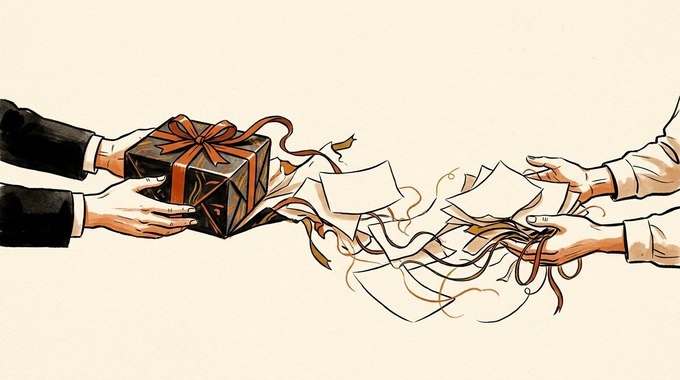
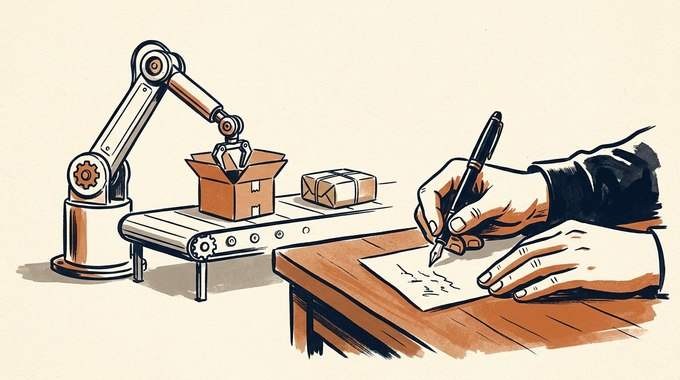
Which work should I hand to AI, and which should I keep doing myself?
It depends on one question: is this a decision or a delivery? Decisions stay with you: the diagnosis, your argument, what to recommend, and what to cut. Deliveries go to the machine: drafting from your notes, reformatting one idea into an email and a post, proofreading, transcribing. Do your thinking first in messy form, then let AI package it with a rule that it can't add conclusions you didn't write. If you don't have a view yet, have AI interview you instead of answering for you.
A study came out of MIT's Media Lab last year, and within a week it had been flattened into a hundred scary headlines about AI melting your brain.
The actual research is quieter and, if you run a solo business, more useful than the panic. Researchers put EEG caps on 54 people and had them write essays: some with an AI chatbot, some with a search engine, some with nothing but their own head.
The people leaning on the chatbot showed the weakest brain connectivity and felt the least ownership over what they'd written. That second part is the one worth sitting with, because your ability to stand behind your own work in a room is the whole job.
I build my entire business with AI. One of the skills I built with it ended up bundled into a WordPress plugin that runs on more than 250,000 sites. So I'm not here to tell you to close the laptop and think harder like it's 1995.
I'm here because there's a real line inside this work, and the people who find it early are going to run circles around the people who never looked for it.
Let me walk through what the study actually says, why your judgment is the thing clients are paying for in the first place, and then give you the specific split I use: what to hand to AI every single day, and what to keep with both hands.
See What the MIT Brain Study Really Said, and What It Didn't
Here's the honest version, because the honest version is more helpful than the headline.
The paper is a MIT Media Lab preprint called Your Brain on ChatGPT, and you can read the whole thing yourself.
Researchers ran an experiment with 54 participants, splitting them into 3 groups for an essay-writing task. One group used a large language model (a chatbot like ChatGPT or Claude). One group used a regular search engine. One group used no tools at all, just their own brain.
Everyone wore an EEG cap that measures electrical activity across the brain, and the study ran over several sessions.
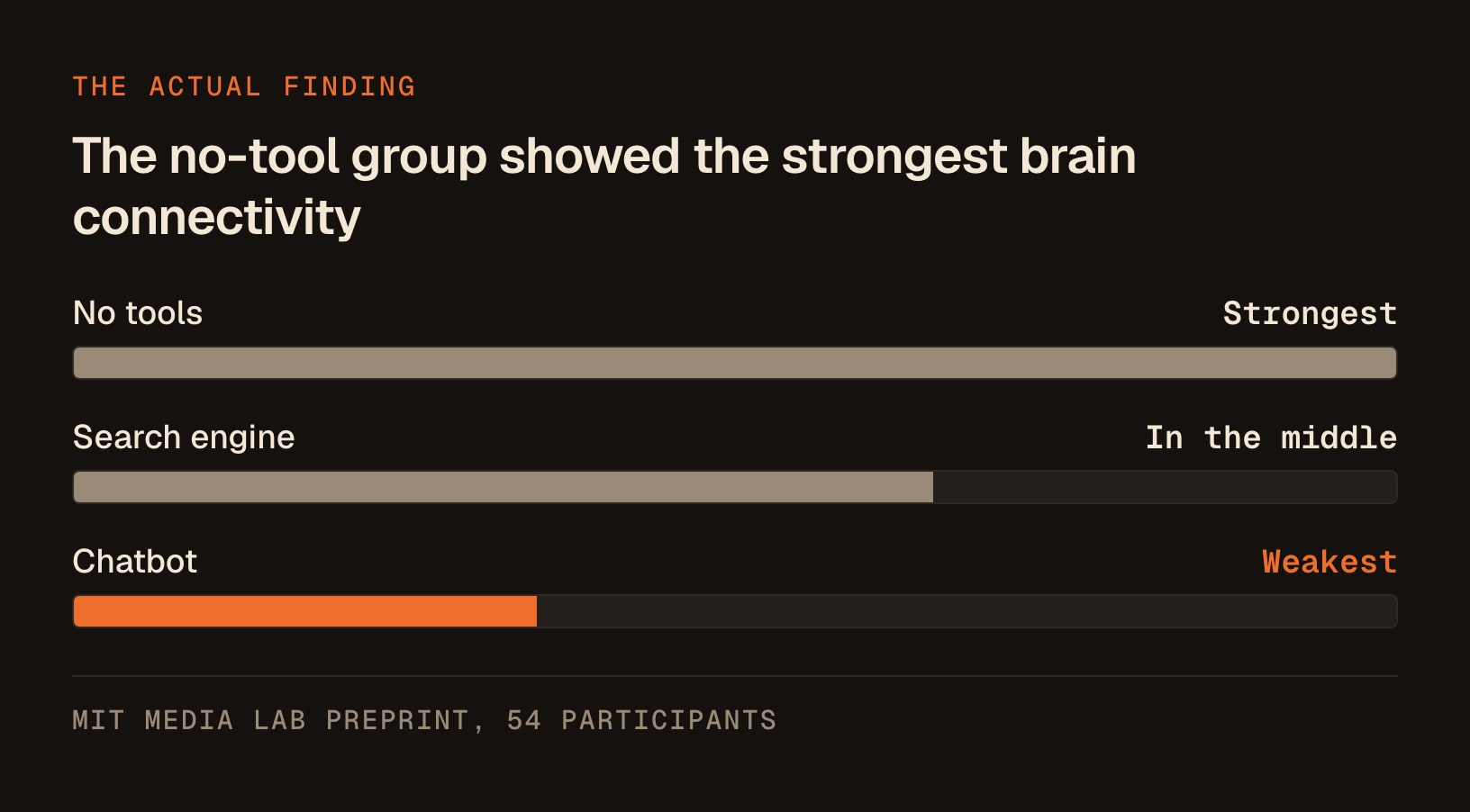
The pattern was consistent. The brain-only group showed the strongest and most widely connected brain activity. The search group landed in the middle. The chatbot group showed the weakest connectivity of the 3.
On top of that, the chatbot users reported feeling the least ownership of their own essays. When asked to quote a line from something they'd written minutes earlier, they struggled. The no-tool group had no trouble doing the same thing.
54 people wore EEG caps. The chatbot group showed the weakest brain connectivity of the 3 groups, and struggled to quote a line they'd written minutes earlier.
Now the part the headlines skipped.
| What the headlines said | What the paper actually shows |
|---|---|
| "AI rots your brain." | The paper never tested that, and the authors were openly cautious about anyone running that far with it. |
| "MIT proved it." | It's a preprint, not a finished, peer-reviewed paper. It's an early result the authors put out to invite scrutiny. |
| "The evidence is overwhelming." | The sample is small, 54 people. |
| "This is what AI does to your work." | The task was one narrow thing, writing school-style essays under lab conditions. |
| "The damage is permanent." | It measured a short window of time, not a career. |
The researchers themselves waved people off the brain-rot conclusion. Anyone selling you that headline is selling you something.
So what do we actually have? A believable warning about a specific habit, not a verdict on the whole toolset. When you hand the hardest part of a task straight to a machine and copy back the output, your brain treats it like someone else's work.
Because in a real sense, it was. You didn't wrestle with it, so you don't own it, and you can't defend it later.
That's the finding that should matter to you, and it has nothing to do with brain scans. It's about whether you can stand behind your own work when a client pushes back.
Your Judgment Is What People Actually Pay For
Think about what a client is really buying when they hire a coach, a consultant, or an advisor.
A client is buying your read on their situation, the judgment call they didn't even know was a judgment call. They're buying the fact that you've seen their problem many times before while they've seen it once. They're paying for the diagnosis they can't run on themselves.
A financial advisor earns the fee on the phone call in March when the market drops and the client wants to sell everything, and the advisor says "here's why we don't." That's a judgment nobody can outsource, and it's the exact thing that can't be delivered by someone who copied their whole worldview out of a chatbot and never internalized it.
That's fine for a grocery list. It's fatal for a consultant, because the entire product is the ability to defend the call under pressure.
You cannot fake ownership in a live room. The client asks why this and not that, and either you fought for the answer yourself or you're bluffing, and people can smell a bluff.
So use as much AI as you want. I use a mountain of it. The real work is being ruthlessly clear about which part of the job is your judgment and which part is just labor around your judgment. One of those you protect. The other you automate today.
Automate the Packaging, Keep the Thinking
Every piece of work you produce has 2 layers.
There's the thinking, which is the actual point: the decision, the read, the argument only you can make. And there's the packaging, which is everything that turns that thinking into something a client can receive: the formatting, the draft structure, the reformatting into an email and a post and a slide, the proofread, the cleanup.
AI is astonishingly good at labor and genuinely dangerous when you let it quietly take over the product. The whole game is keeping those straight.
Here's the split I actually run. Treat this as the reference you come back to.
| The work | Whose job | Why |
|---|---|---|
| Deciding what the client's real problem is | Yours, always | This is the diagnosis. It's the thing they're paying for. |
| Your core argument or point of view | Yours, always | If you didn't build it, you can't defend it. See the essay study. |
| What to cut and what to emphasize | Yours, always | Taste and priority are judgment, not formatting. |
| Turning your messy notes into a clean draft | Hand it off | Structure and phrasing are packaging. |
| Reformatting one idea into an email, a post, a carousel | Hand it off | Same thinking, different container. Pure labor. |
| Gathering and summarizing research | Hand it off, then judge it | AI fetches. You decide what's true and what matters. |
| Proofreading, tightening, subject-line variants | Hand it off | Nobody's judgment lives in a comma. |
| Transcribing a call or a voice memo | Hand it off | It's typing. Let the machine type. |
Everything in the yours column is a decision. Everything in the hand-it-off column is a transformation of a decision you already made.
The moment you catch AI making a decision for you (picking your recommendation, choosing your angle, deciding what your client needs), stop and take it back. Deciding is the whole job, and it stays with you.
There's a simple tell for when you've crossed the line. If you finish a piece of work and you couldn't explain to a client why you made the key choices in it, you didn't do the thinking. You outsourced it.
Copy This Prompt to Package Without Outsourcing Your Brain
Here's the practical move. Do your thinking first, in whatever messy form it comes out.
Talk it into a voice memo on a walk. Scribble bullets. Get the actual judgment out of your head and onto the page, ugly. Then hand that raw material to AI and tell it, in plain terms, that its job is to package and nothing more.
This is a prompt I use constantly. Paste it into Claude (the desktop app), swap in your details, and drop your own thinking underneath it.
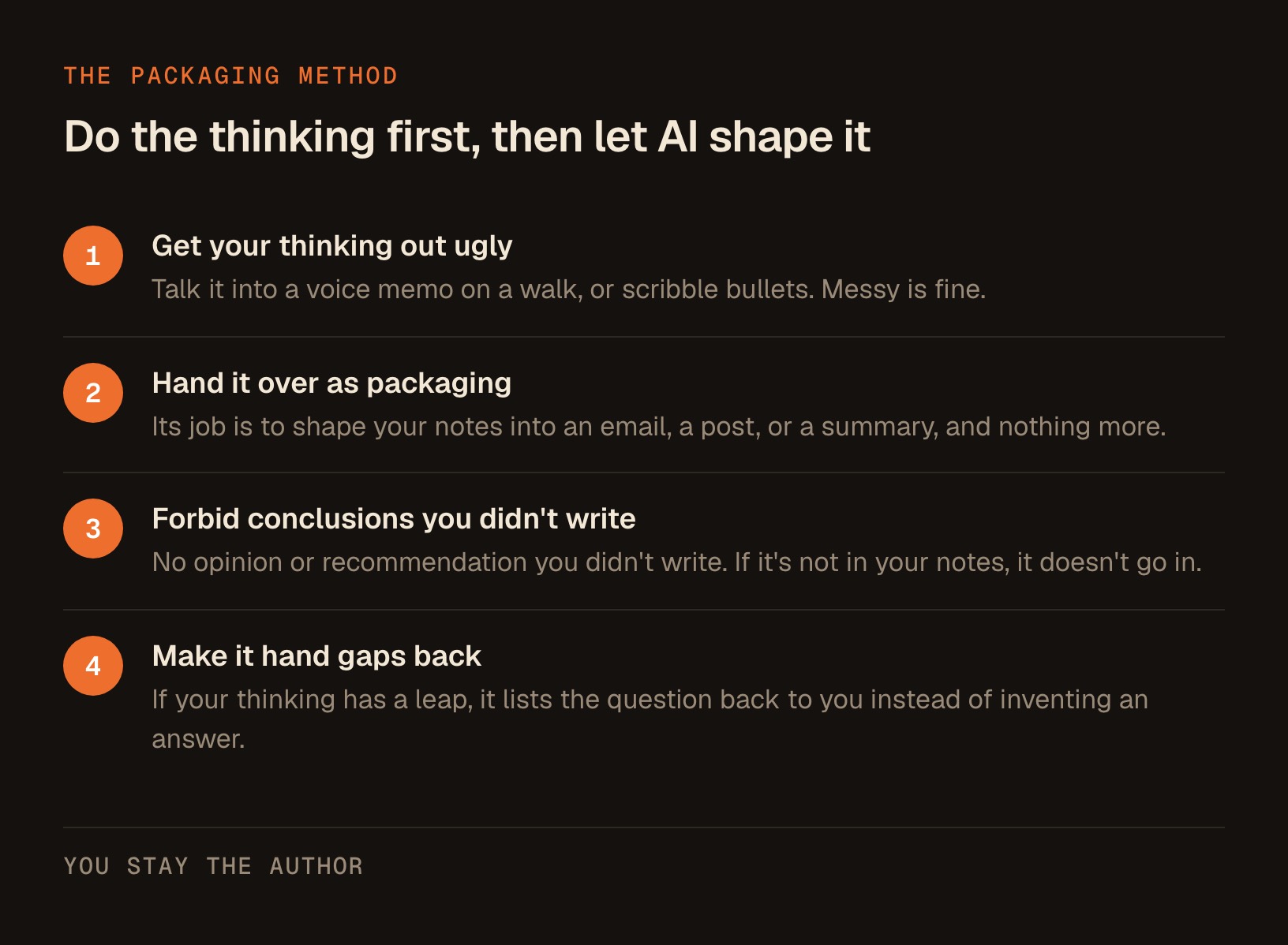
You're my packaging assistant, not my brain. Below is my own thinking on this. Your job is to shape it into [a client email / a LinkedIn post / a one-page summary], and nothing beyond that.

Rules:
1. Do not add any opinion, recommendation, or conclusion I didn't write. If it's not in my notes, it doesn't go in.
2. If my thinking has a gap or a leap, don't fill it. List it back to me as a question at the very end, under a heading called "Gaps to check."
3. Keep my phrasing and my examples wherever they're strong. Don't sand off my voice into corporate mush.
4. Match this format and length: [describe it, e.g. "short client email, 150 words, warm, one clear ask"].

Here's my raw thinking:
[paste your messy notes, voice-memo transcript, or bullets]
Rule 1: "Do not add any opinion, recommendation, or conclusion I didn't write. If it's not in my notes, it doesn't go in."
Rules 1 and 2 are the ones doing the work. The machine can't slip in a recommendation you didn't make, and if it notices you skipped a step, it has to hand the question back to you instead of quietly inventing an answer.
You stay the author. You keep ownership. And you still save the hour it would've taken to shape the thing by hand.
When you don't have a view yet, get interviewed
The method above assumes you already did the thinking. Plenty of mornings you won't have. You'll open a blank page with nothing formed, and that's the exact moment most people let the chatbot decide for them.
Don't. Get interviewed instead. The rule is that AI may only ask questions and may never answer, which turns it into extraction instead of substitution.
Interview me about this client's situation. Ask me one question at a time, up to ten, and wait for my answer before the next one.

Do not offer opinions, options, examples, or recommendations at any point. Do not suggest what my answer might be. If I'm vague, ask a sharper follow-up instead of filling the gap yourself.

When we're done, play my answers back to me as my own argument, in my own words, in the order that makes it strongest. Then list anything I never actually answered.

The situation: [one or two lines of context]
By question 6 or 7 you'll usually hear yourself say the thing you actually believe. Now you have a view, and it's yours, and you can run it through the packaging prompt above.
See the difference in one line
Try it both ways once, so you feel it. Write a client note by dumping bullets and running the packaging prompt. Then, separately, write one by just asking AI "write a client email about X" and letting it invent the whole thing.
| Asked AI to write it | Wrote the thinking, AI packaged it |
|---|---|
| "In today's rapidly changing market environment, it's more important than ever to remain disciplined." | "You called me the last time the market dropped and you wanted out. We didn't sell. That's why we're having this conversation." |
| "There are several important factors to consider when evaluating your options here." | "There are two options and one of them is wrong for you. Here's which one, and why." |
| "Please don't hesitate to reach out with any questions you may have." | "Reply with a yes and I'll get it set up Thursday." |
Read both out loud. The first one sounds like everyone, and the second you get a follow-up question, you'll feel the floor give way. That gap is your entire moat.
Spot the Line Between Thinking and Packaging in Seconds
You don't need a framework for this. You need one question, asked before you open the chatbot.
Ask yourself: is this task a decision, or a delivery?
| The task | Decision or delivery | Who does it |
|---|---|---|
| What this client actually needs | Decision | You |
| What your position is | Decision | You |
| What to recommend | Decision | You |
| What to leave out | Decision | You |
| Whether the draft in front of you is even right | Decision | You |
| Turn it into an email | Delivery | The machine |
| Cut it to length | Delivery | The machine |
| Write 10 subject lines | Delivery | The machine |
| Fix the typos | Delivery | The machine |
You can still use AI as a sparring partner on the decision rows, and I do it constantly. State the call you're leaning toward, ask it to argue the strongest case against you and name what would have to be true for you to be wrong, then you make the call. It asks. You answer. That order matters.
Deliveries go to the machine, every time, without guilt, because that's where AI buys you back real hours.
Here's the test that catches you when you slip. After AI hands something back, not the whole thing word for word, the way you can't with any long document. I mean the core: can you state, in your own words, what you're claiming and why? If yes, you did the thinking and used the tool for labor.
In the MIT Media Lab study, the chatbot group couldn't quote their own essays minutes after writing them. If you can't state your point in your own words, you didn't do the thinking.
You get faster and sharper at the same time. Sharper because you keep doing the one rep that matters, the judgment, over and over. Faster because you stopped spending your afternoons formatting by hand.
People lose their edge to AI when they never draw the line, handing over the decisions along with the labor and waking up one day unable to defend their own recommendations. Draw the line, keep the thinking, and let the machine carry everything else.
Where the Finished Skills Live
When I turn one of these workflows into a finished, repeatable AI skill (something you install once and run whenever you need it, all inside the Claude desktop app, no terminal, no code), it goes into the Solo Creators AI Studio.
Every skill I build lands there, plus a direct line to me if you want a hand drawing this line for your own work.
Use the tools hard. Just keep the part that makes you worth hiring.
Key takeaways
- The MIT Media Lab preprint 'Your Brain on ChatGPT' (54 people, EEG caps, essay writing) found chatbot users had the weakest brain connectivity, the lowest sense of ownership, and couldn't quote their own essays.
- It's an early preprint on a small, narrow task. It does not show AI 'rots your brain,' and the researchers themselves cautioned against that reading.
- The real lesson is about a habit: hand the hardest thinking straight to a machine and you end up unable to defend work that was never really yours.
- For a coach, consultant, or advisor, your judgment is the product. Clients pay for your read on their situation, not for a document they could generate themselves.
- Split every task into thinking (the decision, the argument, what to cut) and packaging (drafting, reformatting, proofing). Keep the first, automate the second.
- Do your thinking first in messy form, then use AI to package it, with an explicit rule that it can't add any conclusion you didn't write.
- When you don't have a view yet, have AI interview you instead. It may only ask questions, never answer, so the argument that comes out is still yours.
- The one-question test: is this a decision or a delivery? Decisions stay with you. Deliveries go to the machine. If you can't quote your own point afterward, redo the thinking yourself.
Get this skill, and every one I build.
30-day money-back guarantee. Cancel anytime.
Questions people ask
Does using AI actually make you worse at thinking?
What did the MIT 'Your Brain on ChatGPT' study really find?
So should I stop using AI for my work?
What's the difference between 'thinking' and 'packaging'?
How do I use AI to write something without letting it think for me?
What if I don't have a point of view on the topic yet?
Why does ownership of my own work matter so much?

Ronnie spent 18 years building a SaaS with a team of 20 that served over 650,000 customers, generated over $14M in sales, and sent over 550M emails. Now he's solo, solving real business bottlenecks and turning them into working AI skills, workflows, and automations. He teaches all of it, with direct access to him, inside the Solo Creators AI Studio Skool community. See what he's built →
 Michael HattawayFounder, Iron Strengthens Iron
Keep reading