How do I catch made-up facts in AI work before a client sees them?
Run a ten-minute check before anything client-facing ships. It depends on the claim. Vague statements don't need a source. Anything with a number or inside quotation marks does: prices, dates, statistics, named people or companies, quotes, and citations. Open the primary source in a real browser, read the address bar, then search the page for the exact phrase. Zero results means the fact doesn't ship. Don't ask a second AI to confirm it, because two models can agree on a fiction. If you can't confirm it, cut it.
A while back my own site published a price of $849 for a product that actually sold for $249.99. When I went to check the number, a second tool "corroborated" it. A tidy little review summary agreed, $849, sounded confident, and I almost let it ride.
The number was invented. The confirmation was invented too. That day taught me the thing nobody tells you about working with AI: a wrong answer will often arrive with a second AI cheerfully confirming it, and that confirmation is worth nothing.
If you build anything client-facing with AI (proposals, emails, one-pagers, blog posts, a slide with a stat on it), you already know the tool is fast and mostly right. The problem is the "mostly."
A model will hand you a citation, a price, a quote, or a case name with the exact same calm confidence whether it pulled it from a real source or made it up thirty milliseconds ago. There's no tremble in its voice. The confidence is identical either way, which is precisely why you can't use confidence as your signal.
I'm not a lawyer, and nothing here is legal advice (check anything legal with your own professional). But there's a public dataset that shows, in cold numbers, what happens when smart, busy professionals trust an AI answer they didn't verify.
It's worth looking at, because it's the clearest picture we have of the failure mode, and because the fix is simple enough to run before your morning coffee.
The public scoreboard of AI getting caught
A researcher named Damien Charlotin maintains a database called AI Hallucination Cases. It tracks legal decisions where a court explicitly found that someone relied on hallucinated material: a fake citation, a quote that doesn't exist, a source twisted into saying something it never said.
I pulled the live numbers from the page's own data on July 16, 2026. At that moment the database held 1,761 documented cases.
Look at the growth curve and your stomach drops a little. As a running total, the database held 6 cases through the second quarter of 2023, 903 through the fourth quarter of 2025, and 1,725 through the second quarter of 2026.
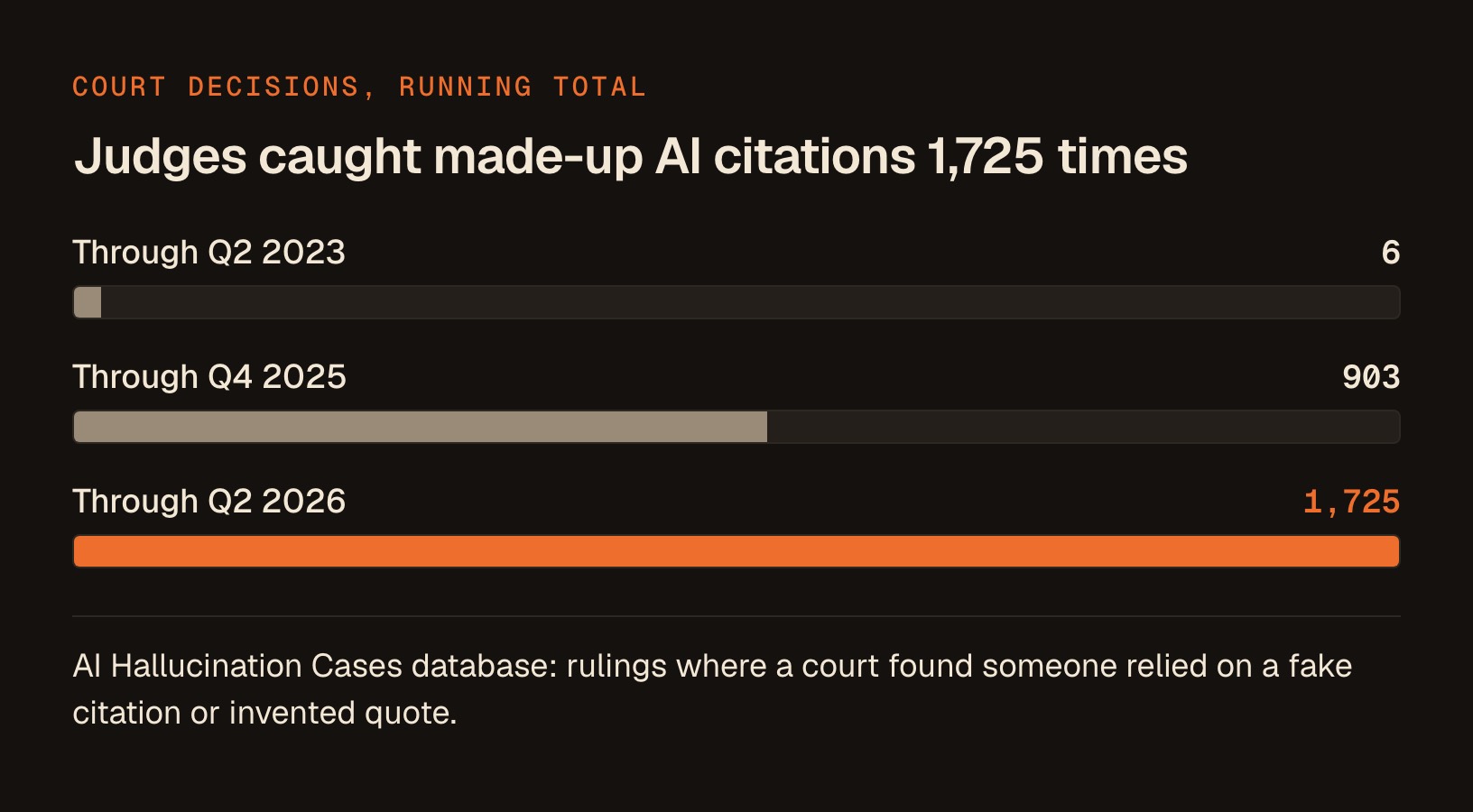
The climb is steep, going up and to the right as more people put AI into real work without a checking step.
The cases cluster where you'd expect a lot of English-language legal filing to happen:
| Jurisdiction | Documented cases |
|---|---|
| United States | 1,218 |
| Canada | 194 |
| Australia | 96 |
| United Kingdom | 60 |
The consequences are not abstract. Real money, real professional standing, all downstream of a fact nobody checked.
| Consequence recorded | Instances |
|---|---|
| Monetary sanctions | 302 |
| Disciplinary referrals | 125 |
3 flavors of made-up show up over and over: a source that doesn't exist, a real source bent to say the wrong thing, and words placed in quotation marks that were never written. Keep those 3 in your head. Your whole verification job is really just checking for those 3 things.
The database logged 6 cases through Q2 2023. Through Q2 2026: 1,725.
Why the court cases predict your risk too
Here's where I have to be honest with you, because the internet is full of people who'd wave this database around as proof that "AI is dangerous" without telling you what it actually measures.
This database tracks courts. Every single case in it is one where a fabrication was serious enough, and public enough, that a judge wrote it down in a legal decision. It's a smoke detector, not a thermometer.
It tells you the fire alarm went off 1,761 times in courtrooms. It tells you nothing about the far larger number of times an AI invented a statistic in a coaching newsletter, a fake testimonial in a sales page, or a wrong price on a website, and simply nobody with subpoena power ever noticed.
If this is the visible tip that pokes above the waterline of formal legal review, the part underwater (the everyday client work with no judge attached) is the ocean.
You and I live in the ocean. The exact same fabrication that gets a lawyer sanctioned will slide silently into your client deliverable, and the only thing standing between it and your reputation is whether you checked.
The corroboration trap that fooled me
Back to my $849. What made that mistake sticky wasn't the first wrong number. Wrong numbers happen. It was the second step, where I tried to be responsible, asked for a check, and got a confident "yes, that's right" that was also fabricated.
This is the trap nobody warns you about. Asking a second AI to confirm isn't verification. When you paste "is this price correct?" into another model, you're not checking reality. You're asking a very agreeable pattern-matcher whether a plausible-looking number is plausible, and plausible numbers are exactly what these tools are built to produce.
There's a subtler version that got me too. A lot of AI "research" runs through a fetcher, a background process that grabs a web page's text and hands it back. Fetchers get redirected, hit bot walls, land on the wrong page, or read a version of a page you'd never see with your own eyes.
A fetcher can return a "verbatim quote" from a page that doesn't contain it, because when the fetch fails quietly, the model fills the gap with something that sounds right. You get a quote in tidy quotation marks, sourced to a real-looking URL, that exists nowhere on the actual page.
Here's the line I draw now, and it's the line the rest of this article runs on:
| This is NOT verification | This IS verification |
|---|---|
| Asking a second model whether the fact is right | The primary source page open in your own browser |
| Re-asking the same model "are you sure?" | The exact sentence located on that page |
| An AI-fetched summary or scrape of the page | The number or quote read with your own eyes |
| A confident citation with a real-looking URL | The URL loaded, and it resolves to what was claimed |
A second AI confirmed my $849. The real price was $249.99.
I learned this the expensive way, so let me hand you the rule I use now, the one that would have saved me the $849 embarrassment and about a dozen since.
The one rule that catches almost everything
Open the primary source yourself, in a real browser, with your own eyes.
That's it. That's the rule that does most of the work. You want the actual page. Loaded in the actual browser you use every day, where you can read the actual sentence with the actual number in it, not a fetch, not a summary, and not a second model's blessing.
Why a real browser specifically? Because the ways AI reads the web are exactly the ways it gets fooled. A page can ship one price to an automated reader and a different price to a human.
A number can be split across separate design elements so that "$8" and "49" sit next to each other and a text grab concatenates them into "849."
(Yes, that is literally how my $849 was born: 3 separate pieces of a page, glued together by a machine that couldn't see they weren't one number.) A page can default to annual pricing and print "$12/mo" while the real monthly rate is higher.
Machines read the plumbing; you read the page. Your eyes catch what the extraction misses.
So the move is boringly physical. When AI gives you a fact that's going in front of a client, you find the one primary source that fact should come from, you open that page in your browser, and you locate the exact sentence.
If you can't find the sentence, the fact doesn't ship. Full stop. Cutting an unverifiable claim costs you nothing. Nobody ever lost a client because a sentence had one fewer statistic in it.
A ten-minute verification workflow for client work
Here's the routine I run on anything that leaves my hands with a client's name near it. It's not fancy. Fancy isn't the point. Repeatable is the point.
Step one: hunt for the checkable claims (about 2 minutes). Read the draft and circle every specific, falsifiable thing. Prices, dates, percentages, names of people or companies, direct quotes, and any "according to [source]" citation.
Vague claims ("many advisors struggle with this") don't need a source. Specific ones ("the average advisor loses X hours a week, per [study]") do. If it has a number or quotation marks, it gets checked.
Step 2: demand the source, in the open (about 2 minutes). For each circled claim, make the AI show its work. Not "are you sure?" (it's always sure). Ask it to name the exact primary source and the exact wording, and to flag anything it's inferring rather than quoting.
This won't catch everything, but it separates the claims the model can point to from the ones it's confabulating, which tells you where to spend your browser time.
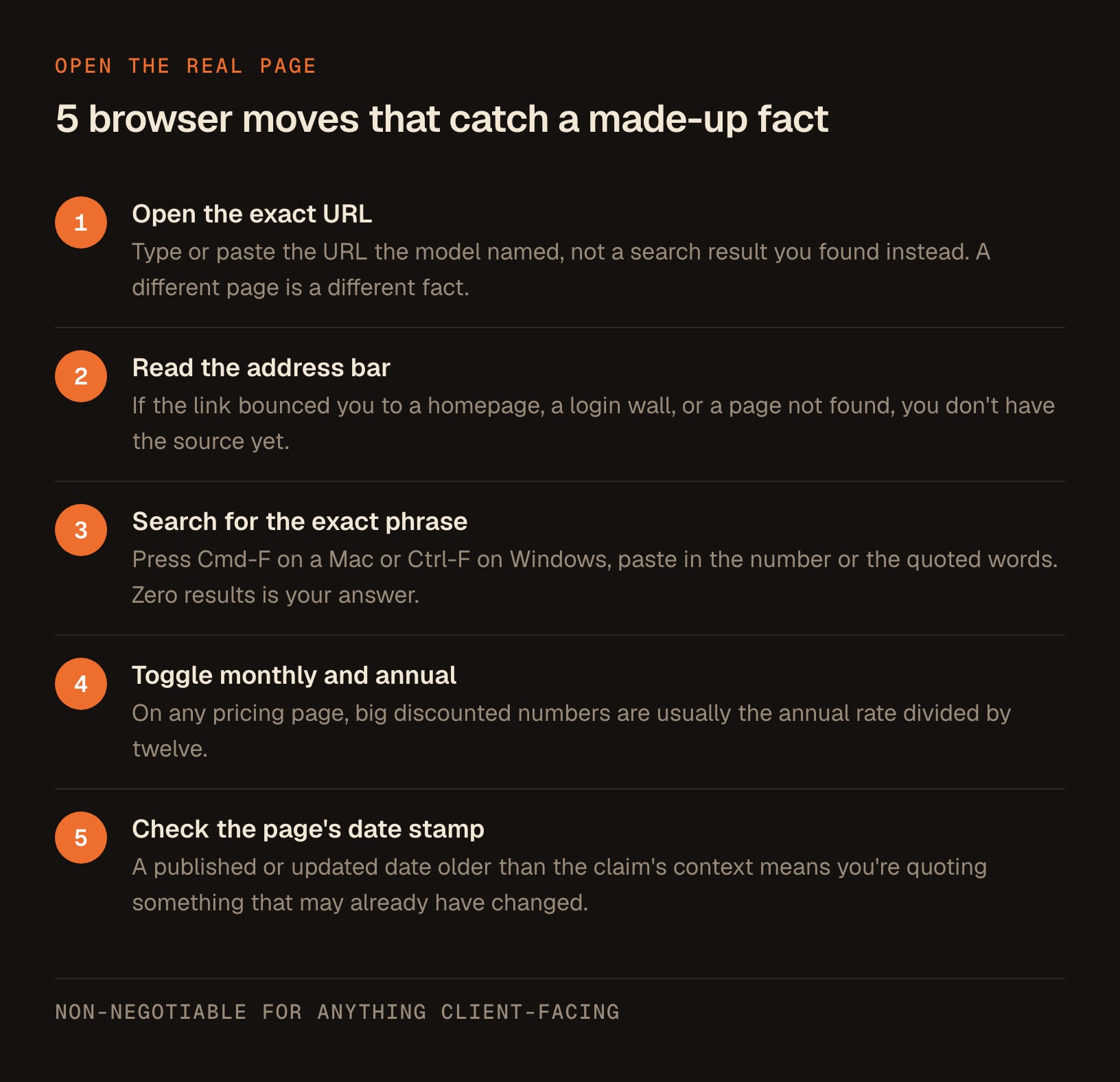
Step 3: open the real page (about 5 minutes). This is the step that carries the whole article, so here it is in 5 small moves you can do without thinking:
- Open the exact URL the model named, typed or pasted into your browser, not a search result you found instead. A different page is a different fact.
- Read the address bar before you read the page. If the link bounced you to a homepage, a login wall, or a "page not found," you don't have the source yet.
- Search the page for the exact phrase. Press Cmd-F on a Mac or Ctrl-F on Windows, paste in the number or the quoted words, and see whether the browser finds them. Zero results is your answer.
- On any pricing page, toggle monthly and annual. Big discounted numbers are usually the annual rate divided by twelve, and that's how a real page produces a wrong price.
- Check the page's own date stamp. A published or updated date older than the claim's context means you're quoting something that may already have changed.
If the quote isn't there, if the price is different, if the page redirected somewhere weird, you just caught a live one. This step is non-negotiable for anything client-facing.
Step 4: kill or keep (about 1 minute). Verified, it stays. Can't find it, it goes, or it gets rewritten without the specific claim. No agonizing. The default for an unverifiable fact is deletion.
| Step | What you do | Where you do it | What kills the claim | Time |
|---|---|---|---|---|
| 1. Find the claims | Circle every number, quote, name, date, and citation | Your draft | Nothing yet, you're just listing | 2 min |
| 2. Demand the source | Make the model name the primary source and exact wording | In the AI | The model admits it generated the fact | 2 min |
| 3. Open the real page | Load the URL, Cmd-F the exact phrase, check date and pricing toggle | Your browser | The sentence isn't on the page | 5 min |
| 4. Kill or keep | Verified stays, unverified gets cut or rewritten | Your draft | Anything that failed step 3 | 1 min |
Here's a prompt I actually use for step 1 and 2. Paste your draft in after it, in the Claude desktop app:
You are my fact-checking partner. Below is a draft that's going to a paying client, so accuracy matters more than speed.

Do three things:

1. Pull out every specific, checkable claim in the draft: prices, dates, statistics, percentages, named people or companies, direct quotes, and any "according to X" citation. List them as a numbered table.

2. For each one, tell me plainly: is this something you retrieved from a real source, or something you generated as "probably true"? Be honest. If you're inferring or estimating, say "UNVERIFIED - I generated this" in that row. Do not soften it.

3. For the claims you say are real, give me the single primary source I should open in my own browser to confirm each one, and the exact sentence or number I'm looking for.

Do not reassure me. Do not tell me the draft looks good. Your only job is to hand me a checklist I can verify myself.
That last instruction matters. You're asking the tool to help you doubt it, which is the opposite of its natural pull toward agreeable, finished-sounding answers.
Step 4 is where most people stall, because cutting a stat feels like the paragraph loses its punch. It doesn't have to. Here's the second prompt I keep on hand for exactly that moment:
Rewrite the sentence below without the statistic. Keep the same length, rhythm, and tone as the original so it still fits the paragraph around it.

Rules:
- Do not substitute a different number, percentage, price, or date.
- Do not add a new source or citation.
- Do not hedge with "studies show" or "many experts say."
- Make the point stand on the plain claim alone.

Give me three versions so I can pick one.

Sentence:
It won't be perfect. It'll still miss things. But together those 2 prompts turn a wall of confident prose into a short list of things you can go look at, and looking is where the safety lives.
When the source won't cooperate
Within 10 minutes of trying this you'll hit a source that fights back. Here's how I handle the 3 common versions so you don't stall out.
| What you hit | What to do |
|---|---|
| The source is paywalled or wants a login | Look for the same figure in the organization's own press release, annual report, or public summary page. If you can't reach a version you can read, treat the claim as unverified. |
| The link is dead, redirected, or the PDF is gone | Treat it as unverifiable and cut the claim. A source you can't open is not a source, no matter how real the URL looks. |
| The page is live but now says something different | The current page wins. Use the current number, and say so in the deliverable ("as of [date you checked]") so the client knows when you looked. |
Where fabrications hide, and how each one gets caught
The 3 error types from the Charlotin data map cleanly onto 3 checks. Once you can name what you're hunting, you find it faster.
| Type of fabrication | Recorded instances | What it looks like in your draft | How you catch it |
|---|---|---|---|
| Fabricated source | 2,989 | A citation, study, URL, or case name that sounds authoritative and specific | Open the source. If the page, study, or URL doesn't exist or doesn't load to what was claimed, it's invented. |
| Misrepresented source | 1,393 | A real source that's been bent to say something it doesn't | Open the real source and read the surrounding sentences. The source is real but the claim isn't in it. |
| False quote | 866 | Words in quotation marks, attributed to a person or page | Search the actual page or transcript for the exact phrase. If the string isn't there verbatim, the quote is fake. |
Fabricated sources dwarf the other 2, so hunt citations first. That's where the odds say your problem is.
Notice that every fix in the right column is the same physical act: open the real thing and look. One habit covers all 3 failure modes.
That's why I keep hammering the single rule instead of handing you a fifty-point checklist.
Fabricated sources: 2,989 recorded instances. Misrepresented sources 1,393, false quotes 866.
What people say when they get caught
The Charlotin database has a column I can't stop thinking about. It records what people did after the fabrication came to light, the remediation. When you strip it down, the human responses cluster into a few very recognizable moves:
| The move | Cases in the database | Why it isn't available to you |
|---|---|---|
| Blame the tool. The AI did it. | 76 | You chose the AI and put your name on the output, so your client hears an excuse, not an explanation. |
| Blame a junior who "must have" introduced the error | 57 | There is no junior. You are the whole production line. |
| Double down and defend the fabrication | 24 | Defending a made-up fact in front of someone who just caught it is how you lose the relationship for good. |
Sit with that for a second. The people in that database had firms and insurance and staff to diffuse the blame across.
76 blamed the tool. 57 blamed a junior. 24 defended the fabrication.
Which is oddly freeing. It means the whole game is upstream. Managing the input is the only lever you have. 10 minutes of opening real pages before you hit send beats any amount of graceful apologizing after.
The professionals with the most to lose are the ones getting sanctioned, and they had more safety nets than you do. Take that as your cue to build the one net you control: the check.
Why this gets more important, not less
It would be comforting to think the models will simply get good enough that verification becomes optional. I don't buy it, and that same curve from the top of this article is my evidence.
As these tools get more capable and more fluent, the fabrications get more convincing. A clumsy fake announces itself: the odd phrasing, the citation that doesn't quite parse, the number that feels off by an order of magnitude. Those are the ones you catch by instinct.
A polished fake slips right through. It has the right shape, the right decimal places, a URL that looks like a URL you've seen before, and a sentence around it that reads like it was written by someone who checked. Polish is exactly what each new model generation delivers.
So the fakes are getting harder to spot at the same time your instincts are being trained to trust the output more. Those 2 lines move in the wrong direction together.
There's also a volume problem. The more of your work you hand to AI (and if you're a solo operator, that share is climbing), the more raw material there is for a fabrication to hide inside.
The curve mostly reflects how many people are using these models for real work faster than they're building the checking habit, rather than how buggy the models are. Adoption is outrunning verification. The gap between those 2 lines is where careers get dented.
So the durable skill here is the unglamorous discipline of confirming a claim against a primary source before it carries your name to a client. Prompt-writing and picking the smartest model matter far less than that habit.
Build the checking step in, once
Every finished AI workflow I build for myself now has verification wired into it, not bolted on after. That's the difference between a tool that makes you faster and a tool that makes you faster at being wrong.
When I package these up, they live in the Solo Creators AI Studio, and the fact-checking habit is baked into the ones that touch client work, so you're not relying on remembering to check on a bad day. If you want every skill I build, plus a direct line to me when you get stuck, that's where they are: the Solo Creators AI Studio.
But you don't need any of that to start. You need a browser and the willingness to open one tab before you hit send.
10 minutes is what a full draft costs you, start to finish. A single claim costs about ninety seconds, which is exactly what my $849 needed: me, looking at the actual page, with my own eyes.
That's the whole trade. Ninety seconds a claim, 10 minutes a draft, against a mistake with your name on it. Do the check.
Key takeaways
- AI states a fabricated fact with the exact same confidence as a real one, so confidence is useless as a signal. Verify the claim, not the tone.
- Asking a second AI to confirm a fact isn't verification. Two models can agree on a fiction. Open the primary source yourself, in a real browser, with your own eyes.
- Step three is the whole workflow: open the exact URL, read the address bar, then Cmd-F on Mac or Ctrl-F on Windows for the exact phrase. Zero results means the fact doesn't ship.
- Damien Charlotin's AI Hallucination Cases database held 1,761 documented court cases as of July 16, 2026, growing from just six through Q2 2023. It tracks courts, so read it as a canary for how common the failure is, not a full count.
- Fabricated citations are the most recorded failure mode at 2,989 instances, ahead of misrepresented sources and false quotes, so hunt citations first.
- If you can't confirm a claim against a real primary source, cut it or rewrite the sentence without it. Dropping an unverifiable fact costs nothing; shipping a fabricated one can cost the client.
- As a solo operator you can't blame a junior or the tool the way sanctioned firms tried to. The only safe move is a ten-minute check before anything client-facing ships.
Get this skill, and every one I build.
30-day money-back guarantee. Cancel anytime.
Questions people ask
How do I actually stop AI from making things up?
Can't I just ask another AI to fact-check the first one?
What's the fastest way to check a claim on a page I've opened?
What do I do if the source is paywalled, dead, or now says something different?
Why does opening the page in a real browser matter more than an AI-fetched summary?
Is the risk of AI fabrication really that common, or just a lawyer problem?
What happens to people who get caught relying on a hallucination?
Which claims in a draft actually need verifying?

Ronnie spent 18 years building a SaaS with a team of 20 that served over 650,000 customers, generated over $14M in sales, and sent over 550M emails. Now he's solo, solving real business bottlenecks and turning them into working AI skills, workflows, and automations. He teaches all of it, with direct access to him, inside the Solo Creators AI Studio Skool community. See what he's built →
 Michael HattawayFounder, Iron Strengthens Iron
Keep reading