How do I know if a free plan will stay free before I build on it?
It depends on how the company makes money. Companies that earn elsewhere tend to keep free plans put: tawk.to, HubSpot's free tools, and Wave's $0 Starter. Watch for trials in disguise, like Freshdesk's 6-month free offer or Riverside's one-time 2 hours with a watermark, and credits that never refill, like Gamma's 400. A $0 plan can still cost you per sale, so read the transaction line. Before you build, open the live pricing page and search for "months," "trial," "one-time," and "credit card."
Tool features, plans, and prices as of .
I went to recommend a help-desk tool I'd used happily for years. I opened its pricing page to grab the free-plan details, and found the free plan had quietly become a six-month trial with a zero on it.
I have a rule now, and it cost me an afternoon to earn it. Never trust a free tier from memory. Pull the live page, read the actual number, then decide.
Nobody emails to tell you when it changes. There's no banner. The pricing page just quietly says something different than it used to, and every article that hasn't been updated is now confidently wrong.
So the skill isn't memorizing which tools are generous, because that list rots faster than you'd think. The skill is checking the live page before you build, and knowing the tells that a "free" plan is really a trial with a countdown you can't see. Here are both, plus what to do if the wall already went up on you.
Know why free plans shrink so you're never blindsided
Free tiers exist for one reason: to get you in the door and dependent. The generous ones are a real loss leader from a company that makes its money far from you. The stingy ones are a slope, built so that the moment your business starts working, you hit a wall and reach for your card.
You can't tell which kind you signed up for by looking on day one. Both plans say $0, both let you build, and the difference only shows up at scale, which is exactly when switching hurts most.
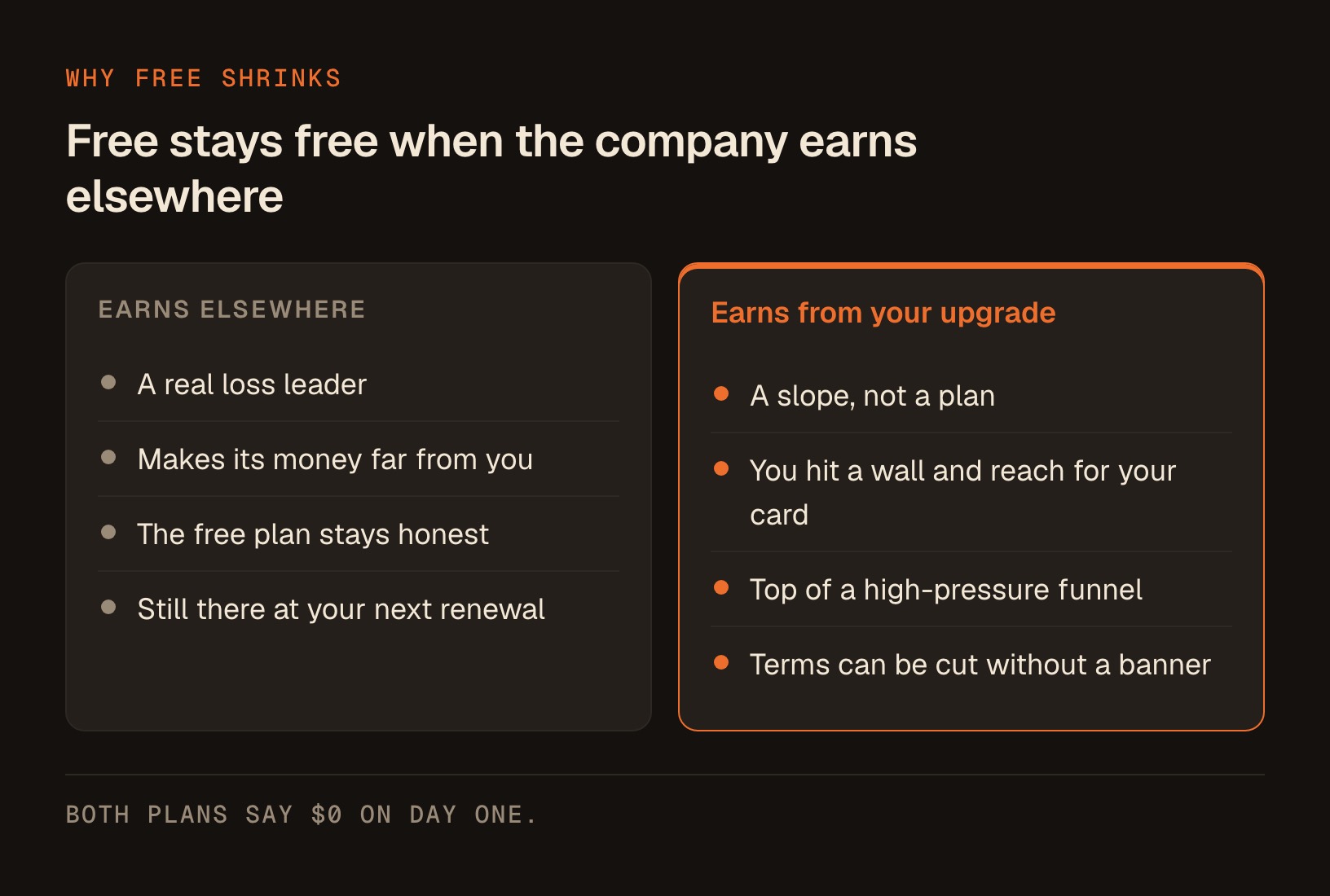
By then your data, your embeds, and your muscle memory all live inside the thing. And the terms aren't frozen. A company can look at its numbers, decide the free plan is too generous, and cut it.
Grandfathering is the coin flip nobody explains to you. Sometimes a vendor leaves existing accounts on the old plan, usually silently, with no announcement and nothing in your billing screen that says "legacy."
Here's the practical part. A legacy plan is usually attached to your account as it currently stands, so the 2 things most likely to kill it are changing plans and letting the account lapse. Downgrade, upgrade, cancel and come back 6 months later, and you often return on today's terms instead of yours.
Verify before you build and re-verify before you scale, and weight your choice toward companies whose business model isn't quietly pushing you toward the paid tier. I run on free and open-source tools constantly and I love them. This is about reading the fine print, not avoiding free.
Spot a trial wearing a free plan's clothes in seconds
The sneakiest move on pricing pages right now is keeping the word "free" while quietly removing the plan behind it and hoping you don't read closely.
Freshdesk is the clearest case. It's a well-known help-desk tool, and for years the pitch included a real free tier. Today the free plan is gone, replaced by a countdown.
Freshdesk's pricing page now reads "$0 for 1-2 agents for 6 months." In month 7 you're either paying or migrating every support ticket you own.
Which is exactly when a support team has the least time to spare.
Riverside, the recording tool, keeps a "free" plan but hollows it out. It's a one-time two-hour allotment with a watermark stamped on everything you export.
Use your 2 hours and the free plan is spent for good, and anything you made with it carries their logo in front of your audience. There's no monthly reset quietly waiting for you.
Once you know the tells, you can spot a disguised trial in about 10 seconds. Hold this next to any pricing page:
| What you see on the page | What it usually means | Real example |
|---|---|---|
| A number of months or days on the "free" price | A trial with a countdown you can't see. Free-forever plans don't expire. | Freshdesk: "$0 for 1-2 agents for 6 months" |
| "One-time" anything (hours, credits, exports) | A sample you use up, not a plan you can live on | Riverside: one-time 2-hour allotment |
| A watermark or "powered by" logo on customer-facing output | The free plan is working as an ad, and you're the billboard | Riverside: watermark on everything you export |
| A credit card required just to start | They're planning to charge it. Real free plans almost never ask. | Common across "free trial" signups |
Avoid the credits that quietly never refill
Watch the word "credits," because it's doing a lot of quiet work on pricing pages right now.
Gamma, the AI deck and site builder, gives you 400 credits at signup on the free plan. That sounds like a monthly allowance, and it isn't one.
Gamma's 400 free credits are a one-time grant that never refills. The paid tiers reset 1,000 credits every month.
On top of that, Gamma's branding stays on your deck until you pay.
So the free plan is really a fixed pool of AI generations. You can burn your whole creative runway on 3 or 4 drafts and then find the well dry, with no refill coming.
Notta, the transcription tool, runs a subtler squeeze. The free plan caps you at 3 minutes per conversation, which already rules out most real meetings or interviews.
The part that actually stops you is that the free plan cannot export a transcript at all. Export is literally a paid-only row on the feature table.
So even inside your 3 minutes, the output is trapped in their app. You can read it on screen, and you can't take it with you, which for a transcript defeats the entire purpose.
The free tier lets you make something you can't fully keep. A deck with someone else's logo on it. A transcript you can't export. It shows you the value, then puts a toll booth between you and actually using it.
Keep more of every sale by reading the transaction line
Here's the one most people never check, because the monthly price says $0 and they stop reading right there.
Wave, the invoicing and bookkeeping tool, has a free Starter plan. Its own page says $0 and includes unlimited estimates, invoices, bills, and bookkeeping records. That part is real and generous.
The part that hides under the $0 is the payment processing, and the rate even changes depending on the card your customer taps:
| Payment type | Rate per transaction |
|---|---|
| Card | 2.9% + 60c |
| American Express | 3.4% + 60c |
So the software is free and moving money through it is not. That's not a knock on Wave, which publishes both rates right on its own page. It's a reminder that on anything touching money (payments, invoicing, e-commerce, bookings with deposits) the sticker price and the real price live on different lines.
A $0 monthly plan that takes a few percent of everything you earn can cost you far more per month than a flat monthly fee would, depending on your volume. Compare the transaction fee, not just the sticker, and do it before you route any real revenue through the thing.
Wave's Starter plan costs $0 a month, and every card payment still takes 2.9% + 60c, or 3.4% + 60c on American Express.
Get your data out before the wall arrives
If you're reading this because a tool you already use just changed its terms, skip the prevention and do these 3 things this week, in this order.
1. Ask support in writing whether your account is grandfathered. Before you migrate anything, before you panic, send one message and get an answer you can screenshot. Ask it plainly: "Is my existing account grandfathered on my current plan, and does that change if I upgrade, downgrade, or cancel?" That single reply decides whether you have a weekend problem or no problem at all.
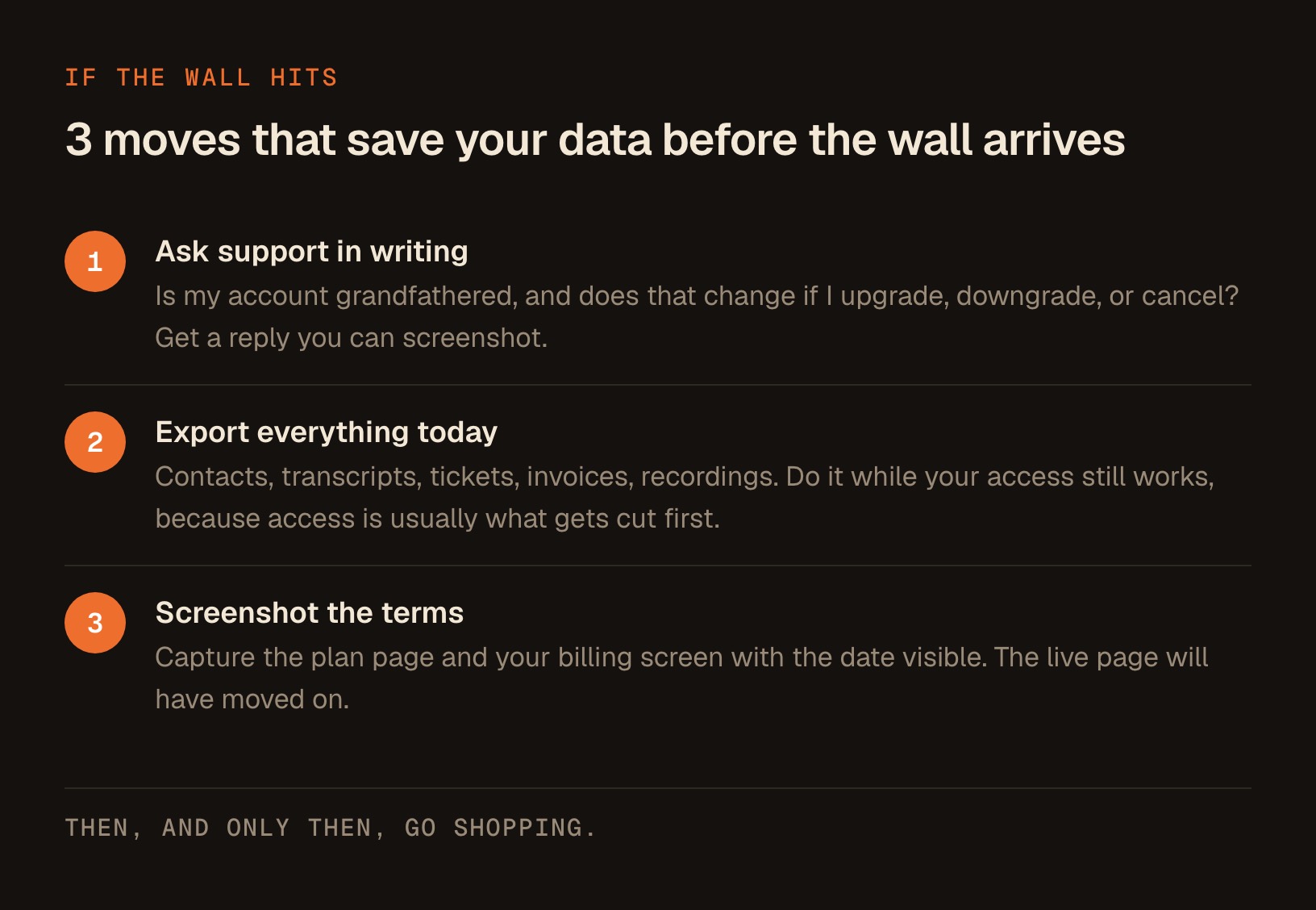
2. Export everything the tool will let you export today. Contacts, transcripts, tickets, invoices, recordings, whatever the thing holds. Do it while your access still works, because access is usually what gets cut first.
And check what export is even possible before you assume it. Notta's free plan, for example, can't export a transcript at all, so on tools like that your "export" is copying text off the screen while you still can.
3. Screenshot the pricing terms you signed up under. Capture the plan page and your billing screen with the date visible. If grandfathering ever gets contested, the version of the page you agreed to is the only evidence you have, and the live page will have moved on.
Then, and only then, go shopping for the replacement. Migrating in a hurry with no export and no written answer is how a pricing change turns into a lost month.
See the real catch on each free tier at a glance
Here's the field in one view. Every row was read off the vendor's own current pricing page in mid-2026, and every one differs from what a lot of older articles still claim.
| Tool | What the free plan gives now | The catch to watch |
|---|---|---|
| Freshdesk | $0 for 1-2 agents, for 6 months | A trial in disguise; pay or migrate at month 7 |
| Gamma | 400 credits at signup | One-time, never refills; Gamma branding stays on your deck |
| Riverside | One-time 2-hour allotment | Watermark on everything; the free hours do not renew |
| Notta | 3 minutes per conversation | Cannot export the transcript at all; export is paid-only |
| Wave | $0 Starter, unlimited invoices | Card payments still cost 2.9% + 60c (Amex 3.4% + 60c) |
Check any free tier in 3 minutes before you build
You don't need a spreadsheet or a subscription tracker for this. You need 3 minutes and a habit. Before you commit real work to a free plan, do this.
Open the live pricing page yourself. Not a review, not a comparison article, not your memory. The vendor's own current page, because everyone else's copy of the number may be stale.
Find the one limit you'll hit first. For an email or support tool it's contacts or seats. For transcription it's minutes and whether you can export. For payments it's the per-transaction fee. Every free plan has a single wall you reach before any other, so find that wall and ask how long your growth takes to reach it.
Read the terms for an expiry and a card. Search the page for "months," "trial," "one-time," and "credit card." Any of those turns a "free plan" into a countdown. No expiry and no card required usually means you're looking at a real free-forever plan.
I run this past Claude now, because it will read the fine print I skim past and it won't be charitable about it. Paste this into the Claude desktop app with the tool's pricing page handy:
I'm about to build my business on the free plan of [TOOL NAME]. Before I commit, act as a skeptical procurement analyst and pressure-test it for me.

Using only the tool's official pricing and terms pages (ask me to paste them in if you can't see them), tell me:
1. The exact free-plan limits: contacts/subscribers, monthly sends or minutes, number of seats, storage.
2. Whether the "free" plan is free-forever or a time-limited trial. Quote the exact words that prove it.
3. Whether it puts a watermark or "powered by" branding on anything my customers or audience will see.
4. Any per-transaction fee, and whether a PAID plan would charge me LESS per transaction than the free one does.
5. The single limit I'll hit first at my size, and roughly when.

Then give me one line: "Safe to build on" or "Treat this as a trial," and one sentence why.
What a good answer looks like: run it on Freshdesk and the last line comes back "Treat this as a trial," because the page itself says $0 for 1-2 agents for 6 months.
That's it. 3 minutes, and you'll never again send yourself or a client down a road that dead-ends at a wall you could have seen coming.
Choose the free tiers that actually stay free
Now the good news, because this is really about choosing free tools whose business model doesn't depend on squeezing you later.
When a company earns its money somewhere other than your upgrade, the free plan tends to stay put, because it's doing a different job than baiting you toward the paid tier. 3 that hold up:
| Tool | What the free plan gives | How they make money instead | The one caveat |
|---|---|---|---|
| tawk.to | $0, "Free. Forever.", "no limits to the number of agents you can add," no cap on concurrent chats or sites | Renting you human chat agents, plus a fee to remove their "powered by" branding | The branding-removal fee has no published number |
| HubSpot (free tools) | Free CRM for up to 2 users with 1,000 contacts, and free access "has no time limit" | Upsells to paid hubs once you outgrow the free limits | Real free-forever only while you stay inside those limits |
| Wave | $0 Starter with unlimited invoices, estimates, bills, and bookkeeping records | A cut of every card payment you process | 2.9% + 60c per card transaction, 3.4% + 60c on Amex |
On tawk.to's branding-removal fee, their own page only calls it "a very small fee" and doesn't publish a number, so I won't invent one for you. If removing that branding is part of your plan, ask them for the number in writing before you build on it, and save the reply.
The through-line: favor companies that earn elsewhere. Human services, one-time fees, open-source with a paid host, an ecosystem play.
tawk.to's page says "Free. Forever." with "no limits to the number of agents you can add," because it earns from renting you human agents instead.
Find the monthly price behind the annual-billing number
One last thing, because even the free tiers that hold up eventually ask you to consider a paid plan, and the paid pricing has its own sleight of hand.
Pricing pages love to show the annual-billing number in big type and tuck the monthly one out of sight. HubSpot's Starter tier is a clean example.
That's roughly 3 times the price for the freedom to leave whenever you want. Annual billing is a commitment dressed as a discount, and it's only cheaper if you were always going to stay a year.
If you're testing something, compare the monthly rate, because that's what walking away actually costs you.
One more wrinkle worth knowing: these pages resolve prices by your location. The same HubSpot page can show a visitor in one country a different currency and a different set of numbers than a visitor in another sees. So when you read a price, read it in your own currency, and find the monthly figure before you celebrate the annual one.
Every finished AI skill I build to run my own business, including the little audit habits like the prompt above, lives in The Solo Creators Studio, and if you want to send me a tool you're unsure about, there's a direct line to me in there.
I built the Studio because I got tired of learning these lessons the expensive way and wanted a place to hand people the shortcut. No terminal, no code, just the things that actually work.
Check the live page. Read the transaction line. Search for "trial" and "credit card." Save the procurement prompt above somewhere you'll find it, and run it before the next tool you sign up for. 3 minutes now saves you a migration later, and it's the cheapest insurance in your whole tool stack.
This isn't legal or financial advice, and pricing pages change, so verify anything that matters against the vendor's own current terms before you rely on it.
Key takeaways
- Free tiers are marketing decisions, not contracts. The plan you researched a year ago can offer something completely different to whoever signs up today, and no one sends a warning email when it changes.
- Some 'free' plans are trials in disguise. Freshdesk is $0 for 1-2 agents for 6 months, and Riverside gives a one-time 2-hour allotment with a watermark on everything you export.
- Watch the word 'credits.' Gamma's free 400 credits are a one-time grant that never refills while paid tiers reset 1,000 monthly, and its branding stays on your deck; Notta's free plan caps you at 3 minutes and cannot export a transcript at all.
- A $0 plan can still cost you per sale. Wave's free Starter is $0 with unlimited invoices, but card payments carry 2.9% + 60c per transaction and Amex 3.4% + 60c, so compare the transaction line, not just the sticker.
- If your tier just got cut, do three things this week: ask support in writing whether your account is grandfathered, export everything the tool will let you export today, and screenshot the terms you signed up under.
- Before you build, open the vendor's own live pricing page, find the first limit you'll hit, and search for 'months,' 'trial,' 'one-time,' and 'credit card.'
- Favor companies that earn elsewhere. tawk.to ($0, 'Free. Forever.,' no limit on agents), HubSpot's free tools (up to 2 users, 1,000 contacts, no time limit), and Wave's $0 Starter tend to stay put.
- The annual price shown by default is a commitment dressed as a discount. HubSpot's US page shows Starter at $7/mo/seat billed annually versus $20/mo/seat billed monthly, and pages resolve by location, so read the monthly figure in your own currency.
Get this skill, and every one I build.
30-day money-back guarantee. Cancel anytime.
Questions people ask
Which free plans got quietly shrunk in 2026?
My free plan just got cut. What do I do this week?
Do existing users get grandfathered when a free plan changes?
How can I tell if a 'free' plan is really a trial?
Is a free plan always cheaper than paying?
What does 'the credits never refill' mean for Gamma?
Which free tools actually stay free?
How do I check a free tier before I build on it?
Why do prices sometimes look different than what I've read elsewhere?

Ronnie spent 18 years building a SaaS with a team of 20 that served over 650,000 customers, generated over $14M in sales, and sent over 550M emails. Now he's solo, solving real business bottlenecks and turning them into working AI skills, workflows, and automations. He teaches all of it, with direct access to him, inside the Solo Creators AI Studio Skool community. See what he's built →
 Michael HattawayFounder, Iron Strengthens Iron
Keep reading