Which free AI tools can I legally use for work I sell?
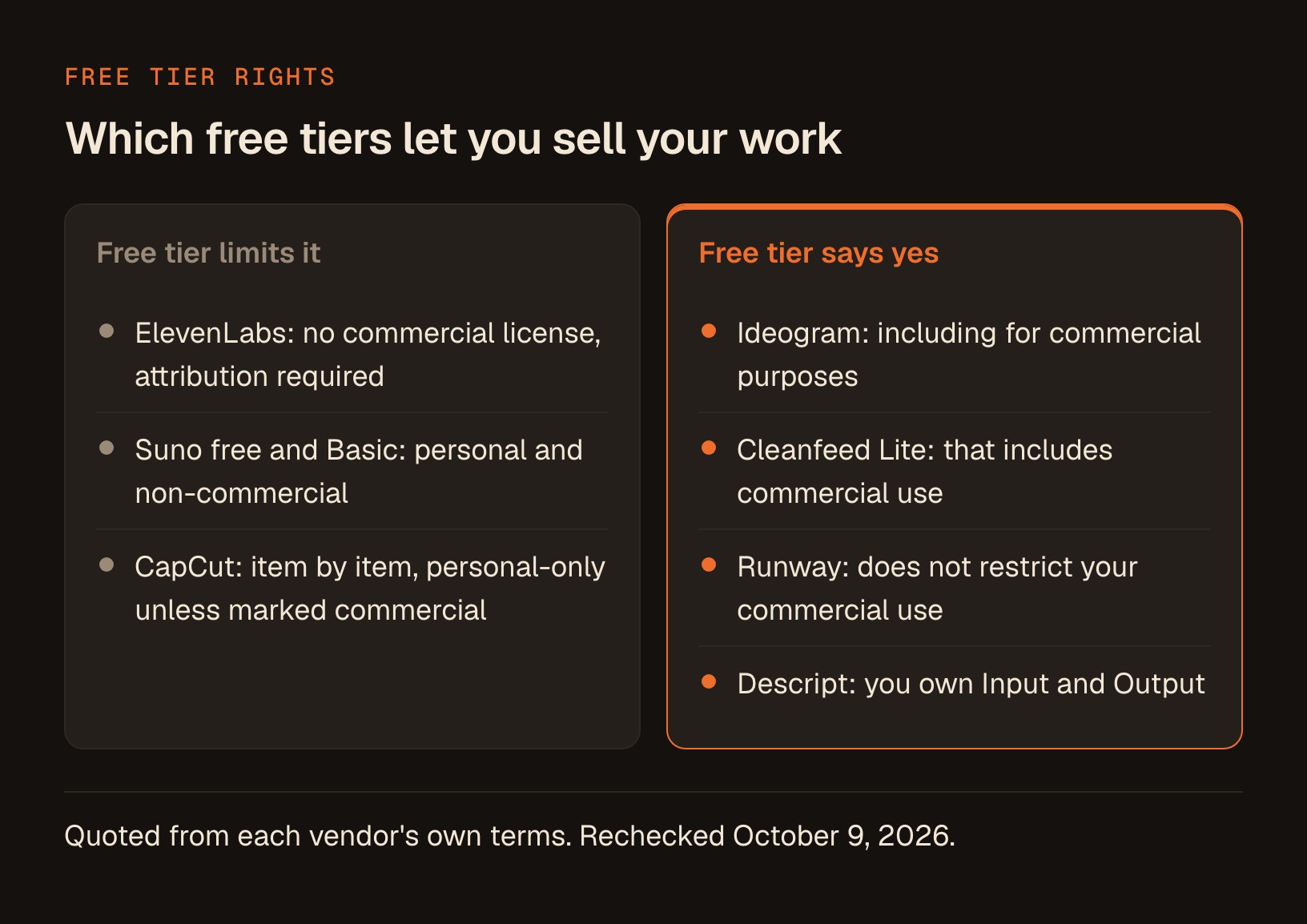
It depends entirely on each tool's terms. Ideogram and Cleanfeed Lite grant commercial rights on the free tier in writing, and Runway doesn't restrict commercial use of your outputs. ElevenLabs' free plan can't be used for any commercial purpose, and upgrading later doesn't fix old free-tier audio. Suno's free and Basic tiers are personal and non-commercial only. CapCut decides item by item. Before a tool touches your paid work, paste its terms into Claude, ask the four questions, and check the clause yourself.
Tool features, plans, and prices as of .
I've run over US$3.5 million through Meta ads, so every promo video, sales-page image, and voiceover I've put out has had real money riding on it. That's how I ended up reading more terms-of-service pages than any sane person should.
A coach I know edited her whole webinar promo in CapCut's free version, posted it to sell a $2,000 program, and had no idea that CapCut's license treats any stock clip, effect, or sound without a "commercial use" mark as personal-use-only. She wasn't careless. She just assumed free meant free to use.
That assumption is the single most expensive mistake I see solo creators make with AI, because a handful of the most popular free tools quietly forbid the exact thing you downloaded them to do: make money.
Most of your favorite tools are genuinely fine. But a few of the ones this audience reaches for first (video editing, AI voice, AI images, AI music) put "non-commercial" right in their own terms, and if you're a coach, consultant, advisor, or course creator, almost everything you make is commercial.
Let me show you exactly who says no, who says yes, and how to check any tool yourself in about 5 minutes.
First, the honest disclaimer: I'm not a lawyer, and nothing here is legal advice. This is one operator reading vendor pages and telling you what they say. For anything with real money on the line, check with your own attorney.
Everything below is quoted straight from the companies' own published terms as of this writing. Terms change, so the habit at the end matters more than any single quote.
Updated October 9, 2026: I rechecked every quote against each vendor's live terms. CapCut, Ideogram, and Suno have reworded theirs, and one Descript line was pinned to the wrong stock library. Every quote below now matches the current pages.
Why "free" and "free to sell" are 2 different promises
When a tool says "free," it's usually talking about price. When it says "commercial license," it's talking about your right to profit from what you make.
Those are separate switches, and vendors flip them independently on purpose.
CapCut's license says a video that mixes commercial-marked and personal-only materials is "not for any commercial use or purpose." One unmarked sticker or sound effect can sink a whole promo edit.
For you, "commercial use" isn't some corporate concept. It shows up everywhere your work touches money: the promo edit, the course voiceover, the sales-page image, the client deliverable. I'll put the full list in a table further down.
The tools I'm about to flag aren't villains. Their free tiers are marketing, and the "upgrade to use this commercially" gate is how the lights stay on. The problem is that nobody reads the terms, so people build a business on a foundation the vendor explicitly told them not to use. Let's fix that.
CapCut and ElevenLabs: the 2 to check before you sell
These 2 are wildly popular with exactly the people I write for. Both, in their own words, put limits on commercial use. ElevenLabs draws the line at the whole free plan, and CapCut draws it one clip, effect, and sound at a time. I'm quoting each one directly so you don't have to take my word for it.
CapCut: commercial rights come one item at a time
CapCut is the default video editor for half the creators I meet. Its terms of service (last updated April 15, 2026) say the rules for commercial use of CapCut's own content "may vary depending on the CapCut product you are using," and point to a second document, the CapCut Materials License Agreement. Most users never open either one.
That license (last updated January 22, 2026) splits CapCut's stock clips, stickers, fonts, effects, and sound effects into 2 groups. Some "may only be permitted for personal and non-commercial use and purposes." Others may be used for "limited commercial purposes," and those carry a "commercial use" or "commercial" mark in the app.
Then comes the line that catches people. If your video mixes the 2 groups, "you can only use such content for the personal and non-commercial use, but not for any commercial use or purpose." Check the mark on every item in a promo before you post it.
Music has its own rule. CapCut's regular Sounds are for video that's "only for personal entertainment and non-commercial purposes," and the license says you shouldn't use one "for any commercial purpose," including promoting a business, without the rights to do so. Even its commercial sounds may only be shared "within CapCut, TikTok and TikTok for Business."
Post that reel to YouTube or your sales page and you need a separate license from the rights holders.
CapCut's own help center pitches the free Standard plan as "ideal for personal and casual use" and lists "commercial-use assets" as a Pro feature. So for a promo, what matters is what's inside the cut. Footage you shot and music you licensed yourself carry your own rights, and every CapCut item needs its commercial mark.
There's a second thing in CapCut's terms worth knowing, and it has nothing to do with the free/paid split. By submitting content, you grant the company and its affiliates a "non-exclusive, royalty-free, transferable, sub-licensable, perpetual and worldwide license to use your User Content."
Read that slowly. Here's what each of those words actually does, in plain English.
| The word in their terms | What it means in plain English | Why a coach should care |
|---|---|---|
| Non-exclusive | They get a licence, and so can anyone else you grant one to | You keep your own rights. This one is normal and fine. |
| Perpetual | There's no end date on their permission | The licence outlives your account, your launch, and your relationship with the app |
| Royalty-free | They never owe you a payment for using it | Your footage can be used without a cheque coming your way |
| Worldwide | Anywhere on earth | There's no market or country carved out |
| Transferable | They can hand the licence to someone else | If the company is sold, the new owner inherits it |
| Sub-licensable | They can grant the same rights onward to partners | Your face, your client, or your product could show up somewhere you never approved |
That doesn't mean they own your video, and plenty of platforms take a broad licence to host uploads. But it's a lot of latitude to hand over by accident.
Practically, 3 things should never go into a free editor: client footage you don't hold the rights to, unreleased material from a paid product you haven't launched yet, and footage of clients who haven't signed a release. Rough-cut wherever you like. For the revenue-critical edit, use footage you own and only CapCut items marked for commercial use, or move it to a tool whose terms already clear commercial use.
ElevenLabs: "Content created outside of a paid subscription (before or after) cannot be used commercially." Upgrading does not launder the files you already made.
ElevenLabs free: no commercial license, and upgrading later doesn't fix the past
ElevenLabs makes the AI voices you've heard in a thousand videos. Their help center is refreshingly blunt about the free plan: "The free plan does not include a commercial license and cannot be used for any commercial purpose," and if you do use free-tier audio, "you must attribute it to ElevenLabs."
So the free voice isn't just non-commercial, it also comes with a credit requirement. The free voice comes with strings.
Here's the trap that catches careful people. ElevenLabs also states that "Content created outside of a paid subscription (before or after) cannot be used commercially." Sit with the "before or after."
If you generate a batch of voiceovers on the free plan, then upgrade next month, the old free clips don't retroactively become commercial. The commercial right attaches to content you make while you're a paying subscriber, so if you know a voiceover is going into something you sell, generate it after you're on the paid plan, not before.
ElevenLabs is one of the best voice products out there, so the point is timing. Be deliberate about when you generate the audio that's going into your paid course, and treat the free tier as a place to test the voice rather than to produce the final asset.
The free tools that hand you the rights
Now the good news, because this is the part that actually helps you ship. Some tools give you commercial rights on the free tier, in writing, with no asterisk. When 2 products do the same job and one of them says "yes, sell your work" while the other says "personal use only," the choice makes itself.
For images, Ideogram grants commercial rights in writing. Its terms state: "We do not claim any ownership rights in your User Input or User Output, and we do not restrict your ability to use User Output for your own purposes (including for commercial purposes)."
That's the sentence you want to see. No ownership claim, commercial use spelled out, "any purpose" stated plainly. For a solo creator making sales-page graphics or social images, that clean permission is the difference between reaching for a tool with confidence and second-guessing every export.
For remote audio recording, Cleanfeed Lite includes commercial use for free. In its own words: "Cleanfeed Lite is free to get started, and that includes commercial use. You can upgrade at any time to Cleanfeed Pro from your studio."
If you record interviews or podcast episodes that feed a paid offer, a free tier that says "and that includes commercial use" is exactly the kind of clean permission you want under your business. Notice that both of these tools grant the right in a single, plain sentence. That is the pattern to look for.
Ideogram, in writing: "we do not restrict your ability to use User Output for your own purposes (including for commercial purposes)."
The five-minute check for any tool (copy this into Claude)
You don't need to become a terms-of-service scholar. You need a repeatable way to ask the right 4 questions. I do this in the Claude desktop app before I let any new tool near paid work. Paste the tool's pricing page and terms into a chat and run this:
I'm a solo creator (coach / consultant / course creator) and I want to use a free AI tool to make content I'll sell or use to promote my paid business.

Here is the tool: [paste the tool's name, the URL of its pricing page, and the URL of its terms of service].

Read it like a skeptical lawyer and answer in plain English:

1. Does the FREE tier allow commercial use, or is it limited to personal / non-commercial use?
2. Does the tool take any license to the files I upload or to the content I create? Quote the exact clause.
3. Is attribution to the tool required when I use the output?
4. Does anything I make on the free plan stay non-commercial even after I upgrade later?

For each answer, quote the exact sentence you're basing it on and name the section it came from. If the terms are silent or unclear on any point, say "unclear" instead of guessing. End with a one-line verdict: safe for paid work on the free tier, yes or no.
2 things make this prompt work. First, it forces Claude to quote the exact sentence instead of paraphrasing, so you can go verify the string is really on the page. Second, it tells Claude to say "unclear" rather than fill a gap with a confident guess, which is the failure mode you're trying to avoid.
Asking the questions is half the job. Grading the answers is the other half, so here's how I read each one.
| The question | A green-light answer | A red-flag answer | What to do about it |
|---|---|---|---|
| 1. Does the free tier allow commercial use? | A sentence that says commercial use is allowed, or that the vendor doesn't restrict it | The words "personal," "private," or "non-commercial," or no sentence at all | Anything other than a clean yes, treat the free tier as personal-use-only until you upgrade or switch tools |
| 2. What licence do they take on your uploads and output? | "We do not claim ownership," or a licence limited to hosting and displaying your content | Perpetual, irrevocable, transferable, sublicensable | Keep client footage, unreleased paid material, and un-released client faces out of that tool |
| 3. Is attribution required? | No attribution clause anywhere in the terms | "You must attribute," "credit is required," a watermark on export | Decide whether another brand's name belongs on your sales asset. If not, upgrade before you export the final |
| 4. Does free work stay non-commercial after you upgrade? | Nothing in the terms limits rights by when the file was made | Any "before or after" or "created outside of a paid subscription" language | Generate revenue-critical assets only once you're already on the paid plan |
One caution I follow myself: an AI can misread a terms page, and pages get geo-targeted and updated. Use the prompt to find the relevant clause fast, then read that clause yourself on the live page before you rely on it. The tool points you at the sentence. Your own eyes close the deal.
Audit the tools you're already using
The prompt above clears the next tool you try. This one clears the stack you already built your business on, which is the more urgent job. List everything you use and the exact plan you're on:
I'm a solo creator (coach / consultant / course creator). I need to audit the AI tools already in my business and find out which ones I can legally sell my work with.

Here are the tools and the exact plan I'm on for each:
- [Tool name] - [free / the paid plan name] - [URL of its terms of service]
- [Tool name] - [free / the paid plan name] - [URL of its terms of service]
- [Tool name] - [free / the paid plan name] - [URL of its terms of service]

Read each one like a skeptical lawyer, then give me one table with these columns:
Tool | My plan | Commercial use allowed? | The exact sentence that says so | Section name and URL | Attribution required? | Licence they take on my uploads

Then sort every tool into one of three buckets and tell me why in one line each:
1. CLEAR - safe to use for paid work on the plan I'm on today
2. UNCLEAR - the terms don't say plainly, so I need to read it myself or ask support
3. STOP USING FOR PAID WORK - the terms limit my plan to personal or non-commercial use

Rules: quote exact sentences and never paraphrase a permission. If the terms are silent or ambiguous, put the tool in UNCLEAR. Do not guess, and do not fill a gap with a reasonable assumption.

Finish with the single riskiest tool in my stack and the one change that would fix it.
Run it once, fix what it flags, and you never have to wonder again until you add a new tool.
Which of these 4 you can sell with
Here's the whole picture in one place. Every entry is quoted from the company's own current terms or pricing page as of this writing.
| Tool (free tier) | Commercial use on free? | What their own words say |
|---|---|---|
| CapCut | Item by item | Some materials "may only be permitted for personal and non-commercial use"; mix one into a video and it's "not for any commercial use or purpose" |
| ElevenLabs | No | "The free plan does not include a commercial license and cannot be used for any commercial purpose"; attribution required |
| Ideogram | Yes | "we do not restrict your ability to use User Output for your own purposes (including for commercial purposes)" |
| Cleanfeed Lite | Yes | "free to get started, and that includes commercial use" |
Print it, screenshot it, whatever helps. But treat it as a snapshot that can go stale.
2 of these 4 popular free tiers, Ideogram and Cleanfeed Lite, clear commercial use in writing. ElevenLabs bans it, and CapCut decides it item by item.
That's why the five-minute check beats any list, including mine.
6 more tools people ask me about
Every time I write about this, the same question comes back: "fine, but what about the tools I use?" So here are 6 more, under one strict rule. If I couldn't find a verbatim sentence on a live page, I say "unclear" instead of guessing, and you run the prompt above yourself.
| Tool | Commercial use on the free tier? | Their own words, or why I can't say |
|---|---|---|
| Suno (free / Basic) | No | Free and Basic users "will only use such Outputs for your lawful, personal and non-commercial purposes" |
| Runway | Yes | "Company does not claim ownership of any of your Inputs or Outputs" and "the Company does not restrict your commercial use of your Outputs" |
| Descript | Yes, for your own recordings | "as between you and Descript, you own all right, title, and interest in and to any Input and Output." Watch the stock libraries separately: Premium Media follows a Storyblocks license, and any other library "may not be available for commercial use without a license" |
| Canva free | Unclear, check yourself | Canva splits rights across a separate content licence for its media library, and I couldn't confirm a single plain sentence covering AI output on the free plan. Run the audit prompt before you sell with it |
| ChatGPT / DALL-E images | Unclear, check yourself | The rules live in OpenAI's terms and usage policies rather than in one quotable line about free accounts. Read the output-ownership clause on the version of the terms that applies to your country |
| Midjourney | Unclear, check yourself | Rights differ by plan and by company size, and non-paying use has historically been treated differently from paid. Read the current terms for the exact plan you're on |
"Unclear" is a real answer, and it's the honest one. It means do the five-minute check before that tool touches a paid asset, not "probably fine."
What "commercial use" actually covers for someone like you
Let me make the fuzzy word concrete, because most people underestimate it.
| What you're making | Commercial? | Why |
|---|---|---|
| A promo video for your paid program | Yes | Its entire job is to sell something |
| A voiceover inside a course you sell | Yes | The output ships as part of a paid product |
| Images on a sales or landing page | Yes | The page exists to convert visitors into buyers |
| Anything you hand to a client | Yes | Someone paid you for that deliverable |
| An ad, on any platform | Yes | Paid distribution of a commercial message |
| A free reel that grows the audience you sell to | Yes, treat it as commercial | It promotes your business, and CapCut's music license counts promoting a business as a commercial purpose |
| A private experiment nobody outside your laptop sees | No | Nothing touches revenue, which is why free tiers are great for testing |
If it feeds your revenue, it's commercial.
I'm not telling you to panic over every casual post. I'm telling you not to build the load-bearing parts of your business (the sales videos, the course audio, the client deliverables) on a tier the vendor labeled personal-use-only. Load-bearing content deserves clean rights.
And the attribution wrinkle matters too. A free tier that "works" but requires you to credit the tool means your polished sales asset now carries someone else's name. For a brand you're trying to make feel bespoke and premium, that's a real cost, not a footnote.
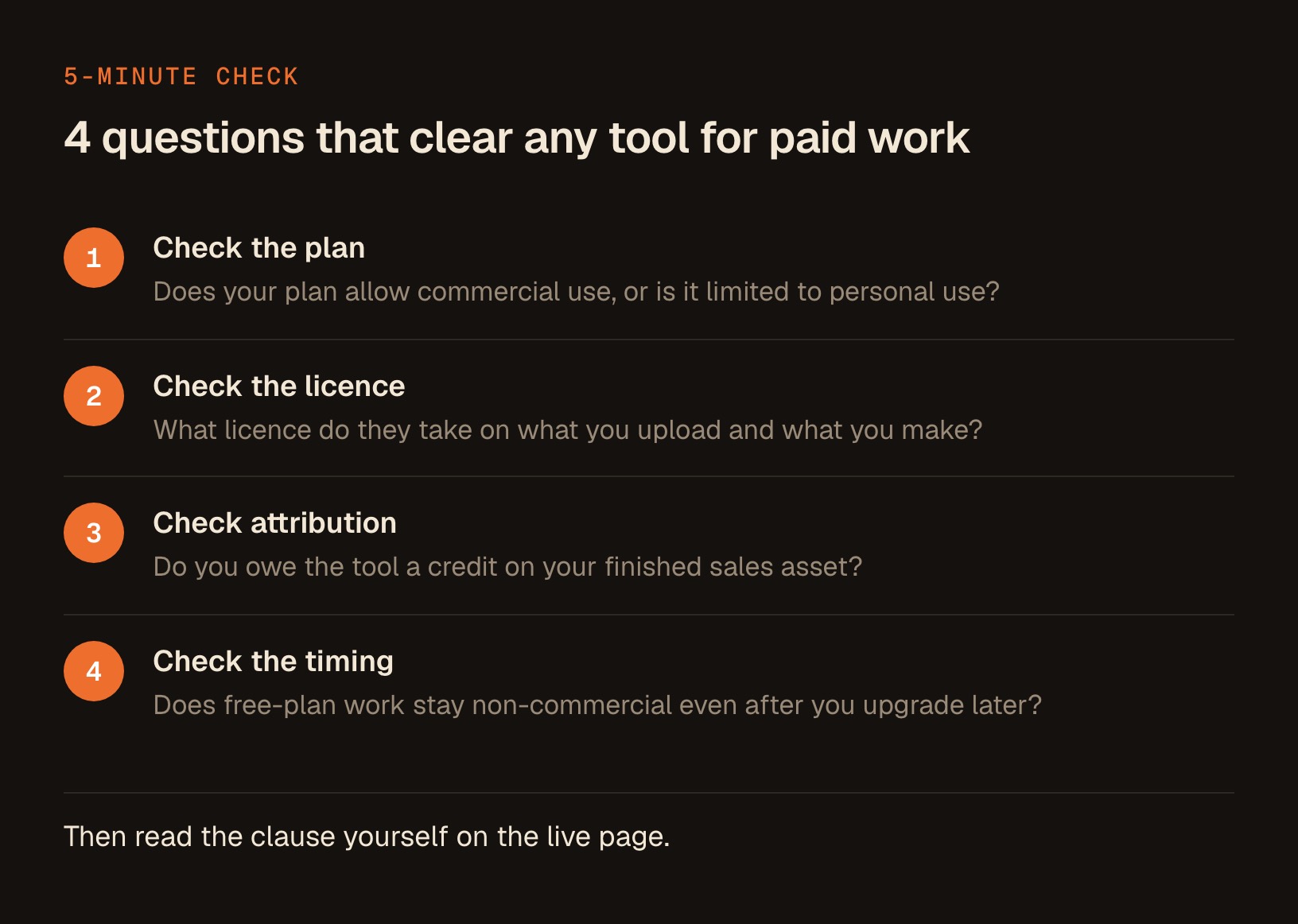
The 4 questions, from memory
This is the same check you just ran, stripped down to what you can do in your head when the prompt isn't in front of you. Before any new tool touches paid work, ask:
- Does my plan allow commercial use?
- What licence do they take on what I upload and what I make?
- Do I owe anyone attribution?
- Does anything I made on the free plan stay non-commercial after I upgrade?
That's it. A few minutes, once per tool, saves you from building a launch on sand.
Assume personal use until the vendor's own words grant you more. And when you find a tool that grants commercial rights on the free tier in one clean sentence, save it, because those are the ones worth building on.
The coach I opened with didn't do anything reckless. She just never saw the sentence, and nobody had ever told her to look for it. Now you've been told.
Everything I make runs through some version of this check, which is why I can move fast without looking over my shoulder. When I build a finished, reusable AI skill for my own business, I bake the rights check into it so the tool it reaches for is already cleared for commercial work.
Those finished skills live in the Solo Creators AI Studio, and if you ever want a second set of eyes on whether a specific tool is safe for your paid work, there's a direct line to me in there. No pressure, just help when you want it.
You don't need a law degree to use AI safely for money. You need to know that "free" and "free to sell with" are different words, ask 4 questions before you commit, and keep your revenue-critical work on tools that said yes in writing.
Do that, and you get the whole upside of free AI with none of the 2 a.m. dread that you built your best sales video on a tier the vendor told you not to.
Key takeaways
- Free and free-to-sell-with are different promises. A tool can cost nothing and still forbid commercial use of what you make.
- CapCut decides commercial use item by item: a video that mixes in one personal-only clip, effect, or sound is "not for any commercial use or purpose," and its terms take a perpetual, sub-licensable license to your uploads.
- ElevenLabs' free plan "cannot be used for any commercial purpose," requires attribution, and upgrading later does not make your old free-tier audio commercial.
- Suno's free and Basic tiers are limited to "personal and non-commercial purposes," while Runway says it "does not restrict your commercial use of your Outputs."
- Ideogram ("including for commercial purposes") and Cleanfeed Lite ("that includes commercial use") grant commercial rights on the free tier in writing.
- For a coach or consultant, commercial use includes promo videos, course voiceovers, sales-page images, client work, and ads, so keep revenue-critical work on tools that clearly said yes.
- Check any tool in five minutes: paste its pricing and terms into Claude, ask the four right questions, then verify the exact clause on the live page yourself.
Get this skill, and every one I build.
30-day money-back guarantee. Cancel anytime.
Questions people ask
Can I use free AI tools for commercial work?
Is CapCut free okay for business videos?
Does upgrading to a paid AI plan make my old free content commercial?
Can I sell music made with Suno's free plan?
What counts as commercial use for a coach or consultant?
Which free AI tools clearly allow commercial use?
How do I check whether a specific tool allows commercial use?
Do free AI tools require me to credit them?

Ronnie spent 18 years building a SaaS with a team of 20 that served over 650,000 customers, generated over $14M in sales, and sent over 550M emails. Now he's solo, solving real business bottlenecks and turning them into working AI skills, workflows, and automations. He teaches all of it, with direct access to him, inside the Solo Creators AI Studio Skool community. See what he's built →
 Michael HattawayFounder, Iron Strengthens Iron
Keep reading