Is it legal to use an AI notetaker on a client call?
Often yes, but it depends on where everyone on the call is and whether they agreed. Many US states allow you to record a call you're on under one-party consent. Some states require all-party consent, and on a mixed-state video call the stricter rule can apply. A disclaimer in the calendar invite is weak. The habit that works everywhere is a spoken 10-second ask at the top of every call, said while recording, with a real option to say no. This isn't legal advice, so confirm your states with an attorney.
Who agreed is what actually matters
I turned on an AI notetaker for a discovery call last month and felt clever about it. Then I caught myself halfway through, wondering whether the person on the other end even knew it was running. That little jolt is worth paying attention to.
Let's start with the honest version, because most articles on this dance around it. Recording a conversation you're part of is legal in a lot of places. The problem AI notetakers create is subtler than "recording bad." The tool joins your call, captures every voice in the room, and quietly assumes that because you (the account holder) clicked "start," everyone else consented too.
They didn't. Your client didn't sign up for the tool. They didn't read its terms. In many cases they didn't even see the little bot icon slide into the meeting. And in a decent number of US states, that gap is exactly where the liability lives.
Quick, important caveat before we go further: I'm not a lawyer, and this isn't legal advice. I'm a solo operator who reads a lot and builds everything with AI. I'm telling you what I found so you can ask your own attorney the right questions. Treat everything below as a starting point for that conversation, not a substitute for it.
The reason this matters for people like us (coaches, consultants, advisors, course creators) is that our calls are the product. We're on Zoom or Google Meet all day, with clients we'll bill, with prospects we're courting, sometimes with their spouse or business partner on the line.
Every one of those people is a party whose consent may be legally required, and if you miss it a great tool becomes a paper trail against you.
Why a disclaimer buried in the calendar invite won't save you
Here's the move a lot of well-meaning people make. They paste a line into their email signature or the bottom of the calendar invite: "Meetings may be recorded and transcribed by an AI assistant." Then they feel covered.
I get the instinct. It feels like disclosure. But passive notice is not the same thing as affirmative consent. Nobody reads the fine print at the bottom of a calendar invite.
Your client accepted a meeting because they wanted to talk to you, not because they read and agreed to a recording clause on line 9. If a dispute ever landed in front of a judge, "it was technically in the invite" is a weak place to stand.
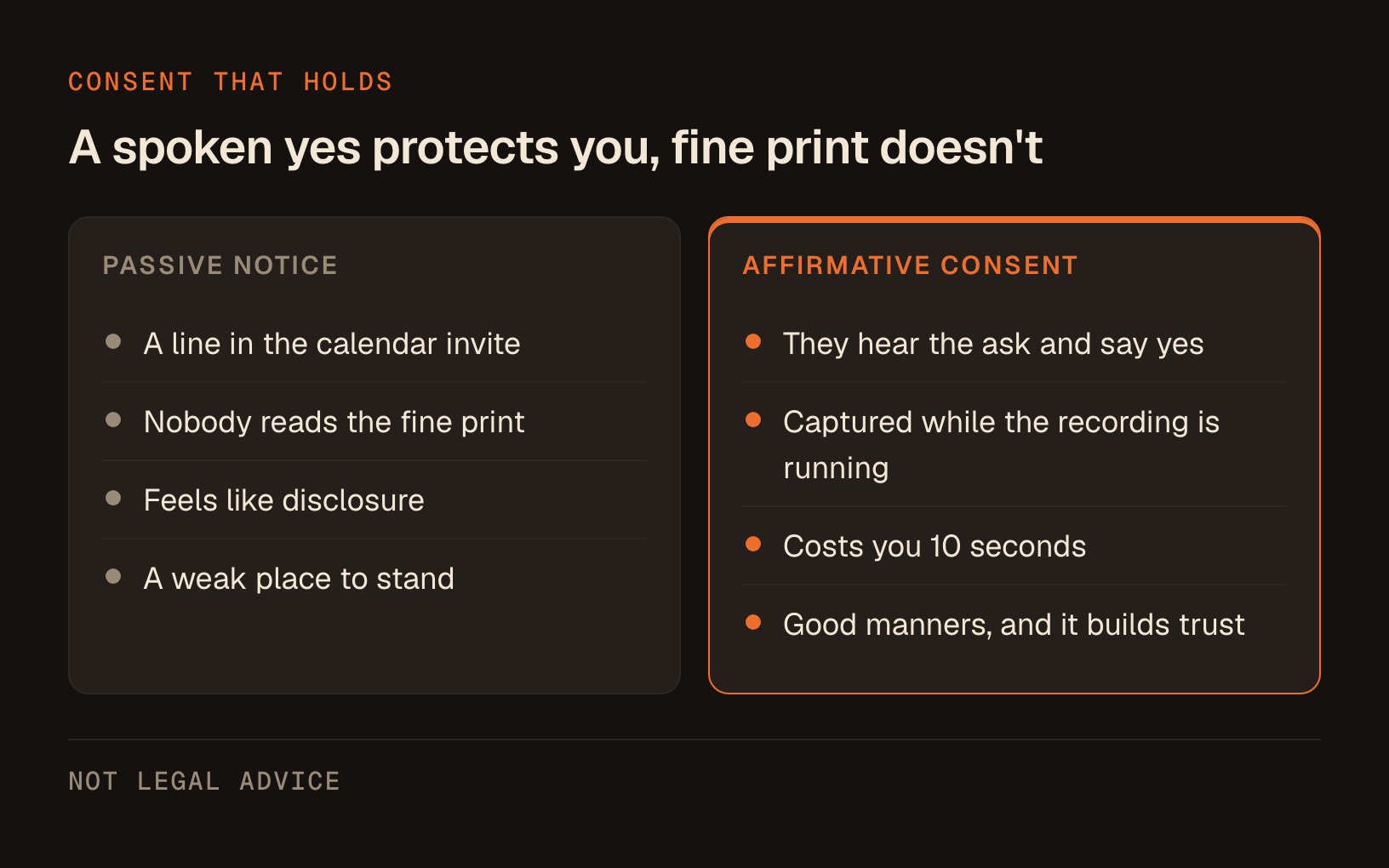
The stronger standard, the one that actually protects you, is simple: the other person hears the ask and says yes, out loud, on the record. That's affirmative consent.
It costs you 10 seconds at the top of a call and it changes the entire posture of the situation. Instead of hoping nobody read the fine print, you have a client who clearly agreed while the recording was rolling.
There's a bonus most people miss. Asking out loud is also just good manners, and it builds trust. When I say "I use a notetaker so I can stay present with you instead of scribbling," clients almost always react warmly. It signals that I'm focused on them. The compliant move and the relationship move turn out to be the same move.
One habit that covers every state's rule
This is where it gets geographic, and where you want to be careful, because the rules depend on where the parties are, not just where you are.
Most US states follow a "one-party consent" rule, which means as long as one person on the call agrees to the recording (and that person can be you), you're generally in the clear under that state's law.
But a number of states require all-party consent, meaning every single person on the call has to agree. Which states those are can shift over time, and the details vary, so confirm the current rules for your state and your clients' states with your own attorney.
Here's the trap: on a video call, the people can be anywhere. You might be sitting in a one-party state feeling safe while your client dials in from a state that requires everyone's yes.
When parties are in different states, the stricter rule can apply. Courts don't always agree on which law governs a mixed call, which is precisely why one portable habit beats a mental map of who is sitting where.
| Your situation | One-party-consent state | All-party-consent state |
|---|---|---|
| Recording a call you're on | Generally allowed with just your own consent | Everyone on the call must agree |
| A calendar-invite disclaimer | Still weak; get a spoken yes anyway | Almost certainly not enough on its own |
| Client dials in from another state | The other state's rule may apply to them | Assume the strictest rule in play |
| The safe universal habit | Ask out loud, every call | Ask out loud, every call |
Notice the last row is identical in both columns. That's the whole point. One habit covers you everywhere. Laws change and vary in their details, so treat this table as orientation and confirm the specifics for your states.
The lawsuit that put this on everyone's radar
If you want the concrete reason this stopped being theoretical, look at the litigation now aimed at the notetaker vendors themselves.
According to a legal analysis published by the law firm Fisher Phillips, a proposed class action was filed against Otter.ai in the US District Court for the Northern District of California. The case is captioned Brewer v. Otter.ai (No. 5:25-cv-06911), filed in August 2025.
The core allegation is the exact gap I described at the top: the complaint claims the company "records not only its account holder customers but also unsuspecting third parties" without their consent.
The complaint says Otter.ai "records not only its account holder customers but also unsuspecting third parties." (Brewer v. Otter.ai, No. 5:25-cv-06911)
The part that should make every solo operator sit up is the theory of who's responsible. Per the same analysis, the suit points out that the company tells its customers to "make sure you have the necessary permissions" rather than getting that consent itself.
The tool's own terms may be quietly making you the one on the hook for getting everyone's yes. So even if the vendor is the named defendant today, the design of these products assumes the customer is the responsible party.
Fisher Phillips's own recommendations to businesses are blunt and worth repeating: "Obtain consent from all participants, including external parties, before using a notetaker," and "consider the need to obtain this consent each and every time you deploy a notetaker." Every time. Not once in your onboarding email. Every call.
The 10-second script that covers you
Here's the payload, the thing I actually want you to steal from this article. Say some version of this out loud, before you get into the substance, while the recording is running so the yes is captured too:
"Before we dive in, I use an AI notetaker on my calls so I can stay fully present with you instead of scribbling. It records our audio and gives me a private summary I use just for our work together. Are you okay with me having it on? If you'd rather I didn't, that's totally fine and I'll take notes by hand."
That's it. Read it aloud once and you'll see it lands in about 10 seconds. Every clause in there is doing a job, and something specific breaks when you drop it:
| Ingredient | The words that carry it | What happens if you skip it |
|---|---|---|
| The why | "so I can stay fully present with you instead of scribbling" | It sounds like surveillance instead of service, and the client tenses up for the rest of the call |
| The what | "It records our audio and gives me a private summary" | They think they agreed to notes, then find out later that audio was captured. That's consent to something they never understood |
| The ask | "Are you okay with me having it on?" | You gave notice, not a request, and there's no yes anywhere on the record |
| The out | "If you'd rather I didn't, that's totally fine and I'll take notes by hand" | You get a yes given under social pressure, which is the weakest kind |
| The timing | Said after you hit record, not before | The yes exists only in your memory, and memory is not evidence |
If you want the pocket version for warm, casual calls: "Heads up, I've got my AI notetaker running so I can focus on you instead of typing. Cool if I keep it on?" Shorter, same 5 ingredients underneath.
And if they say no? You turn it off, cheerfully, and you take notes the old way. Never argue, never guilt them, never quietly leave it running. A yes only counts if no was a genuine option.
One person saying no on one call is a rounding error. One client discovering you recorded them after they declined is a relationship, a referral, and possibly a legal problem, gone.
Then write the yes down somewhere you can find it. Note the timestamp of the moment they agreed, or drop one line in the CRM or the client file: "consented to AI notes, 12 Mar call, 0:14."
Fourteen months later, when somebody asks, you want to open a record and point at it rather than scrub an hour of audio hunting for 10 seconds.
Handle the 3 awkward calls with one line each
The script is easy on a clean two-person call. Real calls are messier, and these 3 are the ones that trip people up in practice.
The person who joins fifteen minutes late. They weren't in the room when you asked, so their consent doesn't exist. Re-ask, briefly, the moment they arrive, and don't make a production of it.
Say: "Quick note now that you're on, I've got an AI notetaker running for a summary afterwards. Okay with you?"
The standing weekly call with the same client. Yes, you ask again. Fisher Phillips recommends considering consent each and every time you deploy a notetaker, and the repetition is deliberate rather than forgetful.
Fisher Phillips, to businesses: "consider the need to obtain this consent each and every time you deploy a notetaker."
Shorten it to the pocket version so it stays a two-second beat instead of a ceremony. Say: "Notetaker's on again, still good?" On call number 9 that reads as consistent, not paranoid.
The spouse or business partner who never says a word. They're a party to the conversation even if they stay silent the whole hour, and their consent may be required exactly like the person doing all the talking.
Name them directly so the yes is unmistakably theirs. Say: "Sam, that goes for you too, are you okay with the notetaker running?" Silence is not agreement, so wait for the actual answer.
Have Claude build your own version in 2 minutes
You don't have to use my wording. The better move is to generate a version in your own voice, matched to your specific business, plus a short internal policy so you're consistent. Open the Claude desktop app and paste this in:
You're helping me, a solo [coach / consultant / financial advisor / course creator], use an AI notetaker on client calls responsibly.

Write me three things:

1. A spoken consent script, about 10 seconds when read aloud, that I say at the top of a client call while the recording is running. It must: explain WHY I use a notetaker (to stay present), say plainly WHAT it does (records audio, creates a private summary), and give the client a genuine, pressure-free way to decline. Warm, first-person, plain-spoken. No jargon. No em-dashes.

2. A 15-second "pocket" version for casual calls with people I already know well.

3. A short internal rule for myself (5 bullets max) covering: ask every single call, capture the yes on the recording, what to do if they say no, don't rely on a calendar-invite disclaimer, and delete transcripts I no longer need.

My business in one line: [describe what you do and who your clients are].
My speaking style: [formal / warm / casual / direct].

Keep it human. I am not a lawyer and this is not legal advice, so avoid absolute legal claims and remind me to confirm my state's rules with an attorney.
Tweak the brackets and you've got a script that sounds like you, not like a policy manual. Save the output somewhere you'll see it before calls (a sticky note, your call-prep doc, the top of your meeting template).
Consent only protects you if you actually remember to ask, so the goal is to make asking automatic.
A quick word on voiceprints and stored audio
2 more things worth raising, because they go a step beyond "did they consent to notes."
First, some notetakers don't just transcribe. They can analyze and store audio in ways that go beyond a plain transcript. If your tool builds any kind of voice profile, ask your attorney whether that triggers any biometric-privacy rules where you and your clients operate.
Second, ask your vendor the storage questions Fisher Phillips flags. Most people never send that email, so here's exactly what to ask and what a good answer sounds like:
| Question to ask your vendor | Why it matters | The answer you want to hear |
|---|---|---|
| Where is my call data stored, and who inside your company can access it? | Your client's words are sitting on somebody else's servers | Encrypted at rest, access limited to named roles, storage region you can state to a client |
| What's the default retention period for recordings and transcripts? | Defaults are usually "forever," and the pile grows quietly | A stated period, plus a setting you can shorten yourself |
| Do you use my calls to train your AI models? | Client conversations could end up shaping a model | No by default, or an opt-out that's already switched off for you |
| Can I permanently delete a recording and its transcript, and how long does it take? | You need a real answer when a client asks you to delete | Self-serve permanent delete with a stated timeline for backups |
| Do you create voice profiles or voiceprints of participants? | This is the piece that can pull in biometric-privacy rules | A plain no, or a clear description you can hand to your attorney |
| Under your terms, who is responsible for getting participant consent? | The terms may quietly put that on you | A straight answer. Expect it to be you |
Don't write that email yourself. Paste this into Claude and send what comes out:
Draft a short, polite email from me to my AI notetaker vendor's support team asking about their data practices. I'm a solo [coach / consultant / financial advisor] and my clients discuss confidential information on these calls.

Vendor: [vendor name]
The states or countries my clients and I are usually in: [list them]

Ask them, as a numbered list, six things:
1. Where call data is stored and who internally can access it.
2. The default retention period for recordings and transcripts, and whether I can shorten it.
3. Whether my calls are used to train their AI models, and how to opt out.
4. Whether I can permanently delete a recording plus its transcript, and how long full deletion takes including backups.
5. Whether they create voice profiles or voiceprints of participants.
6. Who their terms make responsible for obtaining participant consent.

Tone: friendly, direct, businesslike. Under 200 words. No em-dashes. Make it clear I need answers I can repeat to my own clients. End by asking for a written reply I can keep on file.
Delete transcripts you no longer need, and don't let months of sensitive client conversations pile up in a tool's cloud by default. Least data kept is least data exposed.
What to do about the recordings you already took
If you're reading this, there's a decent chance you've been running a notetaker for months without ever asking. That's the normal starting point, and panicking about it helps nobody. Here's the calm order of operations.
Stop first. Start asking out loud on your very next call, before you touch anything historical. The habit going forward is the part fully within your control.
Then inventory. Open your notetaker and sort the back catalogue into 2 buckets: calls with only you and your own team, and calls with external parties (clients, prospects, their spouses, their advisors). The second bucket is the one that matters.
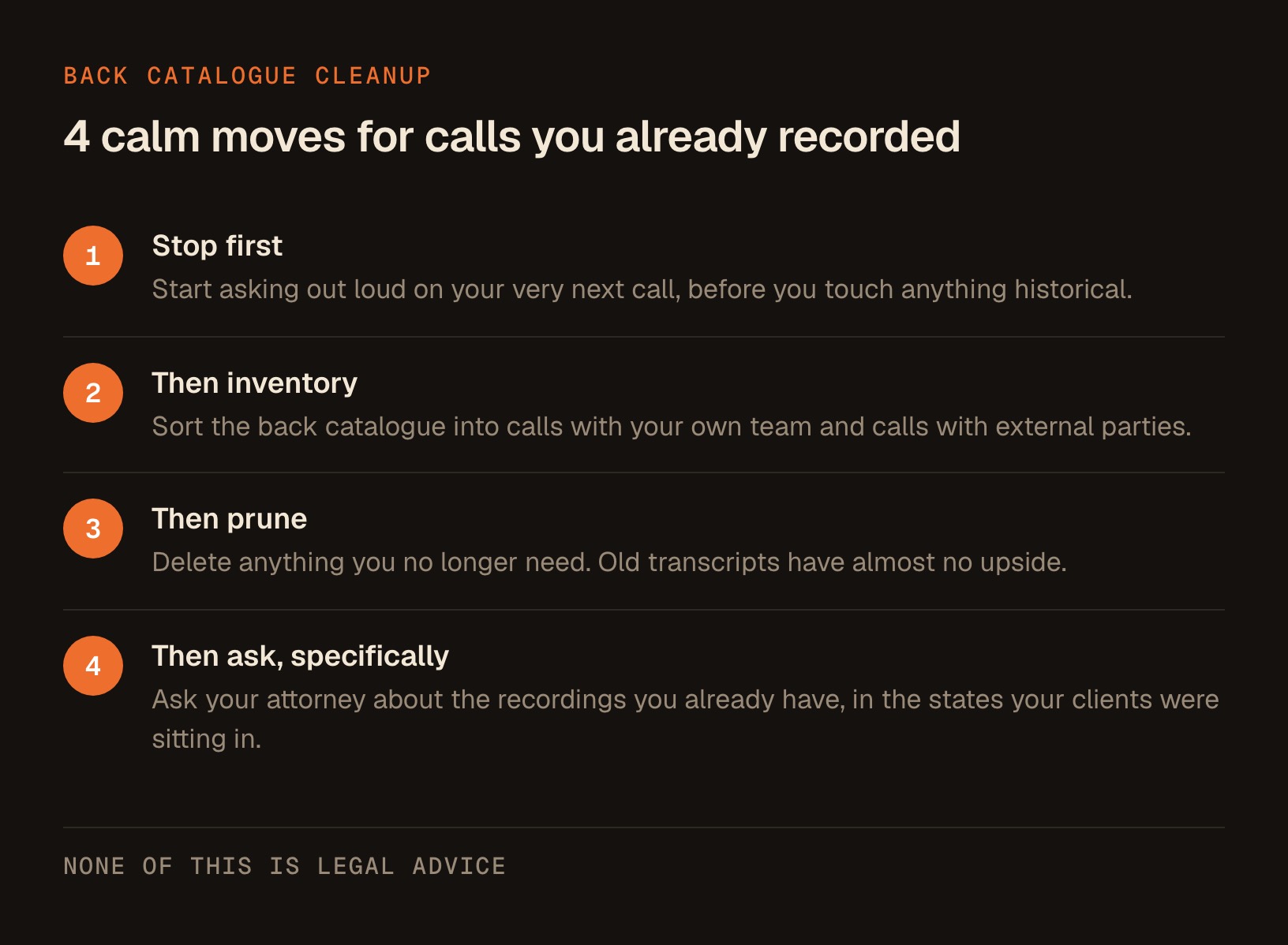
Then prune. Anything you no longer need, delete rather than sit on. Old transcripts have almost no upside and they're the thing that gets read out loud if a dispute ever happens.
Then ask, specifically. When you talk to your attorney, don't ask the abstract question. Ask about the recordings you already have, in the states your clients were actually sitting in, and what to do with them. That's a much better use of the hour than a general briefing on consent law.
I'm not raising any of this to scare you off the tools. I use them and they save me real hours. I'm raising it so the 10 seconds of consent at the top isn't the only thing you ever think about.
Your simple pre-call checklist
Strip all of it down and here's the routine that keeps you clean without turning you into a compliance officer:
- Ask out loud, every call, while the recording is running so the yes is captured.
- Give a real out. If they decline, switch it off and take notes by hand, no friction.
- Log the yes with a timestamp or a one-line note in the client file.
- Don't lean on the calendar-invite line as your consent. It's courtesy, not agreement.
- Assume the strictest rule when people are dialing in from different states.
- Prune your transcripts and know your vendor's retention and training policy.
- Ask your own lawyer about all-party-consent rules, any biometric-privacy rules, and your existing back catalogue. None of this page is legal advice.
And when you're not sure whether a given moment needs a fresh yes, this covers nearly every version of the question:
| The situation | Do you need a fresh yes? | What to say or do |
|---|---|---|
| Someone joins twenty minutes late | Yes | "Quick note now that you're on, I've got an AI notetaker running. Okay with you?" |
| Recurring weekly call, same client | Yes, the short version | "Notetaker's on again, still good?" 2 seconds, every week |
| Client's spouse or partner silently on the line | Yes, and by name | "Sam, that goes for you too, okay with the notetaker?" Then wait for the answer |
| Someone dialing in by phone with no video | Yes, and it matters more | They can't see the bot icon at all, so the spoken ask is their only notice |
| They said yes last month but not today | Yes | Treat every call as its own ask. Last month's yes covers last month's call |
| Internal call, only you and your own team | Usually no | Still worth a line in your team policy so nobody's surprised |
That's a habit you can run on autopilot inside a week, and it buys you a client who's on the record saying yes, which is a much nicer place to stand than hoping nobody read the fine print.
I package the little systems like this (the consent script, the pre-call policy, the prompts above) into the finished AI skills I build and keep inside The Solo Creators AI Studio, so they're one click away instead of something you rebuild from scratch each time.
If you want to see what I've shipped, or just ask me a question about your own setup, come find me at the Solo Creators AI Studio. Either way, use the script.
Key takeaways
- Recording a call you're on is often legal, but AI notetakers create risk because the other people on the call usually never consented, they just got captured.
- A disclaimer in the calendar invite or email signature is passive notice, not affirmative consent, and it's a weak place to stand if a dispute arises.
- Some states require all-party consent, and the specifics change over time, so the clean, portable habit is to ask out loud every call and assume the strictest rule applies on mixed-state video calls.
- A proposed class action, Brewer v. Otter.ai (No. 5:25-cv-06911, N.D. Cal.), filed August 2025, alleges the tool records unsuspecting third parties, and the vendor pushes the consent obligation onto you the user.
- The fix is a spoken 10-second script at the top of every call, said while recording, that explains why, says what the tool does, and gives a genuine option to decline. Then log the yes with a timestamp or a line in the client file.
- Late joiners, recurring weekly calls, and the silent spouse or business partner all need their own fresh yes, and the silent third party should be named directly in the ask.
- If you've already been recording without asking, start asking now, inventory which calls involved external parties, delete what you no longer need, and raise the back catalogue specifically with your attorney.
- This isn't legal advice. Confirm all-party-consent rules and any biometric-privacy rules for your states, and your vendor's data retention and training policies, with your own attorney.
Get this skill, and every one I build.
30-day money-back guarantee. Cancel anytime.
Questions people ask
Is it legal to use an AI notetaker on a client call?
Does a disclaimer in my calendar invite count as consent?
Which states require everyone on the call to consent?
What do I actually say to get consent?
Do I have to ask every single time on a recurring weekly client call?
What about someone who joins the call late, or a spouse who never speaks?
What if my client says no?
What do I do about the calls I already recorded without asking?
Isn't there a real lawsuit about this?
What about voiceprints and stored audio?

Ronnie spent 18 years building a SaaS with a team of 20 that served over 650,000 customers, generated over $14M in sales, and sent over 550M emails. Now he's solo, solving real business bottlenecks and turning them into working AI skills, workflows, and automations. He teaches all of it, with direct access to him, inside the Solo Creators AI Studio Skool community. See what he's built →
 Michael HattawayFounder, Iron Strengthens Iron
Keep reading