Untangle a messy client problem into a clear issue tree
It names the assumption you didn't know you were making, before the client points it out.
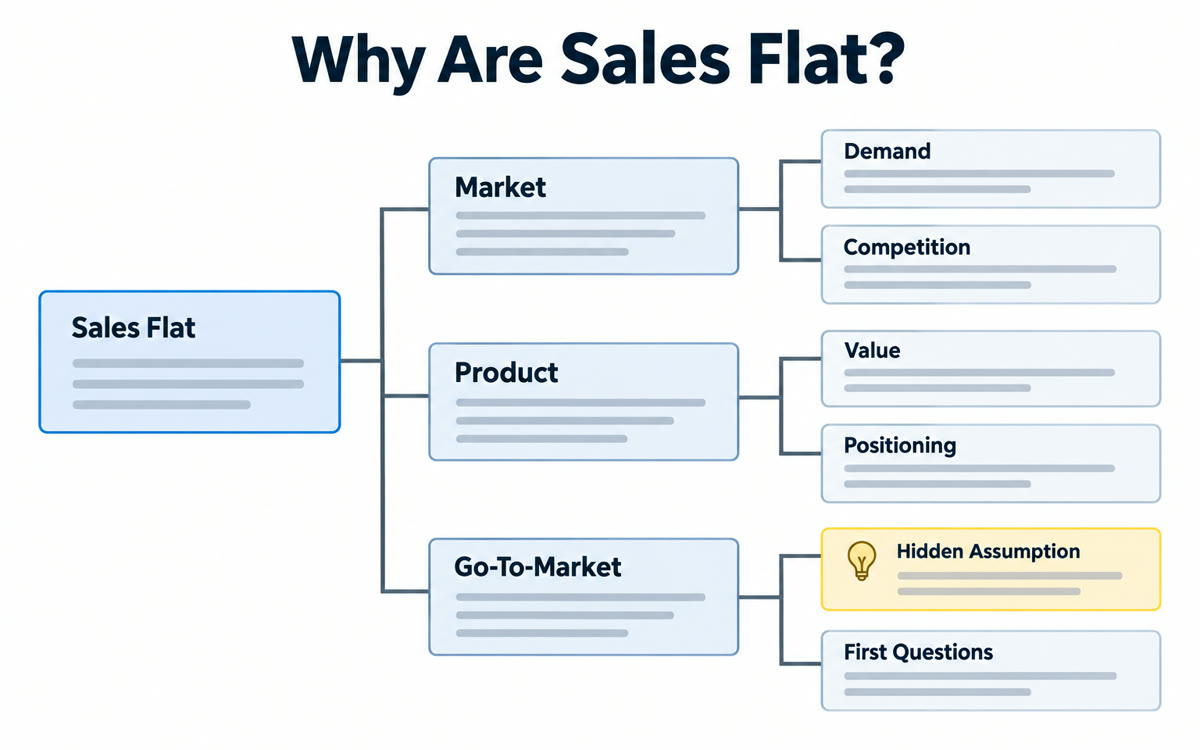
A sample of what you get back, made with AI.
Your prompt
Fill in your details. Skip any you like.
Claude and ChatGPT open with your prompt already typed in. Gemini can't be filled in from a link, so its button copies your prompt: paste it into the new chat.
The prompt that gets copied
Think like a structured strategy consultant. My client is [CLIENT DESCRIPTION, e.g. a 12-location gym chain]. Their problem, in their words: [CLIENT PROBLEM, e.g. profits fell 30% this year]. 1. Restate the problem as one clear question we need to answer. 2. Break it into an issue tree with three to four main branches and two to three sub-questions each. Make sure the branches don't overlap and together cover the whole problem. 3. List the hidden assumptions in how the client framed it. 4. Give the strongest counterargument to the most obvious explanation. 5. Rank the sub-questions by how much they matter and how fast we could answer them, and name the data I'd need for the top three. Show the tree as an indented list I can paste into a slide.
Describe the client's problem in plain words. You get it broken into a clean issue tree, the hidden assumptions, the strongest counterargument and the questions to answer first.
Step by step
- Describe the client's problem the way they'd describe it.
- Paste the prompt and read the tree from the top down.
- Push back on any branch that feels off and ask for a redo.
- Use the top questions to plan your first two weeks.
What you'll get
A one-line problem question, an issue tree as an indented list, hidden assumptions, a counterargument and the first three questions to answer.
- Made for
- Consultants, Coaches
- Works in
- Claude, ChatGPT, Gemini